


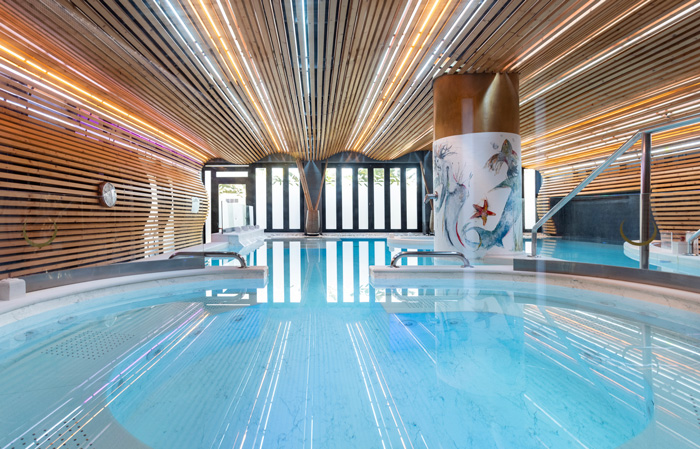
Something that we often hear about is how attached people are to their local aquatic facilities. Parents and grandparents may have visited these pools when they were young, and now they may be taking their own kids or grandkids to the same pool and quite possibly still getting in the water themselves. And those kids are starting to forge their own pool traditions and memories.
Unfortunately, no amount of sentiment can fix an ailing pool. Mechanical systems, pool shells and decks, waterslides, and changing rooms—they all have a shelf life. And while a coat of paint, a good scrubbing and a few repairs can go a long way toward refreshing a facility, oftentimes more serious upgrades are in order. But are limited funds better spent renovating or starting from scratch? That’s the question owners and operators need to ask.
“We are very frequently asked to help assess a pool facility and re-engineer the mechanical spaces,” said Josh Martin, president and creative director at Martin Aquatic Design & Engineering. He said they always recommend making changes to the equipment that will benefit the pool’s operation for the long term, ensuring a sustainable solution that usually ends up saving money down the line. “One of those changes is investing in a regenerative media filter to eliminate wasteful backwashing of sand filters, which are quite prevalent in commercial pools. We also want to ensure indoor facilities can upgrade to have secondary disinfection with UV or ozone.”
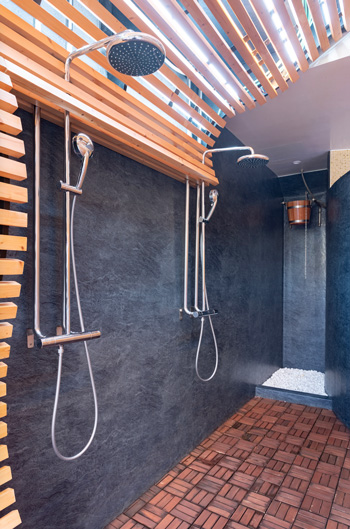
And while the most common reason to upgrade a facility is because something is broken, Martin pointed out that a vast change in operation—such as noticing that your equipment is consuming more energy or water than normal—is often a clue that your equipment is beginning to fail. “It’s a good idea to get a consultation with an aquatic engineer who can assess the changes you’re seeing and recommend new equipment. Spotting the problem early will help reduce downtime while you re-engineer the system and order new parts.”
Another reason for updates is code compliance—staying up to date with local and state codes, as well as Model Aquatic Health Code (MAHC) recommendations. “Generally speaking, pools built prior to a major code change can stay in operation for a little longer, but ADA is one of those items that all facilities have had to comply with,” said Martin. “However, any modification or renovation will have to include bringing the entire pool system up to code. Aquatic engineers will be able to check for needed upgrades when that happens.” And to get the most bang for your buck, Martin said it’s wise to look at—and budget for—any other enhancements you’d like to make while you address those code upgrades.
“Having trained and certified technicians monitor and assess your facility on a regular basis is extremely important to ensure that your equipment is being maintained properly and is up to code on important safety features,” said Jessica Mahoney, vice president of marketing for Landmark Aquatic. Her company offers comprehensive pool audits, which can help assess the state of a facility and identify areas for improvements, as well as ensure compliance with current health and safety standards. Additionally, these audits consider programming requirements, user demographics, financial goals, and budget constraints.
Modernizing mechanical equipment is a common undertaking, including upgrading outdated plumbing systems, replacing old heaters with high-efficiency models, installing energy-efficient pumps and filters, and implementing advanced water quality management systems. In fact, many facilities are embracing newer technology upgrades, including chemical controllers that can integrate with cloud-based platforms, allowing operators to monitor various data and functions remotely. There are flow and pressure sensors, ORP and pH sensors, and turbidity sensors. Advanced leak detection and submetering technologies help operators track water usage and identify leaks.
Audits also typically include an examination of pool infrastructure, and Mahoney’s company offers resurfacing services, including painting and plastering, as well as tile and coping repairs and replacement. “As parks begin to age, renovations and refurbishments of existing play areas—including splash pads, play structures, slide complexes, pools, and decking—are prime areas in which you can restore and renovate high-traffic areas and well-loved attractions—not only to look new, but more importantly, to improve the overall safety and operation.”
Restoring aquatic features and attractions, including waterslides, towers, play structures, and even bulkheads, can significantly improve curb appeal, as well as a facility’s compliance and safety. Many facilities will tackle smaller repairs in-house, such as fixing chips and cracks in fiberglass, but will contract out bigger projects like resurfacing a slide. Mahoney’s company offers proprietary application procedures including paint and gel coat application, power washing and waxing, and fiberglass repair.
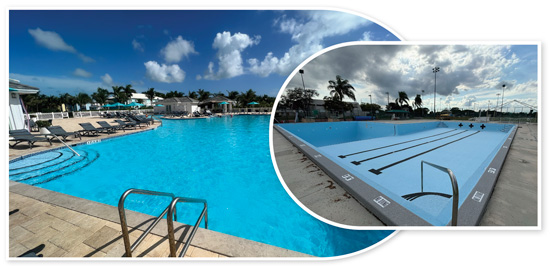
“One example where we see great success in our renovations is the replacement of old decking with (safety surfacing)”, said Mahoney. She mentioned cushioned, slip-resistant tiles that are appropriate for splash pads and pool decks, resistant to UV and chemicals. “This, along with the restoration of an older play structure and slides, can turn an aging part of the property into something completely new and fresh.”
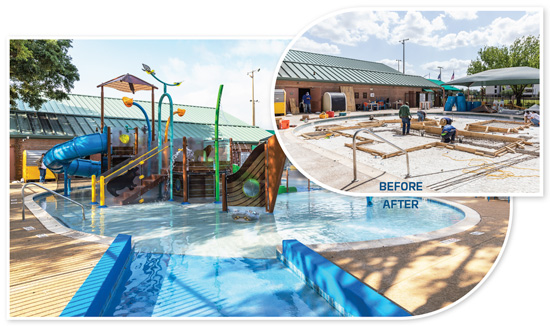
In Houston, the First Methodist Quillian Memorial Center features a large swimming pool and a smaller, shallower pool known as Noah’s Ark, voted Best Pool in Houston in a Great Day Houston poll. In 2023, an outdated play structure and spray features were removed, and replaced with a larger play structure. The feature motor was upgraded by installing a 10-hp motor to ensure optimal flow for the new play features. Additionally, the old plaster and tile were stripped out and new quartz plaster, along with blue/green waterline tile, were installed. Some coping and concrete were removed to create a zero-depth entry, guaranteeing accessibility for all.
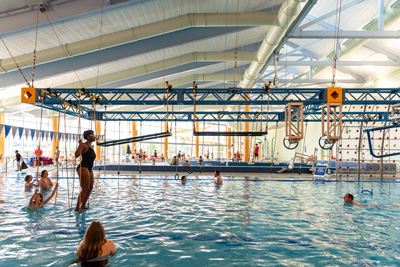
In Thornton, Colo., the renovation to the Margaret Carpenter Recreation Center updated the pool programming space and provided an accessible pipe galley for maintenance and repairs. The facility’s pools, sauna, steam room, family locker room, and associated equipment were replaced with “state-of-the-art aquatic environments and amenities.” Improvements include a new 6-lane lap pool with adjacent aqua-exercise pool, wave pool with lazy river and bubble pit, activity pool with zero-depth entry, play structure, geysers and sprays, two waterslides, and a 20-person therapeutic hydro-jet spa.
Robert McDonald, CEO and senior principal at architecture firm OLC Design, who worked on the project, said that since the City of Thornton has several indoor and outdoor aquatic facilities, they really wanted something unique. “By rebuilding the indoor wave pool, they remain the only indoor venue to operate such a pool in Colorado. Including a zero-depth entry pool with elaborate play structure, and a thrilling indoor/outdoor slide flume, they provide endless aquatic play opportunities for youth. The lazy river serves not only the recreational user but also the therapy and exercise user groups for water walking with or against the current.”
After the renovation, the Margaret Carpenter center had the first ninja-style obstacle course in the state, and McDonald said that adding the amenity to the lap pool increased the usage of that body of water without sacrificing the fitness and competition programming associated with that pool. “Including ramp access to the lap pool, a whirlpool spa, steam and sauna amenities as well as party rooms and a family changing area really rounds out the facility well in terms of catering to a wide-ranging demographic, from families and young children to teenagers to adults and seniors.”
Addressing the new pipe galley, McDonald pointed out that this is not a trend, explaining that in the ’50s and ’60s, constructing a pipe galley around pool perimeters for maintenance was fairly common. With the advent of modern piping materials and methods it’s not so common, but the city experienced pipe leaks in the former pools at the site, requiring costly excavation to expose the broken pipes under the deck. Now, their facilities maintenance department requests that a galley be constructed around all new pools being built in the city, “which does ensure that access for repairs is easier in the future, should that need arise.”
As with new construction, McDonald said that renovation of municipal pools is dominated by several trends to update the facilities to modern standards. At the top of the list of trends is sustainability and energy efficiency. He said there’s a growing desire to upgrade facilities to more eco-friendly designs, “including energy-efficient heating systems, water recycling technologies, and solar-powered features.”
As mentioned, McDonald named technological integration as a trend. “Smart pool technologies, such as automated cleaning systems and IoT-enabled monitoring (Internet of Things) are becoming increasingly popular.” Community-centric designs are a bigger focus, with “existing municipal pools being renovated to cater to diverse community needs,” incorporating features like splash pads for children, lap pools for fitness enthusiasts, and accessible designs for individuals with disabilities.
Economic factors have an effect, according to McDonald, as the market has seen fluctuations due to economic conditions. “For instance, the COVID-19 pandemic initially spurred demand for new pools, but rising interest rates in subsequent years slowed new construction, putting more emphasis on renovations and additions that save and enhance existing aquatic infrastructure.” And regional variations come into play, as warm climates “see higher activity in pool construction and renovation due to year-round usability.”
When pool interiors are deteriorating, some owners opt to install a reinforced commercial pool membrane instead of repairing. “In an existing facility where the client is experiencing cracks and spalled concrete areas, and an unacceptably rough pitted surface, the PVC membrane will provide a like-new interior, eliminating any leaks in the structure and providing a highly attractive, user-friendly surface,” said Jason Mart, owner of an Indianapolis-based company offering products for swimming pool renovation and new construction.
The membranes can eliminate the sandblasting, plastering and painting cycle, and can be installed over concrete, tile, metallic and fiberglass surfaces. “The PVC membrane is installed over literally any existing structure,” said Mart. “It’s most commonly used in concrete pools, but only because there are so many more of them. The application that is practically a no-brainer is over old aluminum pools because it also prevents electrolysis from destroying the aluminum.” He said this can extend an aluminum pool’s life by “many dozens of years.”
The PVC membranes are textured for slip resistance and can be used both outdoors and indoors. “Public indoor pools are one of our primary clients,” said Mart. “High school auditoriums, YMCAs, and athletic clubs can all take advantage of slight price (discounts) by doing the work in the summer break when the facility’s outdoor pool is in use or the focus moves more toward outdoor recreation.”
And while the membranes are most commonly used for pool interiors, they’re also ideal for hot water soaking applications and spas with hydrotherapy pools featuring jets, according to Tony Jordan, business development manager for a company that manufactures PVC reinforced membranes. He pointed out that chlorine becomes more aggressive at elevated temperatures. “The focus is not only on the material’s benefits but on its ability to endure harsher water conditions. To ensure durability, reinforced PVC membranes undergo rigorous testing.”
Jordan said that many rehabilitation and therapeutic spas are also utilizing the membranes, as they can contribute to the safety and sustainability of these environments. “Notably, PVC’s non-porous surface can reduce up to 90% of surface bacteria.
“In addition, there are decking solutions that feature a reinforced PVC membrane designed explicitly for water-prone environments, both indoors and outdoors,” Jordan continued. “This membrane is primarily used for decks surrounding pools, spas, and hot tubs, as well as in locker rooms, shower areas, and splash pads. It can easily be installed over most deck and floor surfaces, especially those cracked, worn, or in disrepair.”
“The integration of a PVC slip-resistant textured decking on the pool deck or in the locker rooms can really transform the appearance and safety of any pool facility,” said Mart, “essentially enabling us to encapsulate the entire facility.
“Typically, customers who have failed concrete interiors are also faced with the problem of leaking recirculation systems, so it’s very common for us to integrate the PVC membrane and attach it directly to a new stainless steel gutter and main drain,” said Mart, whose company provides recirculation systems. “Every stainless steel or PVC gutter is designed to meet the flow requirements of the existing pool’s mechanical system per local code.”
This year, Mahoney’s company completed a comprehensive renovation of the Pearland Natatorium in Pearland, Texas. The project involved major mechanical upgrades, structural refinements, and aesthetic improvements, ensuring long-term performance and sustainability for the existing competition and activity pools.

“The competition pool was replastered as part of the renovation,” said Brandon Jones, aquatics manager at the natatorium. “Prior to the work, we noticed some areas of deterioration and pitting in the plaster. These issues are common, when considering the condition of the filtration system, also at the end of its life.” He added that the activity pool had been replastered a year prior. “Areas along the pool deck—including locker rooms, staff offices, meet rooms, and judge’s box—were all patched and stained to enhance both safety and aesthetics.”
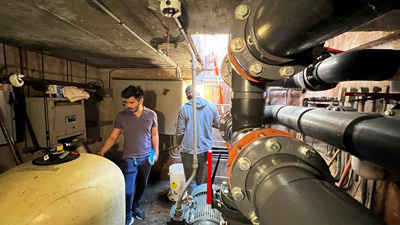
Mechanical systems received a comprehensive overhaul, according to Jones, including a new regenerative media filter (RMF) system, which he said features “unparalleled ease of use,” with the new system filtering the water faster and more effectively, “ensuring both pools maintain optimal water conditions. These upgrades also support sustainability efforts, as the new systems are more energy-efficient, helping to reduce operational costs over time.”
Jones said they also relocated the erosion feeders for both their chlorine and acid distribution systems, and “the results have been transformative. The ease of filling the feeders, along with the improved, less corrosive environment they create, has made the workspace much more pleasant and efficient to work in.”
For air quality, a new HVAC system was installed, to ensure better air flow and reduce humidity levels, “creating a more comfortable environment for swimmers and spectators, especially during high-traffic events. These improvements not only ensure better circulation, cleaner air and water, but also contribute to more energy-efficient operations.”
In fact, Jones said that sustainability was a key consideration during renovation. “We upgraded to energy-efficient lighting and optimized the heating systems. We also invested in automated monitoring systems for both water quality and mechanical operations, allowing us to identify potential issues before they become major problems.” He said the switch from sand filtration to the RMF system brought significant water savings and an “astounding difference in water quality. Overall, these changes are designed to streamline operations, reduce our environmental impact, and ultimately save on long-term operational costs.”
Pearland Natatorium is utilized by various swim, dive, and water polo teams for training and meets. The Marine Corps and local fire and police departments use it for training. The pools are also used for recreation, fitness, therapy, learn-to-swim, kayaking, and special events. Since the renovation, the activity pool features a new transfer lift and enhanced accessibility.
Jones said that feedback has been overwhelmingly positive, with visits increasing, “particularly from families and individuals looking for recreational and fitness programming.”
Since renovating, they’ve experienced a growing number of facility rentals, including the largest swim meet held in the facility’s history. “The water has never looked this great, and the air quality certainly makes for a more enjoyable experience for everyone. It’s clear that the renovation has helped us improve the overall experience for all who utilize the natatorium.” RM