

A dip in the pool on a warm summer day is very inviting, and one reason that communities of all sizes love their outdoor aquatic facilities. And while these swimming pools are often community staples, there are now more options than ever as far as recreation and fitness opportunities. Therefore planners, designers, and operators of these facilities are always looking at how best to allocate funds to attract a wide array of visitors through features and attractions, programming, support spaces, and more.
“The desire to differentiate in an ever-growing competitive landscape is important,” said Jessica Mahoney, vice president of marketing for Landmark Aquatic. “You need to build to meet the demands of your guests. Providing them with a variety of options—one for every member of the family—is a great way to attract guests to your facility,” which she said is especially important for outdoor community centers and municipal parks that cater to families.
Doug Whiteaker is president at Water Technology Inc. (WTI), and Camryn Ballweg works in strategic partnerships and marketing there, and they shared a few design considerations for outdoor aquatic facilities, including:
- Transparent Aquatic Design: strategically placing large features along the pool’s perimeter, creating clear sightlines and in turn reducing the number of lifeguards and staff needed, without compromising guest experiences or safety.
- Scalable Operational Components: designing and operating with the ability to reduce amenities that are open during low-attendance periods to best control staff and utility expenses.
- Multigenerational Appeal: aquatic amenities and features that have durable appeal to a broad range of user age groups.
- Multifaceted Aquatic Design: water depths and pool areas that function to accomplish programs during “non-watertainment” use and then become desired destinations during recreational use.

Darren Bevard, president and COO at aquatic design firm Counsilman-Hunsaker, said that most successful community aquatic facilities are designed and operated to serve a diverse range of user-groups and programming activities. He said their feasibility studies start with an initial needs analysis, where they “seek to gather and value the input of all stakeholders in the project.” This includes demographic research, community engagement through public forum meetings, dedicated user-group focus sessions, and area provider analysis, which is then used to “develop a design program of spaces and features for the proposed aquatic center in alignment with the community vision for the project.”
Josh Martin, president and creative director at Martin Aquatic Design, said they’re typically involved when there’s a vision by a community or business leader, “but engaging the future patrons beyond that is a critical part.” And featuring multiple bodies of water is a common objective when it comes to offering a diverse range of programming. “We would say this is the desire of every project. Typically, there’s more vision than budget, so we always start with a variety of bodies of water and determine what fits the site correctly, but more importantly the budget; we want to work on the ultimate vision and then if we have to, phase it in.”
“By providing a variety of aquatic facilities and water temperature, from splash pads to zero-depth entry pools, from lazy rivers to competitive pools, the community can adjust and adapt to many different programmatic needs and better serve all of their citizens,” said Robert McDonald, CEO and senior principal at OLC Architecture. He said they’re seeing an overall trend toward catering to all four of the basic aquatic user groups: recreational, competition, therapy/wellness, and swim lessons and drowning prevention.
Bevard said there are many advantages to providing multiple bodies of water, often dedicated to a specific set of users or program activities. For example, separating the tot/wading pool on an isolated recirculation system offers the advantage of separating this high user-load area from the rest of the facility. “If there’s a fecal contamination event in the tot pool, it’s isolated there and doesn’t affect other water areas or user groups.”
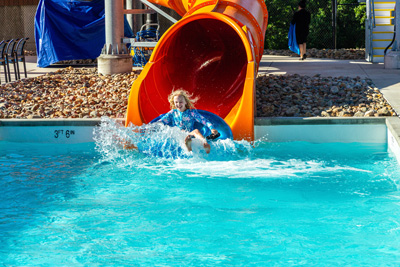
He said separating specific activity areas is also beneficial from a staffing and lifeguarding perspective. “Providing dedicated pool areas for activities such as diving, waterslide plunge, lap swimming, etc., can assist with zoning of the facility from an operational standpoint.”
Ballweg said there are many scenarios where multiple bodies of water make sense, and when including multiple pools, each is often dedicated to a specific function, ensuring that both competition and recreational needs are met efficiently. Also, by combining these, operational efficiencies are achieved. “Shared spaces—such as lifeguard stations, maintenance areas, and concessions—help streamline operations, often reduce training and staffing costs, and ensure better utilization of resources.” For example, concession areas might serve athletes and attendees during weeknight competitions, and weekend guests visiting for recreation.
But Ballweg also pointed out that by incorporating a multipurpose approach to design and programming, you can maximize the potential of a single body of water as well, and intentionally designed facilities and systems can ensure that the pool not only has multigenerational appeal, but often provides substantial cost savings. “The behind-the-scenes of one water system often results in efficiencies with plumbing, filtration, and mechanical equipment. Operational costs may also be reduced as less chemical usage is required, and staffing efficiencies may also be realized.”
In Wisconsin, a project of Ballweg’s company—the Evansville Aquatic Center—is an example of maximizing the potential of a single body of water. The zero-depth entry splash and play area entertains the youngest visitors and their caregivers, while deeper water connects this area to the circular activity pool, anchored by basketball hoops, with open water providing opportunities for recreational play. A current channel offers aerobic programming opportunities including resistance walking, while also providing space for guests to leisurely float. The six-lane competition pool hosts lap swimming, swim practice, and meets, and features starting blocks and an aquatic climbing wall. Additionally, a waterslide tower features body slides terminating into runouts.
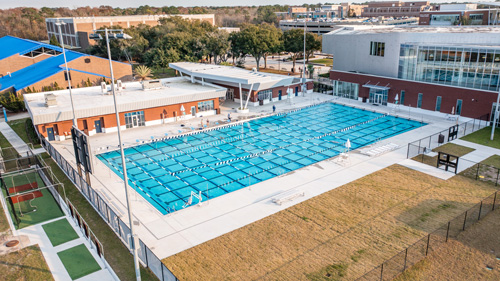
Many communities provide competition pool space for swim teams to support summer league programs, or perhaps as an operating partnership with local school district programs, according to Bevard. “The decision to include (these) capabilities is a function of user group demand,” evaluated in the feasibility study. If a facility is being evaluated for an area where competition is already well-served, there may be less demand to include it. “However, if there’s a shortage of lane space, training areas, or facilities capable of hosting competition in the area, the project is more likely to consider serving these user groups, and may open the door to revenue and partnership opportunities.”
“Facilities that are shared between schools and municipalities or private associations like the YMCA are a great way to ensure a fully programmed pool,” said Martin. He explained that for an investment like a lap pool, you should strive to make it usable for various groups, including different water sport participants, student clubs, paying members of a gym, etc. “Having the ability to split the pool with a movable bulkhead also creates more functionality; a bulkhead with starting blocks offers real swim competition conditions.”
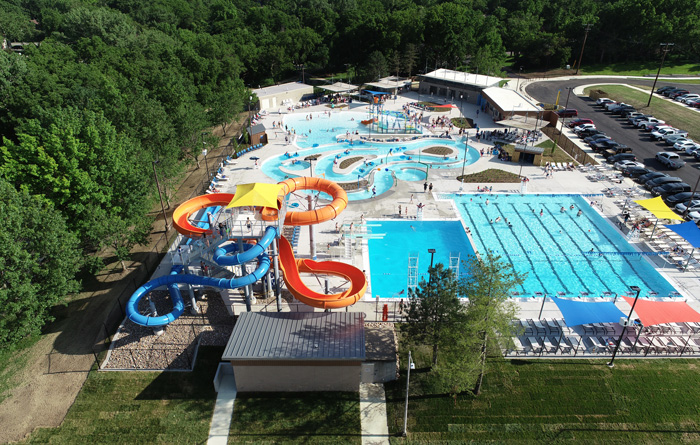
In Lenexa, Kan., the city’s flagship pool—built in 1976—underwent a major transformation after extensive research and public input. Both Mahoney’s and Ballweg’s firms worked on the project. The new outdoor facility—renamed Sar-Ko-Par Aquatic Center—opened in May 2024, and features a zero-depth entry pool with a passive play area that links the shallow water to a lazy river with two options: one channel is faster moving with spray features, while the other is a slower channel for relaxing. Situated within the lazy river are two vortex pools: one spins tube riders around, while the other provides seating to relax. There’s also a splash pad, climbable play feature, and a slide tower with a speed slide and inner-tube slide.
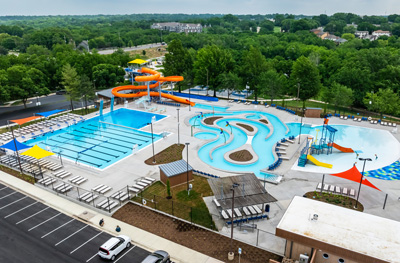
The center also features an eight-lane, 25-yard competition/lap pool with starting blocks, a basketball hoop, stair entry, and a diving well with two aqua climbing walls, and one-meter and three-meter diving boards. Various swim and dive teams utilize the pool for practices and meets, according to Marisa Shartzer, recreation superintendent at Lenexa Parks and Recreation. Spectator seating can be brought in. And when meets aren’t happening, “there are times we reserve some of the lanes for lap swimming, but other times it’s open for any recreational use,” including the diving boards.
Other programming at the center includes learn-to-swim programs, water aerobics, and Splash with Me, “a drop-in activity for kids ages 5 and under with a caregiver to get acquainted with the water during non-open swim times,” said Shartzer. Additionally, there are Movie in the Pool events, birthday parties, and after-hours rentals.
The redesign of the center prioritized environmental stewardship, according to Shartzer. “Energy-efficient filtration systems, LED lighting, and water conservation measures are integral components of the facility. An air conditioning unit that runs on solar energy was added to the concession stand area,” which includes tables.
Another focus was ensuring the facility’s accessibility. “The new design incorporates ADA-compliant ramps, handrails, and lifts to facilitate ease of access to pools and other amenities,” said Shartzer. “An adult-sized universal changing station was also added in the new family restroom. Additionally, staff members are trained to assist patrons with varying needs, fostering an environment of inclusivity and safety.”
The original restrooms were updated, and “the facility incorporated ample shade areas with quality lounge chairs.” A new open-air admissions area was added, as well as improved parking.
Shartzer said an aquatics study was done on the old facility, followed by a comprehensive review that “examined the needs, preferences, and trends in aquatic recreation throughout the region. Staff surveyed more than 400 residents, including fourth and fifth graders from five Lenexa elementary schools. Findings from the study and community input revealed that the existing facility—while cherished by the community—required significant updates to meet modern standards.” And a note to designers: According to those elementary school kids, the most requested feature was a lazy river, followed by slides, diving boards, and “good food” at the concession stand.
The opening year of the center—which Shartzer described as a community and regional attraction pool—was a big success. “Overall cost recovery for the pool was 115%, whereas the old pool operated at only 35% to 50% cost recovery.”
She said the old aquatic center attracted around 28,000 visits a year and hosted just a few birthday parties, while the new center welcomed more than 58,000 visitors and hosted 115 birthday parties. And the Splash with Me program “brought in almost another 5,000 guests. By embracing both tradition and innovation, the Sar-Ko-Par Trails Aquatic Center stands as a vibrant symbol of community pride and progress.”
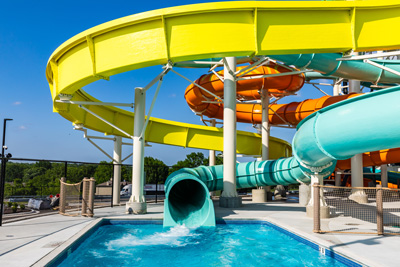
And what about the addition of larger, more impressive attractions to municipal facilities? “Community aquatic facilities continue to trend toward including more waterpark-style features—from signature waterslide attractions to surf simulators. These types of features help to draw attendance and create a regional destination,” said Bevard. “Extreme and adventure-type features such as poolside bouldering walls, ‘cliff diving,’ zip lines, and extreme waterslides have become very popular as a differentiator in serving the preteen and teenage demographics.”
“Customers are increasingly demanding these types of waterpark elements in municipal or park facilities,” said Martin. “Slide towers or splash play areas require larger investments and drive a lot of attention, whereas smaller add-ons like climbing walls or inflatable obstacle courses are easier upgrades that can still create bumps in attendance. Either way, guests are coming to expect bigger and better ‘wow’ elements, even in their own neighborhood community centers.”
Added Mahoney, “Ninja rope courses are great add-ons to existing pools for something new and fun without having to redesign or rebuild your pools.”
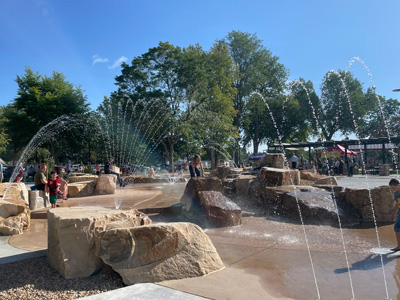
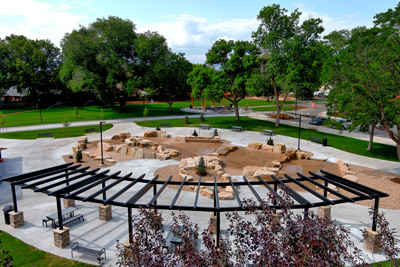
Splash pads are also excellent ways for communities to provide aquatic experiences with minimal cost for construction and operations, according to McDonald. “We’re seeing them being used alongside a community pool as an attraction for young children, and to distract them from the potential dangers of deeper water.”
He said they locate them close to entries of outdoor pool projects, and right outside of locker rooms, “in case the little tyke breaks away from their guardian and makes a run for the water. They’ll see the action, vibrant shapes and colors of the splash pad and hopefully run there first,” rather than accidentally falling into water they’re unprepared for. Splash pads are also great for introducing toddlers to water play, he added.
Ballweg said that spray features are always enjoyed, and are often added or swapped out to provide new, immersive experiences. “We typically see play features incorporated within a zero-depth entry area. In this application, these features don’t typically post significant challenges to mechanical systems and their designs, as they require relatively low gallons per minute.” She said vendors and manufacturers have worked to design “lower-flow features to ensure maximum play value for every system and allow for easy (integration)… into larger water treatment systems.
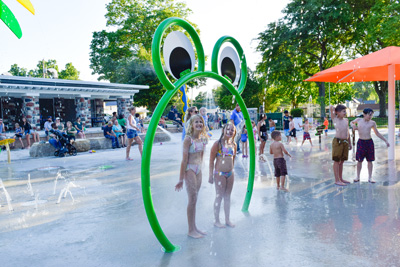
“Designated splash pads may be designed to be separate from the main pool area,” continued Ballweg, who pointed out that splash pads have longer operating seasons than pools, and if there’s no standing water, don’t require lifeguards or attendants. “Both of these features make these spaces ideal for extended use and ease of accessibility.”
And since potential challenges may arise when identifying the placement of this separate—yet connected—area, she said they work closely with clients to ensure all aquatic spaces are thoughtfully planned. “This includes considering access, gating, signage, and how the splash pad integrates with the rest of the facility. We also prioritize shared mechanical spaces and utilities whenever possible.”
And what about non-water support spaces and amenities? “Cabanas—especially those offering shade, comfort, and privacy—are particularly popular and tend to sell out quickly during peak seasons, providing families a dedicated space to call their own,” said Ballweg. “High-quality deck furniture and well-placed concession areas further enhance the guest experience, and contribute to longer visits and repeat business. These features support a more inviting atmosphere while also generating sustainable revenue for the facility.”
“Taking a cue from waterparks, it’s true that community facilities are finding more ways to drive revenue for their parks, whether that’s adding more food and beverage options, rentable cabanas, or creating more deck areas to increase the length of stay,” said Martin. “These enhancements allow facilities to recapture their investments in better/renovated amenities. One of the areas we always try to maintain is at least one or two birthday party areas.”
McDonald said that all successful pools are surrounded by a host of supporting amenities that make them attractive to their patrons. “Adequate storage for lane lines, pool covers, life jackets, etc., is absolutely critical. Having enough deck space for seating and keeping users’ personal effects dry and safe is paramount. Efficient, secure, and respectful changing areas are a must-have.”
Bevard explained that there’s been a significant trend in community aquatics toward hospitality, with many facilities being designed to compete with private-sector providers. “Enhanced concession offerings, support space design, FFE selections (furniture, fixtures and equipment), private cabanas, or reservable spaces are examples of ways to elevate the patron experience in support of the actual aquatic amenities.”
He said these enhancements are extremely important in terms of attracting repeat business, prolonging visits and driving potential revenue. “This is about designing to enhance the human experience.” RM