


As competitive sports facilities evolve, the architects who design them are focused on delivering a better overall experience for spectators and players. They’re also dedicated to offering more for everyone else who enters the facility—whether it’s gameday or not.
These approaches are being seen more and more from facilities designed for the highest levels of professional competition down to high-school and regional competitive complexes. “The difference between the community and collegiate athletic facility is getting smaller and smaller as far as the expectation is concerned,” said Gudmundur Jonsson, senior principal and senior architect at Populous. “The gap between collegiate athletics to professional sports is also getting smaller and smaller.”
The difference in many cases may relate to scale more than the experience delivered, as Colleen McKenna, principal and sports, recreation and wellness practice director for CannonDesign noted. At the college level, for instance, “the Division Twos and Division Threes struggle with the same issues as the Division Ones,” she noted. “They’re still thinking about how they can create a better experience and a better environment. It just might be 3,000 seats instead of 10,000 seats … but with the same level of care for what is experienced by the athletes, parents, and families.”
In many new designs, the emphasis has shifted from “bigger is better” to “better is better,” according to Blaine Perau, partner and architect for RDG Planning & Design. “Many recent projects have focused on the reduction of the quantity of seats in favor of increasing the quality of experience,” Perau said. “Competition venues want to be full, exciting, and engaging.”
New Ways to Watch
Aaron Pleskac, principal and sports, recreation and wellness practice leader for CannonDesign, added that creating that experience includes providing more unique opportunities both to view the game and to go beyond that to create community, memories, and new ways to interact with the venue.
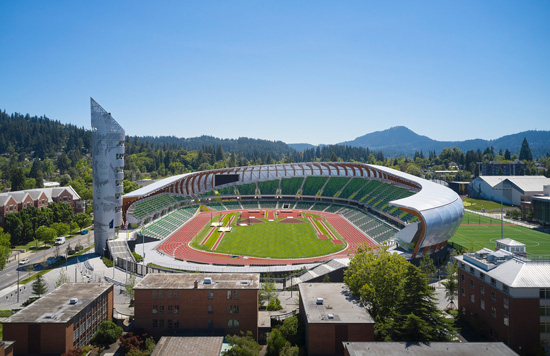
In terms of the game itself, he noted that spectator comfort and options are key. This can be seen in the Hayward Field project for the University of Oregon, a world-class track and field facility that offers spacious 22-inch-wide seats for all patrons, premium suites that are open and close to the field, and a standing-room-only upper-level concourse that gives patrons another view of the action. “You can circumnavigate the whole thing from a high vantage point, which is really interesting given that track and field is really theater—there’s so many things happening all over the place,” Pleskac said.
According to Jonsson, elevating the fan experience also often means less emphasis on smaller, enclosed suites and more on private, open party decks. “It’s not great if people are not as much a part of the game or the event as much when they’re in these boxes,” Jonsson said. “So we’re trying to get the fan base as close as we can with the right atmosphere, so the environment is really, really dynamic. And we often have five to 10 different seating options within a venue.”
Pleskac likewise noted that offering a wide variety of seating options is becoming more common. “So singles, doubles, tables, small groups, couches, stand-up tables, even monetizing the edges and corners of everything and making a unique experience to view a game,” he said.
An Emphasis on Fan Engagement
According to RDG’s Perau, it’s also increasingly important to ensure that that spectator experience can continue when fans are out of their seats. He noted the example of SEP Stadium in Pleasant Hills, Iowa, a new multipurpose high school stadium that seats 6,200. It also offers views of the field from the concourse and concessions as well as technology in restrooms to keep spectators connected with the game throughout the facility.
Another recent project with concourse and concession-area views of the action is Mediacom Stadium in Des Moines, Iowa. Located on the Drake University campus, the project seats 4,000 and is home for the Drake Bulldogs soccer teams as well as Des Moines Public Schools’ middle and high school sports. The project is an example of another growing trend toward multi-school sharing and collaboration that makes a higher-end facility for all users possible.
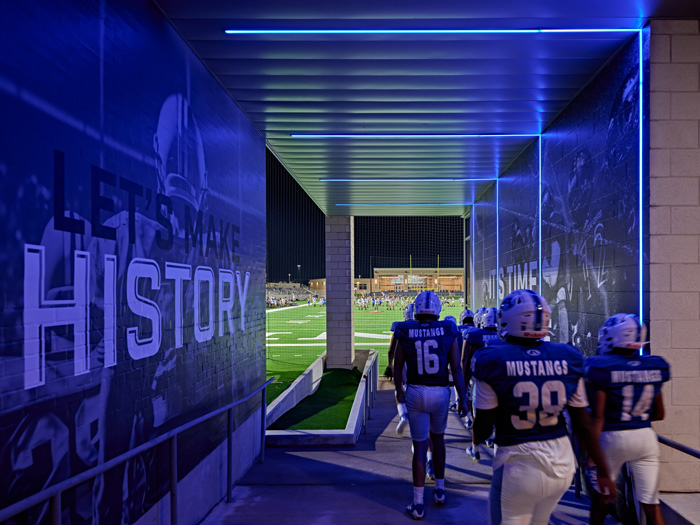
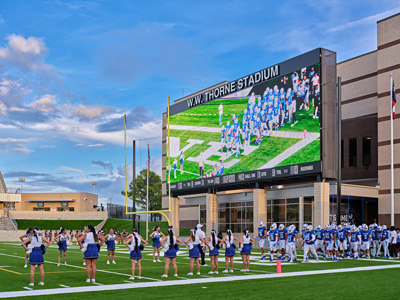
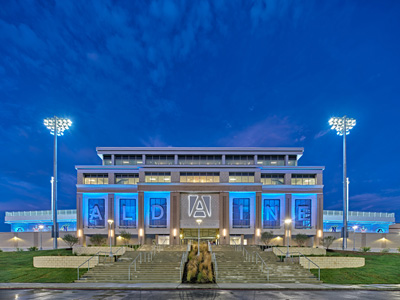
This can also be seen in the W.W. Thorne Stadium replacement project in Aldine, Texas, which serves the school district’s five varsity high school football teams as well as their varsity boys and girls soccer teams. The shared space seats 10,000 and features a large (25-by-75-foot) video scoreboard and LED ribbon videoboards and colored LED lights that can be customized to each team’s colors. It also has a distributed sound system with speakers around the full perimeter of the facility to offer rock concert-like sound.
The large shared facility enables students of each school to have a big-time Friday Night Lights experience at shared cost. “There’s just something about when you’ve got a stadium fully enclosed that really feels like a collegiate-level stadium,” said Scott Klaus, principal and senior design architect for Stantec. “I think it really makes an impact on the kids.”
To maximize the spectator experience, no track was included around the field to keep the fans closer, and the bleachers are set up high to ensure clear sightlines. Since bands can’t gather on the track before halftime shows with this setup, two band plazas along with dedicated private dressing rooms and restrooms for these students are provided so they don’t have to share crowded spectator restrooms.
In consideration of the growing ranks of female referees and trainers, the stadium also includes separate locker rooms for both male and female officials, as well as taping and training rooms separated from the locker rooms to allow trainers of any gender to tape kids up before the game without entering the locker room area.
Better Throughput and Flow
As in many new facilities, Thorne Stadium forgoes the traditional ticket booth for a small guest services room because people have their tickets on their phones. It also emphasizes merchandise through elevated merch stores on each side of the stadium.
Whether it’s ticketing or security, Jonsson noted that the experience for fans from even before the moment they reach the front door has to be smooth. “And luckily, the technology there is getting so much better that is allowing a lot more people through in a quicker fashion,” he said.
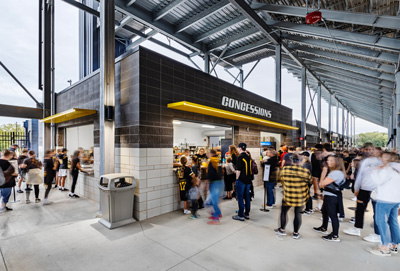
There’s also a growing emphasis on getting food and beverage and merchandise right and as hassle-free as possible since these elements can account for more than half the income at many events. This includes grab-and-go app-based ordering for concessions. “That’s happening really at every level, at every venue. It’s showing up at the college level,” Pleskac said. “I think those are some of the more interesting conversations, because there’s a lot of retrofit that needs to be happening in any venue that is hitting age 20 to age 30. They need to be looking at, how do we stay current?”
At the same time, more consideration is being given to how to do things more efficiently overall, versus overbuilding lesser-used amenities. Pleskac noted that in the case of the Hayward Field project, the decision was made to not build a big kitchen and to have smaller concession areas that were sized for smaller meets. “That was done on the grounds of, why build something permanent if you’re not going to use it that much? How do we do it more efficiently?” he said.
Instead, the facility offers the ability to park food trucks on the contours of the building to build a food zone outside, and the facility can also take advantage of the great existing kitchen at the Matthew Knight basketball arena. “They’re able to self-cater and deliver almost everything they need to most of their venues so that they aren’t duplicating building a really expensive kitchen,” Pleskac said.
Beyond the Game
In many facilities, options provided for spectators are going beyond multiple ways to view the game to include other unique experiences that offer other opportunities to gather and create community and memories. Pleskac noted the example of the Hillsboro Hops Minor League ballpark under construction in Hillsboro, Ore., which features luxury and premium seating and a club environment as well as food courts and kids zones and large gathering areas that can accommodate 1,000 people in the outfield and support it from the kitchen.
“We wanted to create many different ways that you can interact with the venue so that it’s more than baseball,” Pleskac said. “It’s also for concerts and creating gathering space to make this a place that is the heart and soul of Hillsboro—kind of their big living room.”
In regional tournament complexes, Jonsson is seeing more emphasis on additional amenities to cater to the needs of families who are increasingly likely to travel with their student-athletes. “They might be going to another state, and what is their experience as a family and as individuals? What can you provide in these facilities to heighten that experience for them and keep them there?” Jonsson said. “People are looking for some kind of short-term entertainment between games.” That could include playgrounds for younger kids, interactive gaming for kids through to adults, a range of food options, and even places where adults can get some work done.
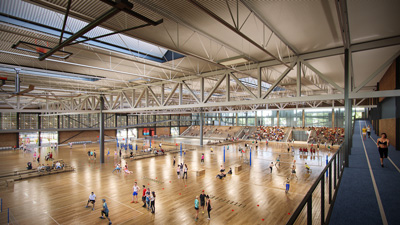
Venue flexibility is also important for tournament complexes. This was emphasized in the recent design of the Kearney SportsPlex in Kearney, Neb., along the I-80 corridor. The new 209,0000-square-foot facility includes 62,000 square feet of wood-floor gym space that can accommodate eight basketball courts, 12 volleyball courts, and 16 wrestling mats for tournaments. It also boasts 65,000 square feet of indoor turf, offering many different soccer pitch arrangements, drop-down batting cages, and a softball practice infield, four dedicated pickleball courts, and a suspended running track.
“In sports complex design, reaching the required threshold for the number of courts/fields to host desired tournaments is critical,” Perau said. “Related to this, gymnasia planning to host basketball and volleyball tournaments must pay close attention to required height clearances and sufficient overruns to accommodate high-level events.”
Use Outside of Gameday
In many facilities, including the W.W. Thorne project in Texas, the facility is also a multi-use space that houses the district athletic offices and a banquet facility that can serve about 400 people. “So that’s a multipurpose facility that the district uses as many as 300 times a year for different events and trainings,” said Klaus.
The banquet facility area also serves as a community room and press box that has a large videoboard that can be used for presentations, and the community space is divisible into three smaller rooms for greater flexibility. “The press box interiors resemble what you would see at a collegiate or professional facility,” Klaus said. The box is split up on two floors. The first level holds the coaches, timer, scoreboard operation, and announcer, while the second level is used for entertainment functions and can also be rented out or auctioned off to raise money for the education foundation.
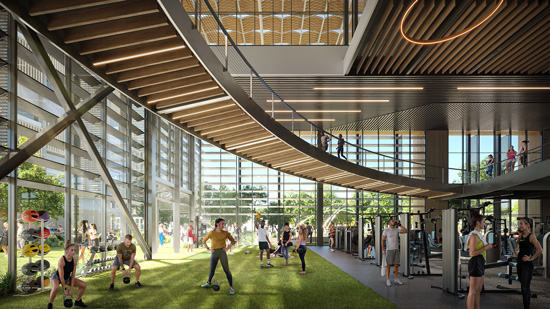
Architects are also seeing more athletic training, rehab, and even wellness facilities being incorporated into new projects as these elements become more valued by athletes at every level of competition.
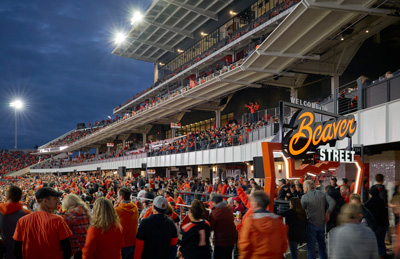
In the recent example of CannonDesign’s project on the west side of Oregon State University’s Reser Stadium, the new west side for the football stadium gives fans a 360-degree concourse. It unifies the fan experience with design details often found in an urban streetscape, including concession areas that offer a storefront appearance while paying homage to the Pacific Northwest’s food hall culture.
But beyond gameday, the facility also functions as a multipurpose event space for OSU and the Corvallis community. It’s where students and families meet for campus tours and has a full kitchen and two large rooms that can host events and banquets for 225 and 280 guests. It’s also the home of a new health center that provides primary care, counseling, and lab services to students and the local community.
A Heightened Spectator Experience
Spectator expectations for technology and entertainment are increasing at all levels of competition. This can start with the basics of demands for charging ability so that fans can always be ready to take pics, post, and share their experiences via phone. But it also goes well beyond that to more immersive experiences.
Jonsson noted the example of the Sphere—the now-iconic multimedia concert space that Populous designed in Las Vegas—as offering a taste of what’s to come for the sports spectator experience.
“I wouldn’t say that’s the norm now, but we’re heading in that direction—that immersive experience that people walk away from and the jaw is still dropping two days later,” Jonsson said.
But it’s a tricky balance in live sports, where you also want to keep fans focused on the action. “When you go to a really good venue, the screen can be a distractor when you’re watching sports—it’s kind of in the way,” Jonsson said. “But how you share information properly to the spectators is going to evolve more and more—and I don’t think we can see the end of how and where that’s going right now.”
What we do know is that people are more tech-savvy than ever, creating growing expectations for venues. “Technology can be a separator between a good venue and a great venue,” said Perau. “Audio quality, experiential video, Wi-Fi bandwidth, and many more considerations are critical to respond to modern venue needs.”
Perau likewise noted that dark, theatrical spaces are not always desired anymore. “We are looking to bring controlled natural light into facilities whenever possible,” he said. “Careful attention is required to avoid glare or unwanted natural light in specific areas, but the quality and desirability of the space increases significantly when proper natural light is introduced.”
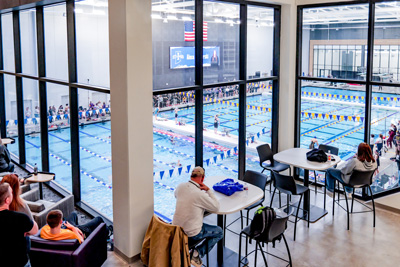
RDG accomplished this with the design of the Waukee Community School District Natatorium, which incorporates a level of natural light not typically found in a competition facility. Perau noted that careful, intentional control of glare and contrast was important to ensure student-athlete safety and ensure a quality competition space. The facility also includes lighting effects that allow for a wash of light over the entire natatorium that coordinates with team colors.
Flexibility
As schools and counties build large, costly buildings, they’re also looking to justify the use of every cent through facilities that offer the flexibility to accommodate multiple sports and uses, at tournament time and beyond.
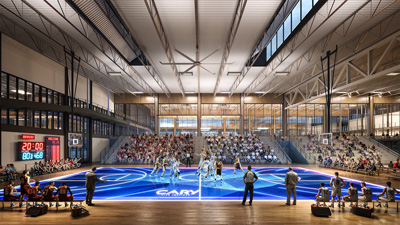
Jonsson noted the example of LED courts that remain too expensive for most, but that are likely to increase in popularity over time due to the flexibility they enable. “Literally, with a switch of a button, you can go from basketball to volleyball to pickleball to anything you really want to, plus training, coaching, things like that.” Jonsson said.
He noted that at some point, mass production of the technology could make it worthwhile for more facilities. “It is one of those elements that will attract tournaments, will attract training, will attract teams to an arena. And it could be a huge revenue opportunity, because you could rent that out separately between games during a tournament,” Jonsson said.
He also noted that increasingly, more facilities are pushing the boundaries of how to turn spectator and other spaces into training, workout, fitness, meeting, and social spaces beyond gameday. “We’re trying to make sure that there’s no space in the building that becomes singular in purpose because of the incredible attention to how they fund these—and every dollar is really valuable in creating these facilities,” Jonsson said. “So it’s really about activating the spaces, and how do we design these facilities so they are energized at all given times?”
For gameday and beyond, these growing demands from consumers, funders, spectators, and community members are resulting in more facilities ready to bring their A-game not just on game day, but every day. In the process, their growing commitment to utility, flexibility, and quality of experience are delivering big wins not just for athletes and fans, but also for the communities these facilities serve. RM