



By Matt Welty
Managers of recreation amenities have to juggle a lot of commitments in the day-to-day running of their facilities. Top of the list of priorities must be customer experience. According to Salesforce, 88% of customers value experience as much as products or services.
After all, members visit sports and leisure facilities voluntarily. They choose which facilities to use to prioritize their well-being in the face of whatever pressures they are experiencing in other areas of their lives. They don’t need any added stress. That’s why it’s important to make the whole experience as seamless and hassle-free as possible. Even the little things can become big problems if they’re not properly managed, and that includes lockers.
Don’t Overlook Lockers
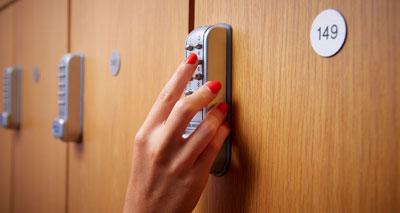
Locker space and changing rooms typically account for 10% to 15% of a facility’s square footage, and they are every bit as important as the figure suggests. Practically 100% of members at a recreation center or sports facility utilize lockers to store their belongings while they swim, train, play, or work out.
Busy recreational facilities have a high turnover of visitors, and whether it’s a swimming pool, a tennis club, or a large sports arena, all facilities need to provide somewhere for people to store their belongings.
Customers want to fully enjoy their chosen activity without additional worries about whether their belongings will still be there when they finish up. A poor experience with a locker can be a deal-breaker for your clientele, resulting in canceled memberships, or leaving bad reviews. This can be devastating for any business in a competitive market like leisure.
Controlling access to lockers is a challenge for leisure managers. Robust, reliable locker locks that are easy to use, look good, and instill confidence that users’ belongings are protected are critical for a facility’s reputation.
What to Look for in a Locker Lock

Every manager in a recreational facility has to have confidence in the locks they put on their clubs’ lockers—asking, ‘are they fit for purpose?’ especially when they have multiple purposes.
Convenient: Coded access ensures that patrons can focus on enjoying the facilities, winning their game, or beating their personal best rather than about where to keep their key. In health spas, where guests move between the pool or treatment areas for brief periods, lockers need an element of temporary access control. As spa guests are often in robes and without bags, keyless access control solutions are the perfect answer. Well designed, secure lockers that accommodate patrons with disabilities can help to ensure inclusivity and ADA compliance too.
Safe: Depending on the activity, physical locker keys can present a risk of injury. Think trampoline parks, zipline rides, or any team or contact sports. To avoid the problem, many leisure facilities opt for a keyless locking solution for the lockers in their changing rooms.
Reliable: When a member steps inside a health club, they want to sweat during their workout and not in the changing room searching for a locker in working order. Trainers and class leaders want to focus on their clients too. They shouldn’t be dealing with locker issues when they can be delivering training sessions that are talked about, and that attract new customers.
Easy to maintain: Managing a large number of lockers is time-consuming. Keypad-style locks remove the need to manually unlock and check lockers at the start of every day, saving considerable amounts of time. Locks that boast features that automatically unlock after a set period of time, when the facility is closed and the locks aren’t in use, are useful to help with access for cleaning. This feature also prevents ‘locker hogging’—ensuring an equal experience for every patron.
Look good: As recreation facilities are upgraded, leisure facilities owners seek locks that reflect the upscale aesthetics of a changing room.
Everyone’s a Winner in This Game
Choosing a keyless, coded access control system for lockers not only greatly enhances the customer experience, alongside this it benefits the recreation facility and staff. Facilities teams can focus on more important tasks, and trainers aren’t presented with unnecessary distractions.
Convenient, reliable locker locks improve safety. Many states and municipalities have regulations regarding safety measures in public facilities. Making lockers easy to use and reliable means that patrons want to use them and so are less likely to leave items poolside or on benches, where they could become safety hazards.
Choosing coded access control for lockers also removes the cost and hassle of having to hand out keys, retrieve them when the guest leaves, or replace them when they are removed or lost. In a competitive market, these small costs add up. It also prevents businesses from having to recuperate these costs from the customer, which can create a very negative impression. Few patrons appreciate ‘hidden costs’ and ‘drip pricing,’ and nothing turns them off faster.
As some keyless locker locks can be seamlessly retrofitted to existing lockers, there’s no need to replace perfectly good lockers, reducing both cost and waste. Waste reduction is now key to many brands’ images, so choosing waste-minimizing locker locks won’t undermine their image or reputation either.
Keyless Lockers in Action
Removing the need for keys removes several risks for recreational facilities. Less loss, lower costs, and less time wasted. Keyless coded locks provide several enhancements too, chief among them being improved customer and employee experience. RM
ABOUT THE AUTHOR
Matt Welty is vice president at Codelocks Inc. Visit www.codelocks.us for more information.