


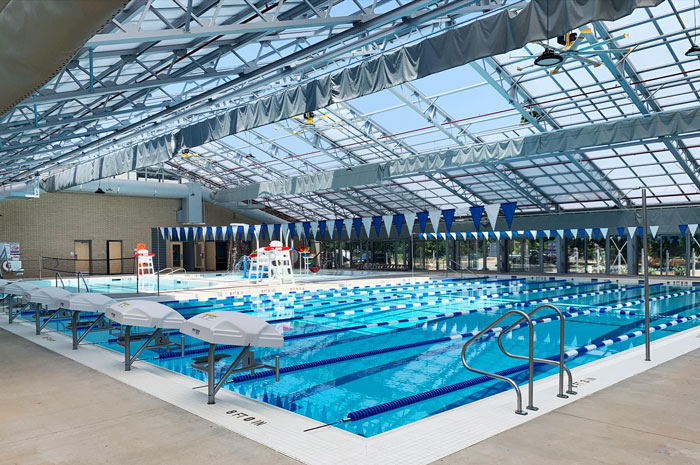
The use of nonconventional structures has become a viable option for sports and recreation directors looking to expand their programming season. Compared to brick-and-mortar buildings, these structures use technologically advanced materials that provide greater flexibility, adaptability, and cost-effectiveness.
“We’ve seen fabric structures used in a number of ways to expand recreation and sporting facilities,” said Christopher Machnich, director of marketing for a South Windsor, Conn.-based designer, installer, and manufacturer of energy-efficient fabric structures. “The obvious use of these structures,” he explained, “is covering a new field or court, but we’ve also seen them used as auxiliary structures to support an existing facility.”
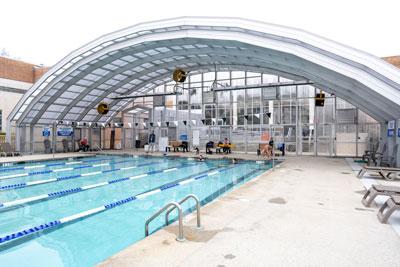
People need to start thinking differently now, said Jim Avery, vice president of a modular tension fabric building manufacturer, with U.S. headquarters in West Jordan, Utah. “It’s all about the value proposition,” he said. “The cost of construction in any industry—and we’ve seen this since COVID—has skyrocketed or increased significantly, which has put pressure on municipalities and private clubs to really scrutinize their spending on sports and recreational facilities. They have gone up significantly. So, the obvious question is ‘What else is out there?’
“You don’t have to build the same way you did years ago, meaning conventionally, such as bricks and mortar,” Avery continued. “You need to come up with some alternatives. I don’t say that these are the cheapest buildings, although they are definitely less expensive, especially for an aquatic center and even fieldhouses because of our clear-span nature.”
Clear-span structures are buildings or structures designed with a large, unobstructed interior space, achieved by eliminating interior support columns or beams. This allows for a wide, open area that can be easily reconfigured for various uses, making them ideal for sports arenas, and other applications where flexibility is crucial.
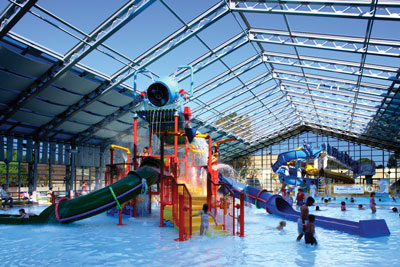
Another option used to expand sports and rec offerings is through retractable roof enclosures and retractable skylights, said Nancy Patterson, director of design and business development for a company that manufactures, designs, and builds such structures, with headquarters in Mississauga, Ontario, Canada.
“When you look at such a facility, which can be located anywhere,” Patterson explained, “you get the best of both worlds because at the push of a button you go from an indoor space to an outdoor space. We can span about 200 feet without columns. That is a differentiator. We are a very large-format fabricator, and that gives you the ability to put a soccer field under one of these roofs and offer year-round, no-weather-delays facilities.
“You have the ability to grow,” she added. “Lots of our waterpark facilities grow live plants in them, and there is no reason why aquatic centers and pools couldn’t do that. The key is to offer an indoor and outdoor experience year-round, and allow any community to expand what they are offering, whether you play on a field or compete in swimming.”
Benefits Abound
One of the great features of a fabric structure, Machnich said, “is that it is expandable. While the structures have a set width, adding on to them lengthwise is as simple as adding more trusses. This allows businesses to get proof of concept and then expand as business dictates. These structures also allow for revenue expansion, as they can be used 365 days a year. With a covered facility, programs no longer have to cancel due to inclement weather.”
Besides this benefit, Machnich explained, “there are more. The fabric lets light filter through the cover, removing the need for artificial daytime lighting. It creates an atmosphere that is well-lit, but gentle on the eyes and shadow-free. These structures offer a true clear-span design that is absent of support posts. This allows fields and floor plans to be arranged in the most efficient manner, and posts will never affect play.”
Local building codes are always a consideration, Machnich added. “While buildings can be tax-free in many municipalities, they still often have to be engineered to meet local building codes. Any questions or concerns should be relayed to the customer’s designer, as they’ll be able to incorporate that into the building’s design. The great thing about these buildings is that they can be built to just about any size and offer plenty of clearance.”
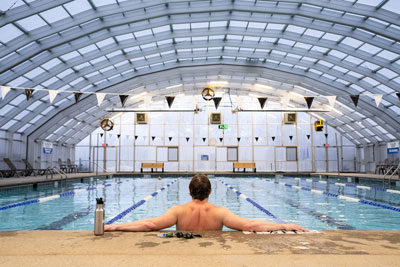
Traditional construction techniques have evolved with climate change, Patterson said. Places that had one tornado now get a dozen, snow is deeper, temperature is hotter, wind is faster, and rain is heavier, so facilities need to be adaptable and constructed for the long term. They need to last longer and not fall into disrepair. “Look at steel aquatic centers and the impact of rust. Right after opening you see it—it’s a mess, and some communities then can’t afford to fix it.”
This is where the technology of better materials factors in, Patterson said. “Retractable roofs allow for less use of mechanical systems and cheaper monthly operating costs. Using less energy makes a building cheaper over the long run, allowing communities to maintain it easier.”
Even with a waterpark, having a retractable roof is cost-effective, just by virtue of being able to open it up and allow for air circulation.
“These buildings require a foundation,” Patterson emphasized. “They are permanent, not temporary. You don’t take them down. You can take down a bubble, but that is extremely expensive to do.
“What is interesting about a bubble,” Patterson explained, “is the upfront capital outlay and then every year, say in winter, they have to be dismantled at the end of the season and then reinstalled. It costs hundreds of thousands of dollars for those tents to go up and down every year. That is a crazy amount of money. For communities, whether it is college, a school, or a municipality running the operation, it is an awful lot of money for a temporary dome, bubble or whatever you put up. While an initial investment in our type of structure is higher, you are not paying annually to take it up and down.”
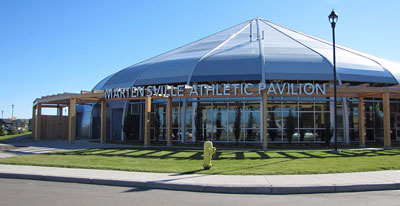
Tension membrane structures are another option. A tension membrane structure, also known as a tensile structure or fabric structure, is a lightweight structural system that utilizes tensioned membranes (typically made of high-strength fabrics coated with materials like PVC, PTFE, or ETFE) to create roofs, canopies, or entire buildings. Unlike traditional structures that rely on compression and bending resistance, tension membrane structures derive their stability and strength from the tension applied to the membrane. This tension is achieved through a network of cables, masts, and other rigid support elements that pull and stretch the fabric.
“These are high-performance structures,” Avery said. “You get the clear span, get the insulation, and you get a significantly more airtight building. Your heating and cooling costs down the road are not astronomical. The structure is more airtight than a conventional building, and it is much brighter on the inside. We are seeing where our clients are saying, ‘Wow, we can actually go ahead now and put this sports facility in whereas before we couldn’t because it was simply too expensive.’ ”
Factors in Decision-Making
Before making a decision on what structures are right for you, know there are a lot of different products on the market, “and not all are suitable for a long-term sports athletic facility,” Avery said.
Certain products on the market are designed for certain applications, he cautioned. “The biggest mistake you can make is going for the lowest price and thinking that a structure used at a fairground can be put up for a permanent gymnasium. But they are just not designed for that purpose.
“Do not think all fabric buildings are the same. They’re not,” Avery said. “If you are new to this technology and have seen one of those buildings, it could be the wrong application. What can then happen is you pigeonhole the whole market. People confuse all these structures as tents. But in the building code they are categorized differently. They might be a tension membrane structure, which in the code can be for permanent applications.
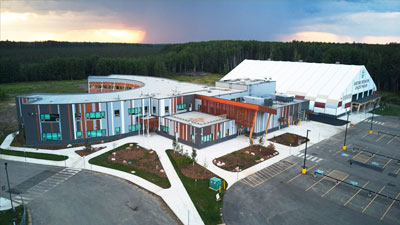
“You need to ensure that if you are going with this technology, you do your homework. Go see one,” Avery advised, “and make sure that whatever it is, it will fit your needs.” If you just put out a bid based on general parameters and go with the cheapest option, you might end up with a structure that’s not really intended for your application, he warned. “You might not get the high performance, the insulation values.”
Before making any decision, Patterson suggested looking at a company’s history of projects. “You want to know that they have done a similar kind of thing for somebody else. The best references are former clients. Our clients go to the projects first, talk to those people who run the project, and then call us. If you are a facility director, a parks and recreation director, that would be a key component—knowing that you will have a positive experience with the people you are going to work with.”
At the end of the day, when you are putting together your project budget and capital costs, it is critical that all components are accounted for. “Retractable roof structures are cheaper to operate,” Patterson said. “They are sustainable, last a long time, don’t corrode, and don’t require maintenance. So, when you are looking at your upfront capital budget, a real consideration should be the ongoing operation. If you can build something that costs you less to operate, you will be happier in the long run.”
You can cut corners on buildings, Patterson said, but that could lead to maintenance headaches from start to finish, and for the next 20 years. “And that is a real shame. Parks and recreation directors need to think about the operation five years down the road when all those other parties might be gone. You’ll want to work with a company that is going to stick around for the long term and help. That’s the key because at the end of the day the parks and rec director is the one holding the bag.”
Simple Installation
Installation for many nonconventional structures is straightforward and incredibly easy compared to traditional buildings.
“Structures are able to meet any building codes, snow loads and wind loads, and offer a number of foundation solutions, from traditional foundations, like poured concrete or piers, to more innovative solutions, like helical anchors,” Machnich said. “Helical anchors drill directly into the ground and create a secure hold that can be used as a permanent foundation, but can also be removed and reused at another location. This is a popular option, because it’s cost-effective and offers a durable, permanent foundation.”
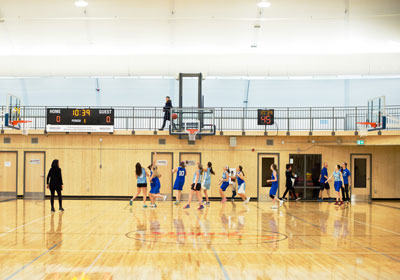
Every site offers its own unique challenges, and there are no exceptions, Patterson said. “But in very basic terms we seek a site that is accessible, such as in a laid out space, a parking lot, where we can assemble the pieces and install them. Our buildings are built in a shop so we are cutting down on on-site waste, and we are a more sustainable building from that perspective. The pieces come to the site, the columns come as a piece, the roofs come in sections. We assemble them and then erect them. The process does need access because of large equipment and cranes.”
Every site is different, and every climate is unique, Patterson added. “Just like any other building, a site that has access around it is always going to be easier to install. But in our case we have installed on the sides of mountains, on 15-story rooftops, in the desert in the Middle East. In Edmonton, Alberta, Canada, the structure accommodates our heaviest snow load, where we get 8 to 9 feet of snow a winter. Every situation has challenges.”
There are constant challenges, leading to constant adaptation and innovation, Avery said of his company’s tension membrane structures, “because this is new technology. That said, we have over 12,000 structures in over 100 countries. Only in the last 20 years has the product really advanced to where you can get the insulation values, the longevity, and the permanence.”
As for installation, “contractors and architects need to understand ours is not a temporary building,” Avery said. “We supply a technical consultant, and we have alliance contractors that put up structures. Once you understand the process—there is a learning curve to it—it is quite simple.”
The structures go up much faster than conventional buildings, he explained. “Most every client we deal with is in a hurry. Now, with sports and recreation, municipalities might not be in a hurry. But tension membrane facilities can be put up relatively fast, since it is all modular, bolted connections. This allows stakeholders and programming directors to avoid saying the structure will be ready in two or three years. These structures,” Avery said, “can come on in as little as six to eight months.”
Build Better
“Fabric structures are definitely increasing in popularity and will continue to do so,” Machnich said. “As more buildings pop up in communities, the more popular they become. We have a number of projects that have gained attention, and then lead to numerous inquiries in those regions. One in particular is a pickleball facility. It is functional and looks fantastic. It’s changed the perception on what a recreation facility can be, and the fabric cover in particular is fantastic for sports. These structures being adopted by municipalities also goes a long way in gaining support.”
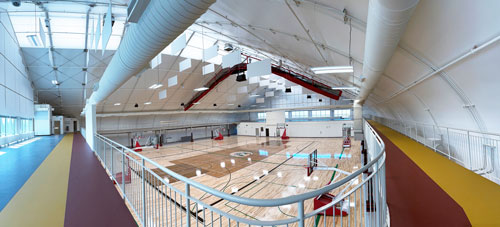
Potential users know that municipalities often have strict regulations that they can’t bypass. Price point and quality are factors that can’t be overlooked by local governments when they’re considering solutions, so when a municipality opts for a fabric structure, it gives it a stamp of approval.
People are looking for a faster, more cost-effective building, There have been some serious product advances, Avery said. “We have a membrane with a 30-year life, which most people don’t understand. We use aluminum, not steel for a lot of reasons: it is much more high-performance in sports and recreation. It doesn’t rust or rot. It is ideal for an aquatic center.”
The industries manufacturing these nonconventional structures are “being held to account when building public projects,” Patterson said. “There are more questions from citizens (it’s their money) so there must be better answers.
“Sustainable construction isn’t just about building better. It is about long-term solutions for communities,” she added. “It’s about being accessible for all, being inclusive, offering services and jobs, promoting health and well-being, and being a responsible consumer. Using clean energy is the future.”
Recreation facilities aren’t just buildings. They are community centers, and when the economy is headed for a downturn and life is expensive, they need to stay open to offer a respite from day-to-day challenges. So, Patterson said, the key challenge for parks and recreation directors is to offer more in a space that is “built better.” RM