


By Kevin Kinsley
Few things are more exciting than witnessing the boundless energy and spontaneous creativity of children at play. New design trends are emerging that recognize the profound developmental value of unscripted free play, particularly when supported by innovative surfacing like synthetic turf and dynamic topographical features like play mounds. This isn’t just about fun; it’s about optimizing neurological development and fostering a generation of agile, adaptable and innovative thinkers.
For too long, playground surfacing has been viewed primarily through the lens of safety and accessibility. Loose-fill options like engineered wood fiber (EWF) and rubber mulch, while meeting critical fall height requirements, often limit a child’s interaction with the ground itself. They are designed to absorb impact, which they do, but they don’t invite engagement. Similarly, traditional poured-in-place (PIP) rubber, while offering a smooth, unitary surface, can feel static and uninspiring. These surfaces act as a neutral backdrop, rather than an active participant, in the play experience.

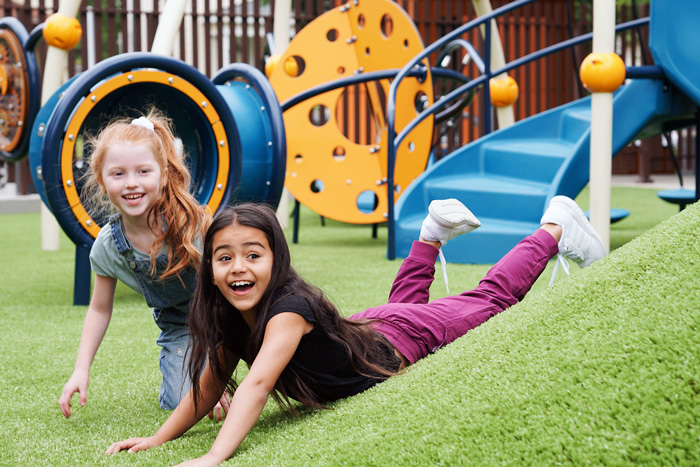
Synthetic turf developed specifically for commercial playgrounds is engineered for both safety and superior playability. Its consistent, resilient, inviting and forgiving nature transforms the entire play area into a vast, welcoming tactile canvas for movement. Imagine a child on a synthetic turf playground: They are not just running from one piece of equipment to another; they are sliding, rolling gleefully down gentle slopes, practicing somersaults with newfound confidence, and engaging in impromptu gymnastics routines. The surface itself becomes a prop, a partner and a stage for their physical activity.
This stands in stark contrast to loose-fill materials, where a child hesitates to drop and roll due to the feeling of a lack of cleanliness, or unevenness of the surface. On synthetic turf, the fear of scrapes and discomfort is significantly reduced, opening up a whole new spectrum of gross motor exploration. This increased freedom of movement is not just about physical exertion; it’s a direct pathway to enhanced motor skill development, proprioception (awareness of one’s body in space), and vestibular stimulation (sense of balance and movement). As children confidently experiment with moving their bodies, they are building a stronger internal map of their capabilities and pushing their physical boundaries in a safe, self-directed manner. Research consistently highlights the importance of varied movement for motor skill acquisition, and synthetic turf, with its invitation to dynamic interaction, provides just that.
But the magic truly escalates when we introduce play mounds and other undulating terrain. Flat surfaces, while functional, offer limited opportunities for creative engagement. Play mounds, on the other hand, are inherently intriguing. Their varying heights, slopes, and curves instantly pique a child’s curiosity, transforming a simple ground plane into a landscape of adventure. Children approach mounds with an almost palpable enthusiasm. They become launching pads for jumps, hills to conquer, or simply soft, inviting places to lay and observe the world. The shift from a passive, flat surface to an active, sculptured environment elicits a remarkable surge in creative play.
This isn’t anecdotal; it’s rooted in developmental psychology. Child Development Psychologist Jean Piaget’s work explores how unstructured play, where children lead their own activities without predetermined rules, is a cornerstone of healthy child development. It fosters imagination, problem-solving abilities and crucial social skills. When the physical environment itself encourages this free exploration, the benefits are amplified. Play mounds provide a natural catalyst for imaginative scenarios. A mound isn’t just a mound; it’s a mountain to climb, a planet to explore, an island to claim, or a wave to surf. This type of play, often involving symbolic thinking, is critical for cognitive growth.
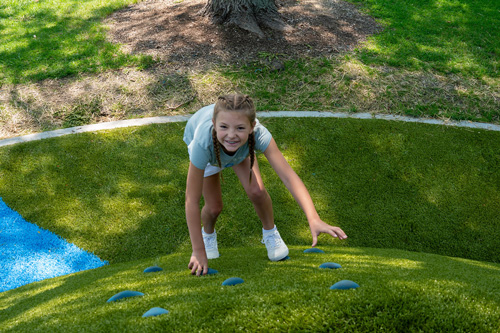
From a neuroscientific perspective, an engaging surface that invites creative, active play is a powerful stimulant for the developing brain. Unscripted, self-directed movement, particularly on varied terrain, engages critical brain regions. The prefrontal cortex, responsible for executive functions like planning, decision-making, problem-solving and impulse control, is actively recruited as children navigate the varied terrain of a synthetic turf mound. They are constantly assessing risks, formulating strategies for ascent or descent, and adapting their movements—all real-time exercises in executive function.
Furthermore, the basal ganglia, a group of subcortical nuclei vital for regulating voluntary motor movements, procedural learning and even cognitive function, are heavily engaged in the fluid, adaptive movements seen on synthetic turf and mounds. As children slide, roll and navigate uneven surfaces, their basal ganglia are constantly refining motor plans and coordinating complex sequences of movement. This intricate interplay between movement and cognition is a hallmark of healthy brain development.
And let’s not forget the periaqueductal gray (PAG). While perhaps less directly linked to overt play actions, the PAG is a critical brain area for modulating pain, fear and emotional responses, and plays a role in innate defensive behaviors. In a safe, inviting play environment where children feel secure enough to take calculated risks and explore freely, the PAG’s role in regulating emotional responses to novel situations is positively influenced. The freedom from the worry of rough surfaces allows children to push their boundaries without excessive anxiety, fostering a sense of mastery and confidence.
The deliberate integration of synthetic turf and topographical features like play mounds isn’t merely an aesthetic choice; it’s a strategic investment in child development. By creating a flexible, inviting and dynamic surface, we’re not just building playgrounds; we’re crafting canvases for imagination, laboratories for motor skill development, and incubators for healthy, active brains. This intentional design fosters an environment where every slide, every jump, every roll, and every creative play activity on a mound contributes to a child’s holistic growth, truly optimizing their potential for active play and all the cognitive, physical, and emotional benefits it brings. RM
ABOUT THE AUTHOR
Kevin Kinsley, brand leader, Playground Grass by ForeverLawn, believes that play is a fundamental necessity at any age, fostering creativity, reducing stress, and enhancing overall well-being. For more information, visit playgroundgrass.com/.