



Parks, family entertainment centers and other recreation facilities often have unused space that can easily be converted into space for active recreation. Disc golf and miniature golf are increasingly popular options, worth a look as a good fit for these spaces. Both are growing in popularity and are playable by a wide variety of demographics.
Disc Golf Grows
According to a 2025 report from UDisc, an app for disc golfers, the U.S. is the undisputed leader in disc golf, with 10,644 of the 16,267 disc golf courses worldwide. The report also noted significant growth in 2024, with an average 3.2 new courses installed per day. With 89% of courses being free to play, the courses usually aren’t revenue generators, but a valued amenity that can add recreational value to underused areas.
Michael Downes, club program manager for the Professional Disc Golf Association, which serves serious competitive and recreational disc golfers alike, notes that disc golf courses can also be a great tool to reinvigorate or improve park areas that may currently struggle with issues ranging from undesirable human activity to invasive plants. “Selecting the plot of land is actually pretty easy in that a park will say, ‘Hey, we’re not even using that 30-acre space over there,’” Downes said.
A designer of several disc golf courses himself, Downes noted that the key considerations when a disc golf course goes into a shared space like a park are safety, sustainability and fun. “You want to make sure that the space you’re using is safe and designed in such a way that other parkgoers aren’t put at risk,” Downes said. “You want to understand the land on which you’re working and how water flows, and understand that installing a disc golf course almost encourages erosion in certain spaces—with more foot traffic comes more trails and more pathways for water to move. And then, of course, fun. If it’s not fun, then nobody’s going to come back.”
Downes noted that an acre or two of space per hole is typical. “So a nine-hole course will take up anywhere between 10 and 15 acres, and an 18-hole course up to 25 to 30 acres, depending on the particular designs of the holes in the layout of the course itself,” Downes said.
Courses are often placed in areas with trees and other natural elements that can be desirable obstacles for disc golfers, while typically staying distant from other amenities like playgrounds and walking trails. It’s important to minimize ecosystem disruption while also making the most of the natural terrain. “You want to consider the topography and how you can use it to create that fun course,” Downes said. “Some holes go up, some go down, along the sides of traverses, whatever it is … use those characteristics to build up the character or feeling of the course itself.”
Working with an experienced course designer can help maximize both the appeal and safety of the design within the chosen space. “As a course designer, you’ll walk the most extreme areas of a particular hole design to determine where the worst throws would go. And then you’ll identify where no one would ever throw it and go another 100 feet further—and that’s your bumper zone,” Downes said.
According to Downes, a safe course in a shared space also keeps disc golfers safe from one another by using fairways that don’t cross each other, while also avoiding blind shots and exposure to swamps or other hazardous areas. Tees and targets should also be far enough away from other holes to protect people as they naturally gather around them.
Course Considerations
When installing a first disc golf course, it’s very common to start small. According to the UDisc 2025 Disc Golf Growth Report, twice as many 9-hole courses have been built to date as 18-hole ones. Danny Voss, marketing director for the PDGA, noted that a variety of options are possible even within a specific format to offer greater flexibility. One is to install a nine-hole course with the inclusion of short and long pads in the tee areas as well as beginner and advanced targets for each hole.
“So then, what you’ve built is like 36 holes if you take the short pin to short tee all the way to long tee to the long pin combination,” Voss said. “That’s totally a viable option, and it’s actually a personal favorite of mine, because it’s a way to squeeze a lot of variety into a small space.”
Nine- and 18-hole courses made entirely of three-par holes are very common. “Doing that is relatively easy because the level of infrastructure that might be required is typically lower,” Voss said. “So the targets don’t need to necessarily be the highest quality, and the tee boxes range from full concrete forms to ground-based tees where you just have a marker on the ground.”
Courses that could potentially host tournaments like a PDGA major are typically built to higher standards and include some holes with a higher par. “For the professional caliber, a par 54 typically just doesn’t happen anymore—par 64 or 66 is probably close to the sweet spot for professional-caliber courses, especially at the championship level,” Voss said.
While more difficult courses are most appropriate for top professionals, a course of par threes may serve as a good competition course for people like Voss’s mother, who competes in the amateur over-70 division. “A county with a great beginner-friendly course and a championship-caliber course 20 to 40 minutes away can still cater to a larger event. And it doesn’t have to be a PDGA major. It could be any other type of PDGA event, but that’s why diversity in course design is really important.”
Disc golf can be a great amenity at ski resorts or as a companion to existing golf courses. Downes mentioned the example of Smuggler’s Notch Resort in Jeffersonville, Vt., which serves as a ski resort most of the year. It also features two world-class disc golf courses that host PDGA championships, offers private disc golf lessons to visitors, and even has a glow-in-the-dark disc golf putting course.
Multigenerational Mini-Golf
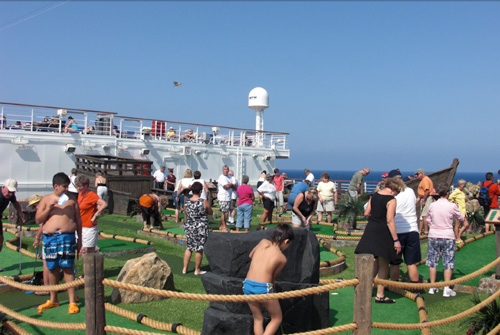
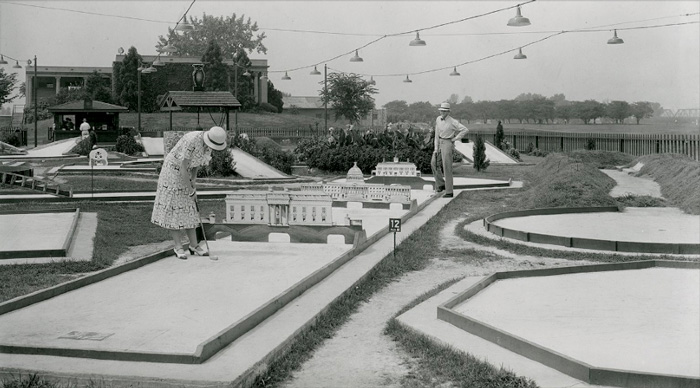
While disc golf can be a great outdoor sport for active adults of all ages, mini-golf is another activity that can offer fun for people of all ages and mobility levels—while offering the added advantage of fitting into smaller spaces.
According to a 2022 National Golf Foundation article, the number of mini-golf participants nationwide hovers around 18 million people annually, while skewing closer to the overall U.S. population than regular golf in attracting a younger, more gender-balanced and more ethnically diverse population. Nearly half (45%) are women, 22% are juniors, and 54% are younger than 35.
Recently, mini golf has seen growth as an entertainment option to complement eating and drinking through the spread of several brands offering a growing number of locations nationwide that include:
- Puttery, an immersive minigolf offering that includes unique, intricate course designs complemented by upscale food and cocktails.
- Puttshack, another minigolf/bar/food hybrid from the founders of Topgolf featuring automatic scoring, special glowing lights and opportunities to score bonus points.
- Holey Moley, a whimsical indoor option that lets you putt through shark-infested waters and pop-culture references, enjoy food and drink, and even venture into a private karaoke room.
PopStroke, an outdoor, family-friendly mini-golf and dining experience.
The sport also holds promise for park districts because the courses themselves typically require low staffing and maintenance, and can complement other amenities as a fun group activity suitable for all ages and abilities. “It’s multigenerational and caters to little kids from toddlers up to grandparents,” said Jeff Sheiber, vice president of sales for a maker of mini-golf courses headquartered in Jackson, Wis. According to Sheiber, a properly designed course will typically offer at least nine holes with a 36-inch pathway along one side of the golf holes and proper turning radiuses for ADA compliance so that everyone can play together.
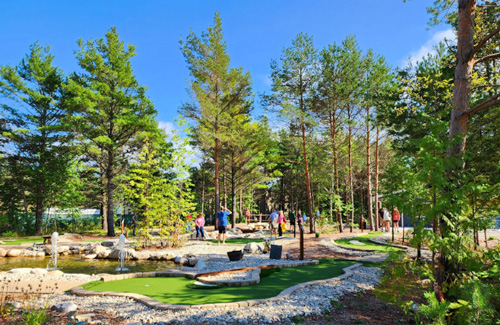
According to Katie and Sal Conaboy, the president and CEO of a miniature golf course design firm based in Scranton, Pa., their concrete, ADA-compliant courses typically start at 7,000 square feet, often include water features, and can last for 30 or more years. They also note another advantage of mini-golf in outdoor settings: They just look good. “You’re adding something that’s so green, and can enhance the environment,” Katie Conaboy said. “It’s not just this big structure that maybe can be a bit of an eyesore—they look really nice so it’s a beautiful thing to add to the community, in addition to being fun.”
The Conaboys noted the importance of working with an experienced course designer to help ensure that the course is interesting, exciting to play to encourage repeat business, and designed to keep the flow of play moving quickly. While the course can be nine holes or 18, they also recommend spending enough to make sure it’s done right—and noted that their clients typically get a payback on their courses in two or three years.
While disc golf courses are often a free amenity, people are usually willing to pay for a well-designed mini-golf course that encourages return visits. “We don’t build any courses that are not interesting, but if you build a flat, old-school style miniature golf course and charge people for it, you’re not going to see the value,” Sal Conaboy said.
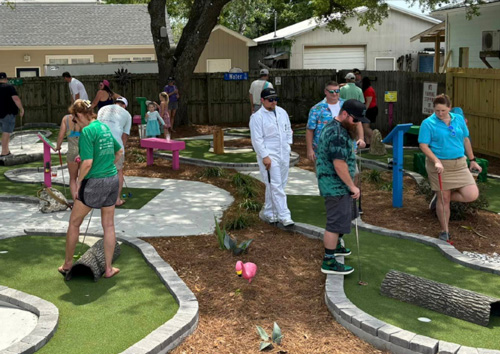
As disc golf grows as a competitive sport, mini-golf is seeing growing interest in this area too. The US ProMiniGolf Association (USPMGA) held its first Master’s event in 1997 in North Myrtle Beach, S.C., at the Hawaiian Rumble course with 15 people, doubled the field the next year, and has been growing ever since. “And now after this, our 29th year, we’ll probably have 80 to 100 people,” said Bob Detwiler, USPMGA president.
Detwiler noted the importance of promotions, like tournaments and other events, to facilitate the success of any mini-golf course. As the owner of courses like Hawaiian Rumble and Aloha Mini Golf in the Myrtle Beach area, he also stressed the importance of location. “Location is the most important thing, and I like being where people go on vacations, because that’s where they tend to play this type of thing,” Detwiler said. “They go to the beach in the daytime, and they get sunburned, and then they have to do something at night … If you’re eight years old or 80 years old, you play mini-golf and you’re laughing and having fun and interacting together and having a good time.”
Sheiber noted that while courses can feature a specific theme, even one that plays up landmarks or history important to the area, it’s also helpful to add interest by changing up the course playability. He also said that it’s easy to make a course festive and different with seasonal décor. “It’s a way to make it seasonal and add charm and flavor in a minimalistic way without big expenditures,” Sheiber said.
He noted that partnering with local charities on tournaments and with local food trucks or restaurants to cater them or other events are great ways to bring additional interest to the course, even if amenities like food aren’t included in the initial plan.
In both disc golf and mini golf, things like clubs and leagues are often great ways to develop ongoing interest and community around a course. And in the case of disc golf, starting a club, such as one through the PDGA, can be a great way to keep the course maintained too.
“The clubs are usually the stewards of the course or property itself, because they’re so passionate about what they do, and they love the sport so much they’ll take it upon themselves to have cleanup days,” Downes said.
And with both sports, the activity is fun, athleticism is optional, staffing requirements range from slim to none, and people of all ages can have fun together. These features make both amenities worth considering as ways to rejuvenate unused spaces and better serve communities. RM