



The potential physical and mental benefits of spending time outdoors have been well documented, including reduced stress and anxiety, improved mood, enhanced cognitive function, improved sleep, boosted creativity, reduced inflammation, and increased vitamin D levels. Some studies even suggest that time spent in nature can lower blood pressure and reduce the risk of heart disease.
And we all know the benefits of exercise, whether we get enough or not. So, it only makes sense to meld these two positive forces together. Here we’ll take a look at some different offerings and equipment in the outdoor fitness realm, as more organizations and communities work to bring this trend to a wider audience.
Whether it’s adding a couple pieces of equipment to a hike and bike trail or outfitting a regional park with a full-on outdoor gym, more communities are adding fitness equipment to their existing spaces. And a variety of other venues are doing the same, including schools and universities, senior living communities, VA and healthcare/rehab facilities, homeowners associations and residential communities, military bases and government institutions, correctional facilities, and cultural institutions.
Oftentimes these fitness parks are built with grants and other funding means. The city of Bellflower, Calif., features four outdoor fitness areas, according to Mike Machado, communications and marketing manager for the city, and all four received some type of alternative funding, from sources including the Kiwanis Club, Kaiser Permanente, Southern California Edison, funds generated by a ballot measure and local matching funds, an outdoor fitness equipment provider grant, an LA County park bond, and an LA County Regional Park and Open Space District grant.
A pocket park in Bellflower has fitness equipment placed along a walking trail, while another park features a standard outdoor fitness equipment area. And a third park offers a “full-scale outdoor fitness center,” according to Machado. “It’s one of the busiest areas of the park, especially mornings and evenings.” He added that this area has been used for outdoor full-body fitness classes and occasionally incorporated into other fitness programming.
And in Thompson Park there’s a general fitness zone with equipment that is “very well-used. We see regular daily use by men and women, generally aged 30 to 70.”
There’s also a ninja course there, which Machado said is “rarely empty. It offers a more advanced play/exercise option for teens and adults and fills a gap between our traditional playgrounds.”
The 12-feature course is designed for users aged 14 and up, said Machado, but “we frequently see younger participants with parental supervision. The layout is engaging for both serious fitness users and casual visitors who want to try something fun and challenging. It’s absolutely been a great way to get youth moving.”
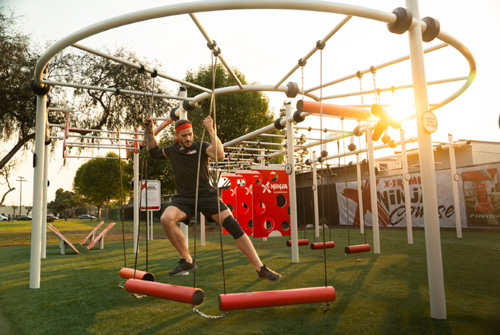
Facing the course are two curved treadmills, which include cup and phone holders. While teens are using the course, parents can watch them while getting in some cardio. There’s also a ninja training ground, for those hoping to improve their performance on the course. The 14 features offer a variety of workouts, including adjustable suspension trainers, kettlebells and a sit-up bench. And a Boxing Zone—which Machado said has more of a niche following—features a Muay Thai boxing station, kickboxing station and speed bag. “While it’s not as heavily used, it attracts a few semi-regular users and some who are just curious to try it out.”
Many communities that add outdoor fitness equipment are hoping to promote socialization as well as fitness, and Machado said that’s been the case in Bellflower. “We regularly see groups of residents walk or bike from home to exercise together. Many have built a sense of community, working out side-by-side daily and encouraging one another. The social benefit is evident, and all of these fitness areas have been very positive additions to each park.”
Allison Abel is director of marketing for the Anaheim, Calif.-based provider of outdoor fitness equipment that designed and supplied the Thompson Park fitness area in Bellflower, along with providing a grant. She said they intentionally design spaces to promote socialization as much as possible. “This can be seen in both our layout designs and units that face users toward one another. Encouraging users to laugh and connect with one another makes fitness more fun, which also motivates them to work out longer and more frequently.”
Abel said the ninja courses are growing in popularity and can be found at schools, parks and youth centers. “The obstacles in each course range in difficulty level, meaning there are some obstacles nearly everyone can complete while others push users to practice.” She said the ninja training ground is equipped to help users build endurance by training the motions, grips and strength required to excel on the course, but it’s also great for other goals, offering a “wide range of calisthenic exercises of varying difficulty levels.”
And while outdoor fitness courses and layouts are customizable, predesigned packages simplify the design process, according to Abel, by having a “predetermined, curated selection of units that provide a comprehensive workout routine tailored to different end-user demographics. Even if project planners choose to start out with one of our packages, they’re always welcome to modify them to fit the specific needs of their space and end-users.”
Abel said customers appreciate their complimentary custom-design services because the 3-D models make it easy to envision exactly what different equipment might look like at each project site. “To help customers get the equipment that’s right for their community, our designers consider factors such as configurations that make the most of the space while maintaining appropriate clearance zones, ways to encourage social interaction, color preferences, user demographics, elements of a comprehensive workout and more.”
Independent Health is a health maintenance organization serving Western New York, and this summer they partnered with YMCA Buffalo Niagara to kick off the 14th season of Fitness in the Parks, a free community wellness initiative that brings more than 500 outdoor fitness classes to 24 parks across Western New York. Classes are free with no registration required.
“Fitness in the Parks is for everyone, with no pressure and no expectations,” said Michelle Carbery, senior corporate wellness specialist at Independent Health. “There’s a range of offerings to help everyone get outside for a fun and active summer, from getting your heart rate up with a strength-training Core & More class to your first time stretching in a yoga session. No matter your age or fitness level, it’s important to stay physically active.”
Independent Health is focused on preventive care, and Carbery pointed out that engaging in regular exercise has many benefits, such as weight control, building strong muscles and bones, aiding with sleep, and improving your mood and mental health. “And the outdoor setting helps people relax a little bit, it’s a little less intimidating because you don’t have the structure of the gym where you’re surrounded by weights and equipment. Instead, it’s grass. It’s trees. It’s open sky. Just enjoy being outdoors in a natural setting.”
The program has proved successful, with last year’s attendance topping 5,600. Carbery said it’s a great opportunity for new and longtime participants alike to try a new class. “The certified YMCA instructors are able to modify exercises, making it accessible to all ages and abilities, including seniors and those with limited range of motion or other health concerns.”
Some classes recommend bringing a mat for ground exercises, and some instructors do use park “equipment” if available, according to Carbery. “For example, a park bench can be used for tricep dips and assisted push-ups; it’s a good way to give participants an idea of how they can utilize common items in different ways when exercising.”
Carbery said that instructors are often asked which class is best for that individual, and the answer is always the same: “It’s the one you enjoy! When you get that burst of energy and sense of accomplishment from a class that you had fun in, you’re more likely to keep going back and making it part of your routine. And with over 20 different styles of classes to choose from, participants should be able to find that perfect class for them.”
David Vetrovec is golf director for the City of Madison, Wis., and he said they have outdoor fitness offerings at city golf courses, particularly the Glen Golf Park, a unique mixed-use recreation golf park, offering a blend of programmed activities and a nine-hole golf course.
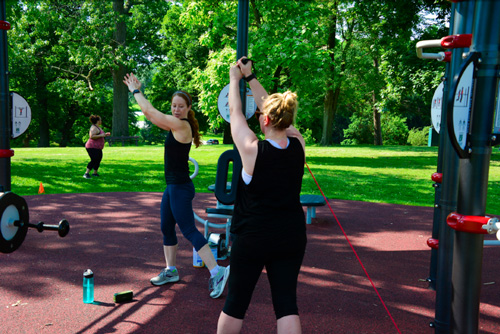
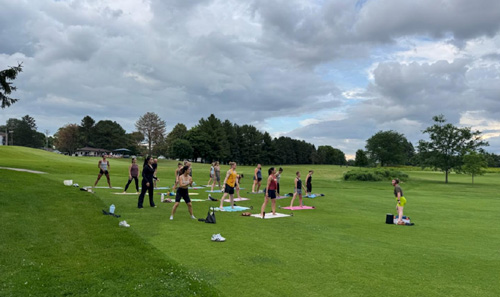
“We have one day a week set aside for morning walking and running called Monday Mornings at the Glen. We’ve held group fitness classes run by a partner where 40 to 60 people come and exercise out on the first fairway. We’re working to see how we can grow our partnerships and expand the offerings.”
Programming is consistently well-attended and run by certified personnel. “Connection to nature is the big advantage to holding these classes outdoors. No indoor setting can replicate what nature can provide.”
Residents in the Illinois capital of Springfield are also getting in some fresh-air workouts. “The outdoor fitness equipment located in several of our parks is well-utilized and continues to be a popular amenity across the district,” said Amanda Tippin, assistant director of recreation and marketing at the Springfield Park District. She said the equipment at Comer Cox Park and Lincoln Park see consistent use and remain active year-round, while “Duncan Park’s fitness area tends to be more seasonally popular, with increased activity in the spring and summer months.”
Each site tends to attract different demographics, according to Tippin, depending on the surrounding neighborhood and park amenities. “Some locations draw more families or older adults, while others are favored by young adults and fitness enthusiasts. Overall, the equipment supports our mission of promoting health and wellness for all ages and abilities, and it’s encouraging to see it used in diverse ways throughout the year.”
In 2019, AARP teamed up with nonprofit FitLot to build one outdoor fitness park in all 50 states, plus the District of Columbia, U.S. Virgin Islands and Puerto Rico, over three years. And Springfield was proud to be chosen as a FitLot location—in Lincoln Park—that first year. “AARP not only helped fund the equipment, but also supported the community by providing three years of free instructor-led programming after its inception, which was incredibly well received,” said Tippin.
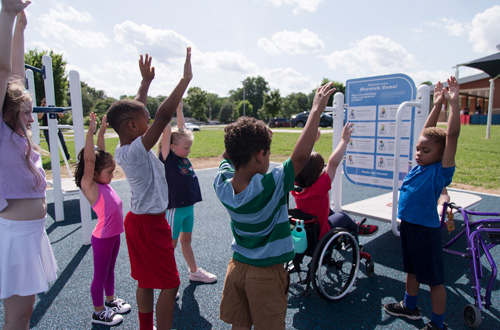
At Comer Cox Park, “The Springfield Park district partnered with the National Fitness Campaign to bring this space to life,” said Tippin. “We also partnered with the City of Springfield to secure additional funding and successfully applied for a grant through the National Fitness Campaign to support the project. This location has become a well-used and valued amenity within the community, supporting our shared mission of expanding access to free, high-quality fitness opportunities in public spaces.”
The fitness equipment at Duncan Park is managed entirely by the Senior Services Center, according to Tippin, who oversees all programming there, including hosting regular fitness classes geared toward older adults. “It’s a great example of how partnerships can enhance community health by providing age-appropriate opportunities for active living.”
Tippin said maintenance on the equipment has been relatively straightforward. “Our team regularly inspects the equipment to ensure everything remains in good working condition.” Specialized rubber surfacing designed for outdoor fitness use was installed at Lincoln Park (red) and Comer Cox Park (blue). “It has held up well, and we continue to make sure all areas meet safety standards and remain up to code.”
As far as outdoor fitness programming, Tippin said they’re gradually expanding their offerings. “Right now, we offer Yoga in the Park, which has been a great way for participants to relax and connect with nature. We’re also planning to introduce a fall walking club and a bodyweight training program to further promote outdoor wellness opportunities.” Programs are led by certified instructors, and some may be free while others may include a minimal registration fee, “depending on the structure and support needed.”
Tippin said their outdoor fitness areas help promote both physical activity and social connection, naturally encouraging people to gather, whether it’s through classes, casual workouts or simply being outside together. “Especially during community-led programming or peak times, it’s common to see people striking up conversations, working out in pairs or groups, and building a sense of community.”
This past April, Batavia, Ill., unveiled its new state-of-the-art fitness court along the Fox River at Clark Island Recreation Area, suitable for all generations and fitness levels. In partnership with the National Fitness Campaign, Blue Cross and Blue Shield of Illinois, and with support from the Illinois Department of Natural Resources, the park district led the project.
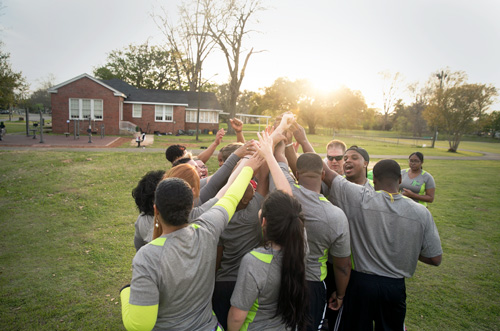
In addition to the seven body-weight exercise stations, the space includes a dynamic rear wall mural, featuring artwork inspired by native plants and butterflies, “creating a uniquely inspiring workout environment,” according to Katie Burgess, director of community development and community engagement at the Batavia Park District. “It’s been a great addition to our active community and a popular stop for people travelling along the beautiful River Trail.”
The Fitness Court studio design also supports group training, including Power Hour classes and Jukebox Sessions—high-energy workouts synced to music. Kathy Freedlund, fitness director for the Batavia Park District, said more classes are coming, including Short Circuit, where participants are shown how to work the equipment. “Another fun class we’ll offer is Nordic Walking, using the Nordic walking poles and taking them to the walking trail. We’ll walk for about 30 minutes and return to the court to use the equipment, followed by a good stretch. We’ll also be offering some pop-up classes TBA. I’m quite excited to get people outside to exercise!”
Abel said they want their outdoor fitness centers to feel like places of belonging that make exercise both accessible and inviting. “Our mission to create inclusive fresh-air gyms spurred the development of our wheelchair-accessible line, allowing individuals with mobility impairments to work out alongside their able-bodied peers without transferring from their wheelchair.” She said units are designed to target muscles commonly used by those propelling manual wheelchairs, as well as muscles on the reverse side of the body to prevent common injuries.
“Similarly, (we) hope to empower seniors to exercise by providing low-impact options that are fun and easy to use,” said Abel. She said their low-impact and wheelchair-accessible units are often paired together to ensure the space has something for nearly everyone. “The need for inclusion is rightfully gaining recognition, and (we) want to pave the way for inclusive outdoor spaces by creating equitable recreational opportunities for people to better their mental and physical health.
“Outdoor fitness is a wonderful way to bring communities together,” Abel continued. “With common park designs, there are often certain demographics that are left on the sidelines when it comes to recreational activities, such as parents, older adults, individuals with mobility impairments, and teens not interested in sports. Outdoor fitness zones serve as multigenerational spaces that allow people to strive toward bettering themselves, together.” RM