


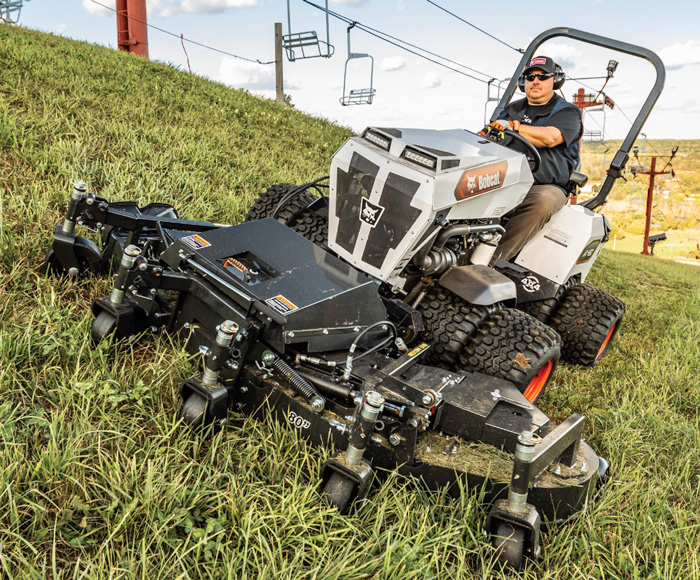
The complexity of recreational grounds maintenance is obvious: Weather and the challenges of frequent usage combined with equipment upkeep and staff management tax even the most experienced professionals. How do they ensure golf courses, multi-and single-use sports fields, gardens, quads, lawns, and other outdoor areas always look their best?
Darin Pearson oversees the daily operations of Eagle Bend Golf Course, Holcom Park and Sports Complex, Youth Sports Complex, and Clinton Lake Sports Complex for the parks and recreation department of the city of Lawrence, Kan., as well as more than 60 miles of trails and bike paths, 33 neighborhood parks and 1,600 acres of park land.
His early career grew at golf courses, and while those public and private locations are unique in the groundskeeping world, Pearson said there is a lot of common ground between the care and feeding of golf courses and maintaining baseball and football fields, gardens and parks.
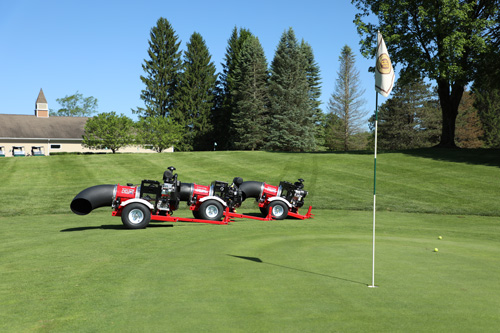
“We are always trying to promote strong root systems, disease resistance and how to handle wear tolerance,” he said. “On the athletic fields, we are making sure to have safe playing conditions for athletes. On the golf course, the focus is not only on safety, but also on aesthetics and playability. The most gratifying thing they have in common is the cheers when someone sinks a putt or when a player hits a home run. That is what makes our job so satisfying!”
Like umpiring, groundskeeping is usually only noticed when it’s done badly. Overgrown grass, weeds, divots, brown patches—all stick out like sore thumbs to the eye, call into question the quality of the entire operation, and unfortunately can result in injuries. Grounds staff must know the nature but also the nurture, of both grass and people, said Pearson.
It all starts with the science of turf management…
“Not all grass is created equal,” Pearson said. “Different species and varieties have distinct requirements for water, nutrients, sunlight and mowing height. A one-size-fits-all approach leads to subpar results. Always know your grass type and its tendencies.”
…and executed by the art of personnel management.
“It is all about the people you have working for you and with you,” Pearson said. “There is a quote from the book ‘Good to Great’ by Jim Collins that I always think about when I am hiring personnel for my departments. ‘Get the right people on the bus, the wrong people off the bus, and the right people in the right seats.’ The old adage ‘People are your most important asset’ turns out to be wrong. People are not your most important asset. The right people are.”
Pearson said the best advice he’s gotten about staff management once the hiring is done has been to get creative with work schedules, especially when using part-time staff.
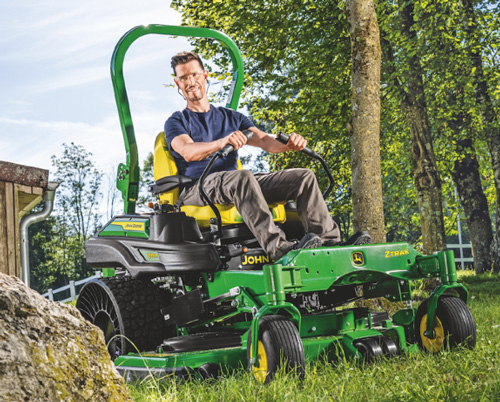
“To meet operational needs and stay within budget, we’ve had to adapt to staggering schedules—some employees work 32-hour weeks, while others cover weekends or traditional Monday-to-Friday shifts—to ensure coverage seven days a week,” he said.
All of the work, whether with nature or the employees, is in the context of how to work smarter not harder, Pearson said.
“We all keep hearing we need to do more with less,” he said. “We have had to adopt more efficient methods to get our tasks done in each department. There has been a lot of cross-training staff to handle the tasks across parks, athletic fields, the golf course and even our indoor facilities.
“Our profession has evolved from a largely manual trade to a more skilled, tech-driven profession. You need to be able to be ready for these advances while balancing a budget with greater precision more than ever.”
The equipment used in groundskeeping can be mortgage-worthy, costing in the hundreds of thousands of dollars, and the state-of-the-art machines can return investment in time saved, Pearson said.
“Technology with GPS-guided mowers and field painters has made us more efficient and has helped trim labor shortages/costs,” he said. “We now use battery-powered tools and have moisture readers for the golf course greens. All of these advances have helped make our tasks a little easier with a better end-product.”
Pearson said the future of groundskeeping is here: “I’m assuming we will see GPS-guided sprayers, drones and autonomous mowers as the standard. We will rely on real-time data analytics with soil moisture reading devices and weather forecasts, and AI will be adjusting our irrigation systems based on real-time data.”
Guy Gabbey, a sales manager with a golf course equipment manufacturer, confirmed that clients are most concerned with speed and efficiency, as well as ease of use and maintenance. His company’s engines are all now fuel-injected, for instance, to maximize fuel consumption and up-time, he said.
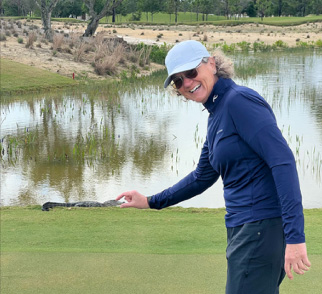
“With so much to be done every day on the course, superintendents need things to be done right, and fast,” said Gabbey. “Equipment that works well, but needs to be in the shop, isn’t effective.”
Compared to 10 years ago, there’s a stronger demand for multifunctional machines that can handle a variety of tasks and reduce the need for a large fleet, said Kristie Willett, senior government account manager for another grounds equipment manufacturer. That’s especially important for parks and recreation departments trying to stretch their budgets and manage multiple facilities with smaller teams, she said.
For most field managers, Willett said the core challenges haven’t changed—but the pressure to solve them has. One of the biggest issues is maintaining consistent field quality despite unpredictable weather and heavy use. Whether it’s too much rain one week or drought the next, turf conditions can shift quickly, and crews need tools and techniques that help them respond just as fast.
Staffing is another major hurdle.
“Many teams are responsible for large areas but have limited full-time staff, so efficiency is key,” she said. “That’s compounded by the need to train new or seasonal workers quickly, especially during busy sports seasons or event schedules. Equipment downtime and complicated fleet management only add to the strain, making it critical to have machines that are reliable, easy to use and supported by responsive service.
“These challenges are all connected—and solving them often comes down to choosing the right mix of equipment, training and support to keep teams productive and fields in top shape.”
Willett said athletic and recreational field maintenance has evolved significantly over the years.
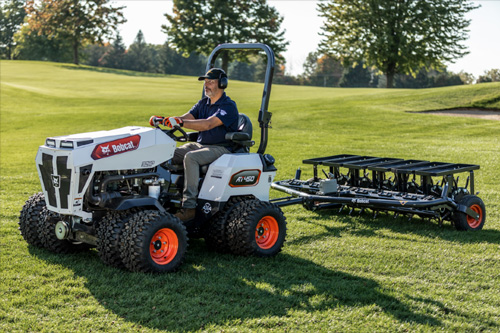
“Equipment that was once limited to single tasks has been replaced by machines that are more versatile, efficient and easier to operate,” she said. “That evolution has been especially important for parks and recreation teams, who often maintain a variety of field types with limited time and staff.”
One of the machines made by Willet’s company combines the capabilities of a pickup truck, tractor and loader into one machine, allowing crews to haul topsoil, grade infields, run attachments like aerators or mowers, and more.
“For field managers juggling seasonal sports, heavy traffic and tight turnaround times, having that level of flexibility in a single piece of equipment helps keep surfaces safe, consistent and ready for play,” said Willett.
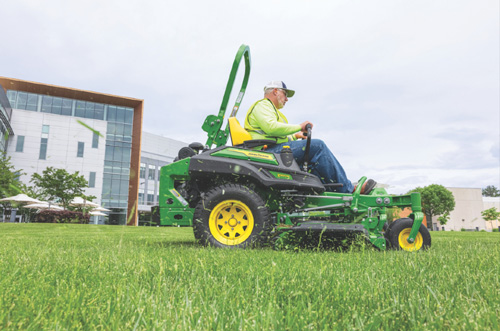
Mower manufacturers understand that recreational grounds, such as parks, sports complexes and multi-use fields, have unique demands compared to other turf environments, said Luke Gribble, go-to-market manager for one such company.
Gribble said today’s mowers are engineered with features that enhance productivity, cut quality and operator comfort across large and diverse terrains. These machines are designed to handle the frequent starts, stops and tight turns common in recreational settings, while also delivering a professional-grade finish, he said.
Over the years, clients have increasingly prioritized fuel efficiency, sustainability, operator comfort, and the versatility and quick-changing ability of implements, Gribble said.
More recently, customers are looking for data-driven decision-making tools, he added. His company offers a service that does just that for real-time insights into equipment usage, maintenance needs and productivity. The digital platform empowers recreation managers to make decisions about their turf care by:
- Tracking equipment usage across multiple fields and locations, ensuring the right mower is used for the right job.
- Monitoring maintenance schedules to reduce downtime and extend equipment life.
- Analyzing mowing patterns and productivity, helping teams optimize routes and reduce fuel consumption.
- Coordinating across teams with shared access to real-time information, improving communication and accountability.
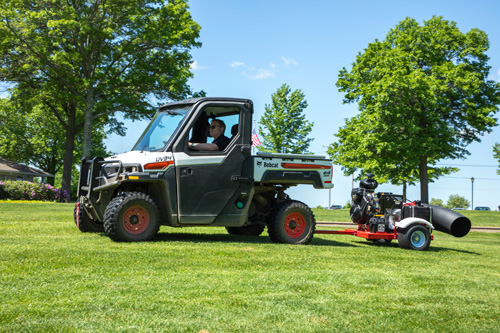
Equipment like front mowers and wide area mowers include modems that enable instant connectivity to the platform, and the modems can be installed on equipment that doesn’t come from the factory with them, said Gribble.
“We are always staying close with our customers in all spaces to ensure we are continuing to meet their needs and to leverage them as thought partners for key trends and shifts that they see so that we can respond to fill their evolving needs,” Gribble said. “Particularly, the shortage of labor continues to be an issue that many customers have voiced concerns with.”
One of the ways Gribble’s company is trying to solve this is through innovations like its autonomous electric mower. This fully electric, stand-on mower is designed to operate either autonomously or manually as a direct response to the growing labor shortages in groundskeeping and the need for sustainable, efficient solutions.
“It allows recreation departments to automate routine mowing tasks, freeing up staff for more specialized work while maintaining consistent turf quality,” said Gribble.
Athletic fields and golf courses certainly have many needs that tax managers’ experience and resources, and the same can be said for grounds with recreational uses like hiking or simply relaxing.
Bill Quade is the director of horticulture for the 8,000-acre Biltmore estate in Asheville, N.C., which includes open spaces and park-like areas used for walking, hiking, picnicking, outdoor adventure activities and relaxation. One of the highlights is the estate’s historic gardens, originally designed by Frederick Law Olmsted, widely considered the father of American landscape architecture. There are six formal and informal gardens, a conservatory, and nature trails connecting them to the French Broad River, the estate’s Deer Park, a lagoon, farmyard, and woodlands.
Quade said no matter the size and prestige of the grounds, there are foundational lessons he learned early on that still apply today. “One of the most important early lessons was to invest time in understanding the technical side of groundskeeping,” he said. “Above all, I learned that healthy soil is the foundation for everything. Take care of the soil, and it will take care of you. This becomes more challenging with factors like heavy foot traffic, budget variations and maintenance windows, but the principle remains unchanged.
“Regardless of scale, the basics matter. Maintaining healthy soil through proper fertilization, weed management, moisture control and smart plant selection is key and achievable even with limited resources. Starting with those fundamentals builds a strong foundation for any size operation.”
Marrying that essential knowledge with the advancements in science, equipment and data analysis is the path ahead, said Quade.
“Technology has been the biggest driver of change,” he said. “From operating irrigation systems from a smartphone to using autonomous mowers, the tools we have today have revolutionized grounds care. Advances in seed and plant genetics have also improved disease resistance and adaptability, making landscape care more manageable.
“It’s hard not to see groundskeeping being shaped heavily by technology going forward. Staying current with technological advancements will be essential. That said, the core principles of stewardship, sustainability and care for the land will always remain central to the profession.”
After 35 years in golf course maintenance and the past 18 as the manager of the City and County of Denver’s seven golf courses, Pamela C. Smith has learned a thing or two about doing nothing. She said the best advice she’s gotten, and advice she’d give newcomers to the profession is…
“Go Home!” she said. “I spent way too much time at work, as if it was an addiction. But at times, you just do what you love and are committed to it. But finding a better balance could have been nice. Give it your best every day and then go home. Work hard, play hard. Enjoy all you can with your family and career.”
When it is time for work, though, Smith recommends slowing down the approach to problem-solving.
“Don’t rush in to solve a problem,” she said. “Always driving to identify an issue and quickly address it can often make the situation worse. Sometimes we instinctively know what to do to work through a problem; using a combination of experience and good judgement usually wins the day.
“But when novel issues come up or a twist on causation, and if it isn’t an emergency, take some time to really think about all the circumstances, possible solutions, and outcomes before diving in. Take a breath, don’t react, and when you can think clearly, then make the decision on next steps.”
Mistakes are valuable teachers, Smith said.
“Don’t let a mistake go to waste—yours, theirs, ours—it is all an opportunity to evaluate what we can do differently next time and achieve a better outcome,” she said. “If someone is unwilling to learn from a mistake or take ownership, that is a big red flag that they are likely going to continue to make the same mistake and cost your organization.”
Once new employees are brought in, develop them, said Smith.
“We can only get so far on our own hard work and expertise,” she said. “We should always engage and mentor the next generation of leaders and technicians. If they are ambitious and eager to learn, then it is our job to help them maximize their potential.”
Smith said that out in the field, turfgrass maintenance has always been a blend of art and science. However, the technological advancements in equipment and water management tools have definitely driven up the science aspect of turf management. One of the biggest changes she is continually adapting to is the high demand for golf.
“The demand for golf in the last five years has definitely changed how we structure our work,” she said.
Handling that popularity while also budgeting the resources of time and money is crucial, Smith said. When resources are restricted, staff cuts the detail work out of its routines.
“Our end users may not immediately notice, but over time these areas can become larger maintenance issues,” Smith said. “It’s a balancing act of cutting out things that can wait in order to keep the golfer’s experience unaffected in the short run. Even when budgets are sufficient, we have experienced forced cutbacks due to inability to find staff to fill the positions.
“Currently we are experiencing consistent resources from both budget and staffing so we are doing a lot of catch-up—as much as possible with the amount of golf play! It is always something.” RM