


By Tony Jordan
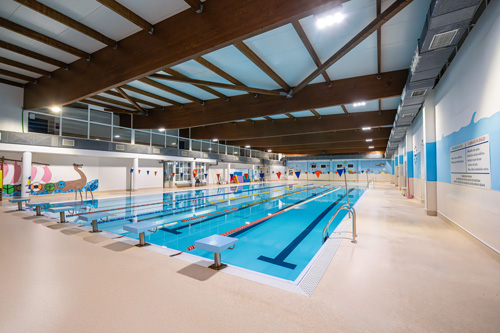
As pool professionals continue to look at different coatings options for pool interiors to offer clients, they are also looking for new options for the surrounding deck area. This is particularly important for pool renovations, as new pool deck surfaces can offer an immediate facelift to any aquatic facility.
Pool decks are one of the most important surfaces at an aquatic facility—both for safety and aesthetics. This is where a PVC pool deck membrane becomes an attractive solution.
Renovation Benefits of PVC Pool Deck Membrane
Concrete and stamped concrete have traditionally been the primary choices for surrounding pool and spa decks. However, once these surfaces become worn and cracked, aquatic facilities need ways to renovate these decks.
PVC membranes can provide a long-
lasting waterproof solution that does not require recoating and comes with far less maintenance than traditional decking solutions. Unlike concrete decks, PVC membranes for pool and spa decks can be installed in almost any temperature.
Additionally, installation of the PVC pool deck is more efficient than traditional decking materials. Aquatic facilities will appreciate the shorter installation time needed for a PVC deck because they do not have to worry about optimal temperatures or drying time for concrete. PVC decking membrane can be installed on and over all concrete surfaces, tiled floors or even wood.
Reinforced PVC also offers additional safety benefits for decks experiencing cracking, flaking, delamination and peeling. In some cases, the decks around pools can be the most dangerous part of any pool. Older, cracked or peeling decks can lead to injuries due to slippery surfaces. Some cracks can even cut bathers’ feet. Reinforced PVC encapsulates the deck, making the area slip-resistant and waterproof.
Having a fully waterproofed deck has many advantages, including long-term structural advantages. For example, if the pool deck is not properly waterproofed, the water left by swimmers exiting the pool or splash-out or deck cleaning can penetrate the floor and infiltrate the substrate, causing future maintenance issues. This risk is frequently underestimated by construction companies. Water on the deck that does not drain properly can infiltrate the structure and deteriorate the pool, not to mention being visually detracting and unsafe.
Using reinforced PVC to waterproof the entire deck avoids all this because it guarantees complete waterproofing of the deck. When combined with a compatible gutter system, it ensures a seamless waterproofing from the pool to the deck. Further, the slip-resistant PVC ensures all safety requirements in all areas of the wet-zone are met.
PVC Deck Membrane Installation
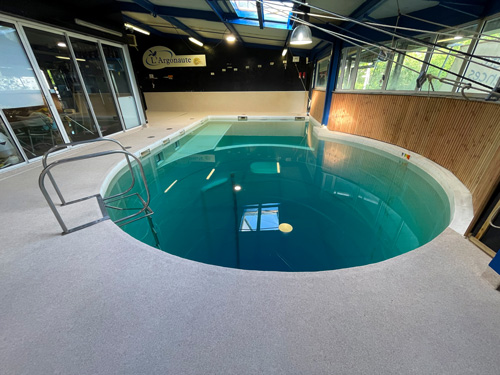
When installed over existing concrete, the installation requires the following steps:
- Filling any cracks or holes in the surface.
- Leveling and cleaning the surface.
- Applying glue.
- Applying an antimicrobial felt/geotextile layer.
- Laying down and welding together the reinforced PVC.
Commercial aquatic facilities also benefit from the shorter installation time; the only downtime is if the surface requires leveling, in which case, a leveling material is poured prior to the installation of the reinforced PVC. The installation time is similar to welding the interior of a pool.
Similar to the installation of reinforced PVC on pool interiors, reinforced PVC for pool decks is also rolled out and heat-welded together on-site to ensure an accurate, smooth fit to the shape of the deck that hides any visible joints. The process does require some skill, but many suppliers provide on-site training and initial installation assistance to pool professionals who are just getting started. Once trained, reinforced PVC can be installed year-round on indoor pools and even in cooler climates, such as late fall and early spring.
Deck Preparation
It is essential to carry out a thorough cleaning of the entire surface, as well as the pool area. The reinforced PVC membrane will replicate the shape of any imperfection or impurity. For this reason, and given the decking area is usually large, it is recommended to use an industrial vacuum cleaner, to remove both solid and liquid waste. Several extensive cleans will be carried out after each stage prior to the membrane application.
Geotextile Application
The geotextile layer has the dual function of filling the step generated by the butt-welding strip, and of attenuating eventual irregularities in the underlying floor. If the existing floor has strong irregularities, it is recommended to provide for prior repairs.
Before applying the floor adhesive, the surface must be thoroughly cleaned again, removing any debris from the leveler and other impurities that can cause both aesthetic and adhesion problems. Once the pavement is leveled and free of impurities, pavement adhesive is applied.
The antimicrobial felt/geotextile layer is glued to the floor, making sure it coincides perfectly with the butt-welding strip, taking good care not to overlap or leave any space between.
Cutting & Welding the Membrane Into Place
The reinforced PVC membrane is rolled out and cut to the dimensions of the pool deck, and then heat-welded together on-site to ensure a smooth fit. Since decks require a completely smooth finish, installers use what is commonly known as a ‘butt-welding’ technique. To do this, installers butt the reinforced PVC edges against one another, rather than overlapping them. This creates a smooth decking surface.
Safety & Maintenance Benefits
PVC deck membrane material is very resistant to chlorine and stains, thanks to its highly protective acrylic lacquer coating. The membrane’s smooth surface prevents the accumulation of dirt and grime—reducing the need for frequent cleaning and maintenance. Unlike other decking products, there is no need to use acid or other dangerous and abrasive cleaners to keep the surface in perfect condition all year long.
The PVC deck membrane offers a commercial-grade, long-term solution because it is not only thick and nonporous but also coated with a protective lacquer that resists chemical abuse, water absorption and UV deterioration. Plus the material comes in a variety of colors that can give your facility a contemporary, updated look!
Once the reinforced PVC is installed, the surface underneath the pool deck may continue to shift and crack, but it will not affect the reinforced PVC pool interior itself.
PVC deck membranes also work well in locker rooms, showers and more. Due to its commercial-grade slip-resistance and fire-resistance properties, this product can truly renovate any floor surface. If your aquatic facility is considering a deck renovation, consider a PVC deck membrane. RM