


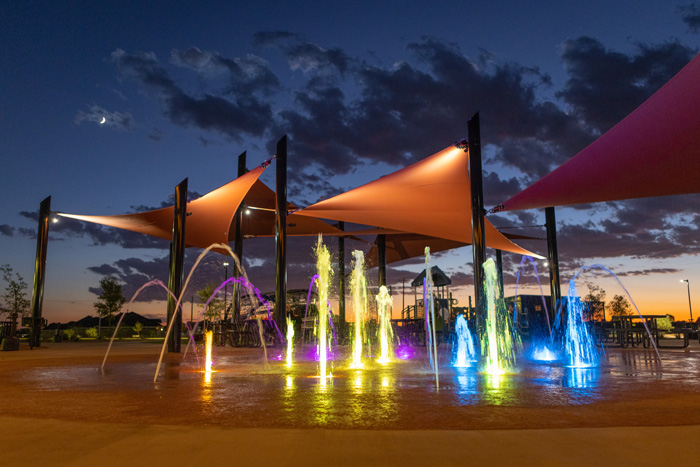
From cities with large parks and recreation facilities to rural towns with limited budgets for their playgrounds and parks, the advent of affordable splash play facilities can offer relief from the heat, and provide amusement and summer fun.
With record-breaking heat becoming more common—like Phoenix experiencing 100 degrees Fahrenheit or higher for 113 days last year—the demand for splash pads, interactive fountains and cooling stations has surged across the country, said Aaron Skogen, general manager at a Delano, Minn., water feature and spray park design, fabrication and construction company.
For that reason, among others, he said, “We are seeing a continued trend where pools are getting replaced by splash pads to reduce operational expenses and drowning risks while providing an aquatic amenity to people of all ages and abilities.
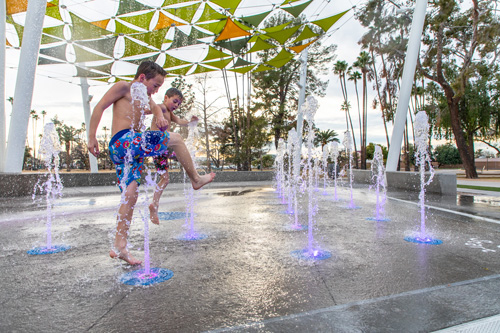
“Some splash play facilities are simple with ground sprays on the floor,” Skogen continued. Some get more involved with spray toys and dump buckets, while others are so large they feature play structures with waterslides, functioning almost as mini-waterparks. “Beyond this, in many existing aquatic facilities, splash pads are increasingly adding a new type of amenity to destinations like zoos, resorts and condo communities.”
These amenities can be essential. Urban areas can suffer from the heat island effect, where concrete and pavement amplify temperatures and limit access to natural cooling. Splash play offers an accessible way to cool down while engaging people of all ages in fun activities. Splash pads bring relief in the most inviting way possible. Whether it’s toddlers chasing gentle sprays, teens running through high-action features, or families gathering around interactive water tables, these spaces turn hot days into memorable shared experiences.
Spraygrounds can offer just as much benefit to parents as kids, said Wyeth Tracy, president of an Ontario, Canada-based pioneer in the splash play and waterpark equipment manufacturing business. “Parents can sit on the sidelines and watch the kids burn out that energy, and they don’t have to worry about deep water.
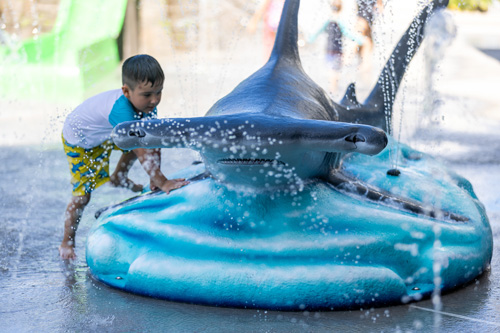
“In the old days,” he continued, “parents would have to be in the pool with their kids all the time. Now, kids play on the different features and will spend two … three … four hours in these areas.”
For amusement parks, hotels and resorts and waterparks, this might add an extra day to a family’s itinerary. “Kids are the ones with the pester power,” Tracy added. “Kids will pester their parents to take them to the place they like. A hotel might be a destination for them because it has that water playground. That’s important for people running these kinds of businesses.”
Something for Everyone, Everywhere
While splash play has become a key component in many larger parks and recreation spaces, “Yes, we also see splash play in smaller municipalities all of the time,” noted Kelsi Goss, vice president of design for a Minneapolis company that specializes in slip-resistant and engaging splash pad surfaces. “One of the benefits of having splash play and pads for these smaller communities is that they don’t need to staff lifeguards. And guests don’t need to know how to swim, which is especially helpful for younger or disabled guests and/or populations that don’t have easy access to swimming lessons.”
Goss added that aquatic playgrounds can be “fairly affordable to add in limited space, and they provide a great way to have fun beyond the more typical playground amenities.”
Cost Considerations
Indeed, beyond their play value, splash pads can be a smart investment. Compared to traditional municipal pools, they’re typically more affordable to install and maintain, while offering year after year of high-impact, low-barrier fun.
As stakeholders consider the financial viability of offering splash play, Katie Swanson, a communications manager and colleague of Aaron Skogen, pointed to the costs of “design, materials, maintenance and mechanical systems as elements to factor in. The size of your park and any custom elements will impact your overall price, given the increase in materials, design and manufacturing time.”
Material choice is important as well, she said. “Materials like stainless steel are extremely durable but are also a greater investment up front. Water supply source and type of recirculation system will impact cost, as these range significantly in complexity and design.”
Ensuring that your splash pad meets safety standards may add additional cost to the project, Swanson said.
Explore funding alternatives. Matching grants, for example, can help with the cost of designing and installing a water play park. Goss advises stakeholders to check for community development block grants (CDBG) that might be available.
Key Considerations
There are many reasons to consider installing splash play in public spaces, according to our experts in the field, from aesthetics to inclusion and beyond.
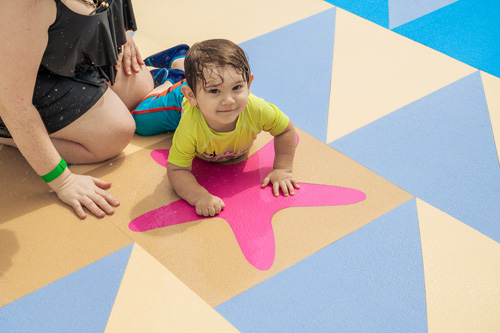
“Communities across the country are reimagining public spaces to be more inclusive, welcoming and engaging for everyone,” Skogen said. “Splash pads are leading the way; in fact, they’re the number one planned aquatic amenity today. Splash pads offer a truly inclusive play experience. People of all ages and abilities can participate without barriers created by deep water or complex entry points. And because splash pads are built at ground level, they naturally accommodate mobility devices, making it easy for everyone to join in the fun.”
Spray play also provides powerful sensory experiences, Skogen explained. “From the feel of water pressure to changes in temperature and flow, splash pads offer dynamic, multisensory engagement that’s especially meaningful for children with diverse needs. Plus, without standing water, there’s a significantly reduced risk of drowning, making them a safer option for communities.”
“When considering a splash pad,” Goss said, size, features and design are always top of mind for operators. “Some of the more thoughtfully creative ideas are inspired by the local community. For instance, our flooring has been installed on a car-themed splash pad in Detroit and a beach-themed splash pad along Florida’s coast. It’s always nice when facilities can add some level of customization through their selection of themed play toys, sculptural elements on their play structures, or intentionally designed flooring that can include graphics and logos. Some have even gone so far as to design movie characters into surfacing to create an immersive experience. On a simpler scale, an intentional color palette and more abstract geometric patterns can tie into a specific theme or the surrounding environment. We’ve seen neutral splash pad surfaces with tans and olive green be used in the desert and gradients of blue selected to create underwater designs.”
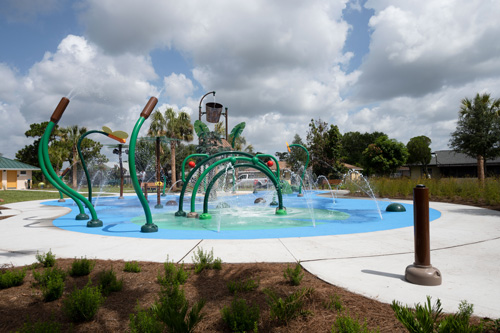
Once you’ve chosen to install a splash pad play area, one of the most critical decisions you’ll also need to make is selecting the right mechanical system. Ultimately, this choice impacts everything from budget and maintenance to water usage.
There are essentially two types of splash pad mechanical systems: recirculation and domestic systems, Skogen said.
Recirculation systems utilize a water reservoir to recycle water. These have advantages such as reduced water consumption and the ability to provide very high flow rates to the splash pad. On the other hand, they require daily maintenance and staff oversight, including managing water chemistry, backwashing filters, cleaning strainers and maintaining compliance with local health codes.
Domestic systems, Skogen noted, “use potable water and send it directly to the drain after use. These systems are more straightforward and cost-effective to install and operate, but typically use more water.”
Beyond the mechanical system, it’s important to consider site logistics. Location, environment, prevailing winds, utility access (water, waste and power), and nearby amenities like parking and restrooms will play a major role in how successful your splash pad project will be.
Interactive Play and Inclusion
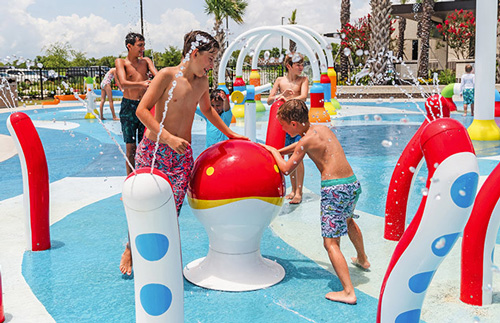
When splash play began, some 35-plus years ago, Tracy said, “there were merely mushroom umbrellas.” But now, he continued, “the play offerings are imaginative in scope. It can be a tipping bucket that kids get under and be excited when it’s going to tip over. It can be a small, low-level water feature that has a number of different nozzles that have no moving parts but is interactive, where kids can go there and put their fingers on these nozzles and make the other nozzles grow. Inevitably they will call their friends because they are running out of fingers until you have a bunch of kids working on that.”
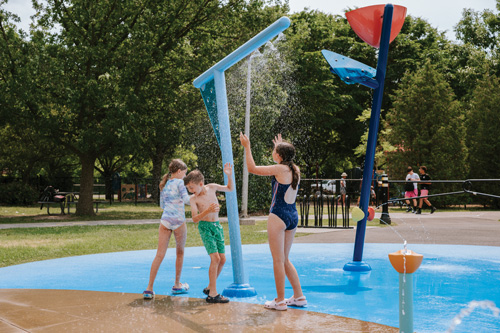
This is simple interactivity with no maintenance and no moving parts, Tracy continued. “Alternatively, you can have a little more sophisticated water cannon where you can crank the handles and make the water work. We also do water features where we put a hand wheel on it. Kids can turn the handles and make different water effects happen. They can make a wheel turn, a spinner spin. It’s all water-powered. So, we are empowering the kids and having them feel like they are making it all happen.”
It’s important to present water in different ways, providing a variety of physical sensations, Tracy said. “It is important that we present water in different ways, so that when the water hits the body there is always a different sensation: One might be a soft volume, others might be a spread-out spray. There are all kinds of ways to present water to the players.”
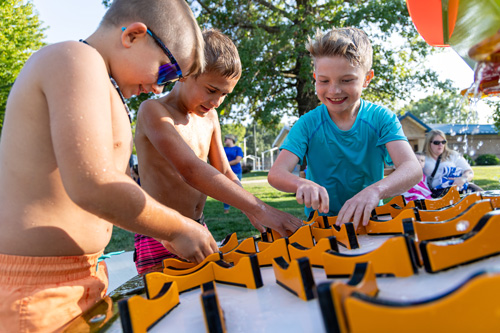
“Indeed, with splash play, there is a wide variety of features designed to engage the senses and encourage both individual and cooperative play,” Skogen said. “For example, in-ground manifolds can be configured so that stepping on one spray affects others nearby, creating cause-and-effect play that’s both surprising and fun. Above ground, there are features that allow kids to spin, rotate or redirect water flow. These hands-on experiences give users a sense of control and invite experimentation. Other structures incorporate gates, levers and windows that promote problem-solving and collaboration.”

Skogen described a water table station designed for group engagement. It allows kids to manipulate water paths and build their own play narratives, offering a blend of tactile and social play.
As far as inclusion, Tracy said, “you want to create an area where you can move around these features; where, if you are in a wheelchair or have a different handicap, you will still be close to these features and make things. Put in enough low-level features that everybody can use.”
Low-level, lighter-pressure features help accommodate all age groups by providing a way for the youngest visitors to ease into the water fun. “Start with ground jets and have low-level features for the really young tots, such as something eight inches high in the center (a dome),” Tracy said. “To a tot, crawling on that is a mountain. You’ll want products that are low-level, mid-level and then high-level. Even at the high level, parents will get in there and get a bucket splash. That is how you can deal with all the different age levels.
“When planning to equip your splash play space, look for everything for babies up to age 12,” Tracy added. “Once you get past 12, you have to start looking into waterslides for the teens. They want to have more exciting rides and slides.”
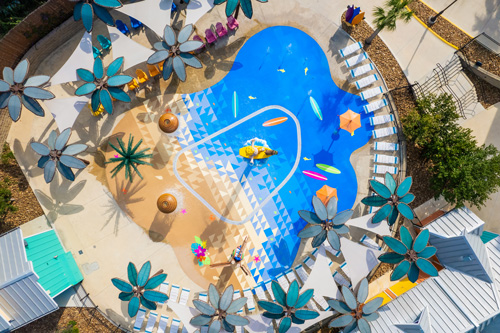
Ultimately, Tracy explained, “our approach to design focuses on layered play. It gives kids of all ages and abilities opportunities to play independently, side-by-side with a friend or collaboratively in a group. We want every splash pad to be a dynamic environment where users can graduate from simple interactions to more complex exploration over time. Our toys are designed onto a splash pad, depending on what people want. You can have different themes—there are so many: pirates, tropical, zoo animals, and cowboys. There is no limit on the themes you can do.”
Bringing People Together
Unlike traditional dry playgrounds, which are often segmented by specific age groups, splash play offers a unique opportunity to bring people of all ages and abilities together in one shared space, Skogen said. For example, “We approach inclusive design through intentional zoning, creating layers of experience that support developmental needs, sensory preferences and social interaction. We typically design splash pads using three core zones: the gentle zone, the universal zone, and the dynamic zone.”
The gentle zone may include delicate ground sprays and smaller structures with soft water formations ideal for toddlers and younger children, with easy access for caretakers. The universal zone may include products that dump, pour, shower or spin, intermixed with ground sprays. “This zone is also used as a transition between the gentle and dynamic zone,” Skogen said. “The dynamic zone is where the action ramps up. High-volume dumping buckets, ground sprays, climb and play features, and highly interactive products are included to target older kids, teens and even adults.”
By layering these zones and providing a range of sensory inputs, you can deliver an educational, exploratory design that encourages physical and social development, with the ability to grow confidence while engaging in the play elements.
Water Conservation
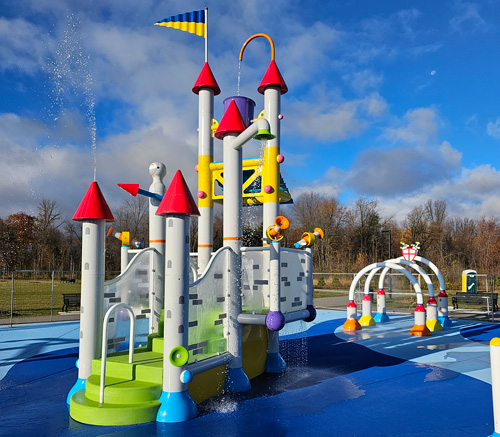
“If conserving water is on your to-do list, one of the most efficient solutions is a recirculation system, which treats and reuses the same water throughout the splash pad’s operation,” Skogen said. “This closed-loop approach significantly reduces overall water consumption over the course of a typical season, making it ideal for high-use or larger installations.
“That said, there are also smart conservation strategies available for domestic or pass-through systems, which use potable water and discharge it after use.”
Another effective method for conserving water is sequencing—a timed activation of different features in a rotating pattern. This not only reduces water flow at any one time, but also adds an exciting layer of interactivity, encouraging users to explore, move around the space and engage with a variety of water effects.
Skogen’s company offers a non-electric, mechanically operated solution designed specifically for water-conscious communities. “It is a domestic pass-through system that limits flow to just 60 gallons per minute. This system is ideal for smaller municipalities, pocket parks and urban cooling stations. And because it doesn’t require electricity or complex infrastructure, it’s a cost-effective option for projects looking to conserve resources without compromising on play value and safety.”
Surfaces and Safety
When splash pads first started gaining popularity in the 1990s, Goss said, the vast majority were surfaced solely with concrete and sometimes even tile. Of course, those are not the most forgiving surfaces when guests are running and playing in water.
While the most common surface for splash pads is a medium broom finished concrete, Skogen said, “… we do see many projects where the concrete is stained or colored to enhance its aesthetic. Concrete, when properly finished, provides a long-term, durable and easy-to-clean surface for your splash pad. Other products like a tile surfacing system are becoming more popular as well.”
“For a while,” Goss continued, “some facilities attempted to make splash pads safer with aggregate rubber pour-in-place products often used on playgrounds. Since those are primarily designed for dry applications, they generally don’t hold up well in aquatic environments.”
Ever since NSF created a safety surfacing standard recommending splash pad floors that provide cushioning, slip-resistance and durability, the market has been transformed. “Surfaces are safer and provide a more boundless play experience,” Goss said. “Colorful tiles and the ability to custom-cut designs, graphics and logos into the floor have added a new dimension of theming and fun to splash pads. Activities like hopscotch, checkers and mazes can even be included to expand play options.”
Softer, slip-resistant surfaces on splash pads are also key for creating inclusive environments, Goss explained. “The youngest of guests can comfortably crawl across them, guests who may feel uneasy on their feet can more confidently navigate and engage with aquatics, and multigenerational play is welcome as caretakers can sit or explore splash pads as well.
“We want to make them even more enjoyable for all families who visit those inclusive locations.” RM