

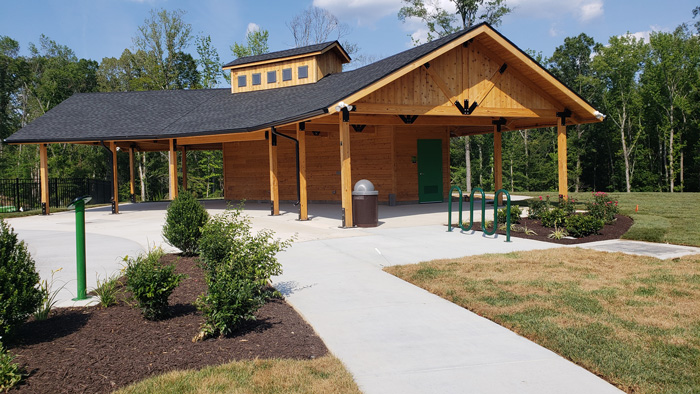
There are many features, amenities and programming options that attract visitors to parks and other public gathering spaces, from playgrounds, picnic areas, splashpads and bike trails to concerts and softball games. And while restrooms aren’t the most talked-about amenity, they’re certainly one of the most important when it comes to visitor satisfaction and length-of-stay times, and these offerings can’t be overlooked by overseers of these spaces.
Kyle Earlywine, co-owner of a Washougal, Wash.-based manufacturer of prefabricated restroom structures, believes that prefab options are great in general “because you can go from undisturbed ground to a functioning restroom building in days instead of months. Setting the restroom typically only takes a few hours.”
And there’s no limit to the materials, finishes and fixtures available with prefab buildings, he said, “although some finishes are better applied on site if there’s a likelihood of being damaged during shipment or if there are locally sourced materials the customer wants to use.”
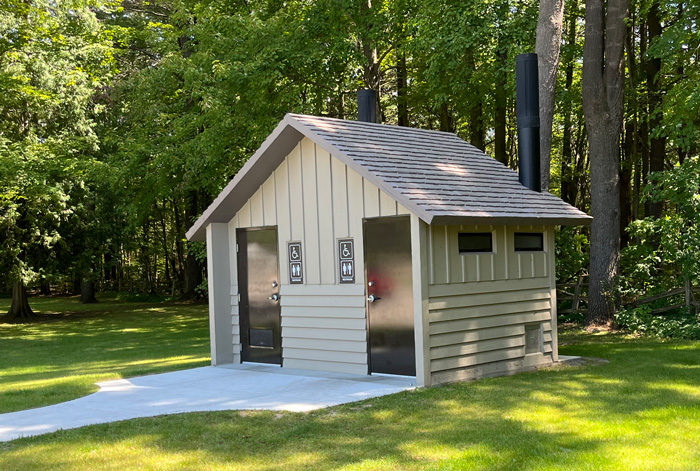
“In terms of building aesthetics, we’re seeing many customers upgrade their exterior finish selections to wood lap siding, stucco-like finishes or corrugated metal to match and blend in with the surrounding architecture,” said Kristyn Young, director of marketing and planning for a Minden, Nevada-headquartered designer and manufacturer of prefabricated restroom structures. A simple change to the exterior can elevate the building’s look, according to Young, making it “feel more modernized, while keeping the interior more traditional.”
And she said another noticeable shift is requesting a shed-style roof over a traditional gable roof. “This style change has been increasing in popularity year after year.”
Gregg Zentarsky, sales manager for a manufacturer of precast concrete restrooms based in Spokane Valley, Wash., said that multiple wall textures and a variety of colors are available to match or complement existing structures, as “many want to keep a consistent aesthetic throughout the park,” or an entire park system. “Although most buildings our customers (purchase) are based off of standard designs, we do a fair amount of custom designs to meet their needs for specific buildings.”
Dan Apple, David Worthington, and Bryce Sterling are all licensees of a Midland, Va.-based manufacturer of precast concrete restroom buildings. Sterling pointed out that architectural precast concrete is very versatile, providing “maximum flexibility for finishes, textures and colors.”
Apple said buildings are typically designed to blend in with the surroundings, and exterior finishes and colors are “discussed with the customer, which will aid in that process. With form liners we can emulate many finishes, from brick to stone to wood—even vinyl siding.”
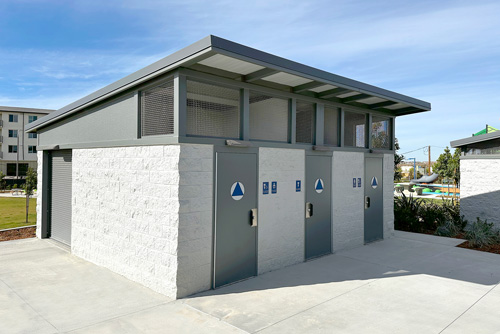
Added Worthington, “For an additional cost, customers can select the application of various cultured stone to the pre-assembled modules,” or have it applied on site.
Sterling said that while they have a portfolio of predesigned buildings, every project is approached as a custom-designed and -manufactured building. Apple explained that in about 30% of their builds, standard plans are modified to accommodate a customer request. “For example, we’ve modified a four-room restroom into three restrooms and one storage room. We’ve converted some into showers as well, or maybe a family room that allows some privacy.” And Worthington said that while each project is custom, “certain limitations such as overall transportable size and weight limitations must be considered.”
Single and dual ADA restroom buildings are delivered pre-assembled, pre-plumbed and pre-wired, and can generally be operational within hours of delivery. “There’s typically one water line, one waste line and one electrical connection to be completed by the purchaser,” said Apple.
Larger restrooms may be shipped in multiple modules, according to Sterling, “but they also arrive fully outfitted with plumbing, electrical and fixtures. We’ll perform the installation of the building onsite.” Customers are typically responsible for building foundation preparation.
Hannah Duncan is marketing and communications director for a Roseburg, Ore.-based company that designs, manufactures and supplies park buildings, including restrooms, providing building plan sets and specifications for customers. “Many customers choose to hire a local contractor for the construction, but (we) also offer construction services for customers who are seeking a turnkey solution.”
She said it’s very common to do custom designs, as “public parks are a community focal point and gathering place. There are many ways to customize the buildings on these sites to reflect the personality of the area.”
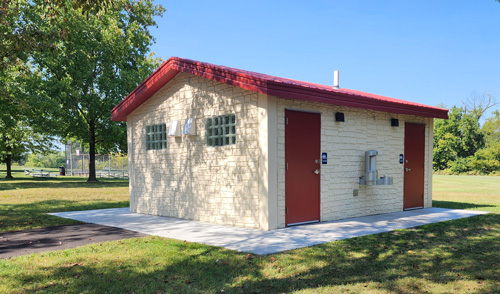
And as different areas have different code requirements and regulations, Duncan said they work in all 50 states to help customers navigate this and have “gotten plans approved from LA County in California to Chesterfield County in Virginia. Our engineers will make sure that the plan set meets local building codes for their jurisdiction.”
And for some, adding more sustainable buildings with renewable energy implementation is a focus. “Some customers are interested in saving power and water with specific building products. Others may be interested in something more complex, like a green living roof.”
Earlywine’s company has a focus on eco-friendliness, and he said there are some environmental advantages to modular construction, such as less site disturbance and material waste. And he listed some other “eco advantages” they offer, including toilets and urinals that are more water-efficient; restrooms powered by solar, even when things like hand dryers and water heaters are required; the ability to collect and use rainwater; and he said their flush vault systems require minimal ground disturbance. Additionally, he said they can offer features such as circular sanitation for greywater. “This could be enormously beneficial for areas that need showers but don’t have access to potable water.”
For their flush-vault restrooms, Earlywine said they take a regular flush restroom building and add a vault underneath that holds the sewage and provides the water needed to flush the toilet. “In the mechanical room we have pumps that bring water to the fixtures and a hatch that provides vault access to the pump truck.” Additionally, using one-quart toilets, waterless urinals and low-flow faucets, water usage can be greatly reduced. Used sink water can be filtered and reused for flushing. Power options include grid, solar or battery. “Customers are using these in cold climates and operating them year-round when they can add heat to the building,” using either grid power or propane, added Earlywine.
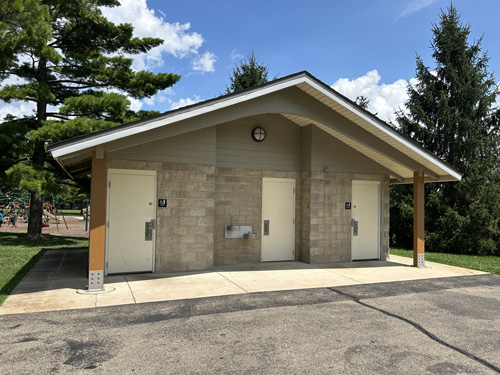
“The vast majority of restroom buildings throughout the U.S. are waterless,” said Zentarsky.
Added Duncan, “They’re a great fit for areas without plumbing or electricity that still need the services of a restroom.” And she stressed the importance of ventilation technology to make these structures work. “The key is to place waterless restrooms in a site that’s exposed to the sun. The heat will pull the air up through the pipe and out of the building. Sufficient airflow will keep the restroom smelling ‘sweet.’”
Sterling said their dry restrooms also use “wind and sun to vent the restroom’s air.”
As far as maintenance, Zentarsky said cleaning is simple with precast concrete restrooms. “Simply remove amenities like toilet paper then hose the facility out using soapy water or disinfectant solution on the walls, riser and floor.”
Apple agreed: “With the entire structure made of concrete there’s nothing to rot, nothing to weather and nothing to degrade in the sun. There are anti-graffiti coatings that can be applied over the concrete stain, but they need to be reapplied after you pressure-wash off any vandalism. We’ve found that just re-staining over any vandalism is a more economical solution for most customers.”
Added Worthington, “Penal-grade stainless steel toilets and water fountains are an available option for owners in high-vandalism areas.”
Earlywine described a “continuing trend” where buyers or potential buyers don’t think vandal resistance goes far enough in protecting the restroom from abuse. “We hear so many stories of restrooms being closed down because cities are tired of dealing with the problems.” He explained that companies have responded with innovations aimed at discouraging people from misusing restrooms, and described their innovation made entirely of steel and aluminum, which “can even come with a bullet-resistant window that allows people outside… to see inside. A privacy partition inside the restroom provides just enough privacy for people using the toilet. Criminal or inappropriate behavior inside the restroom would be visible from the outside.”
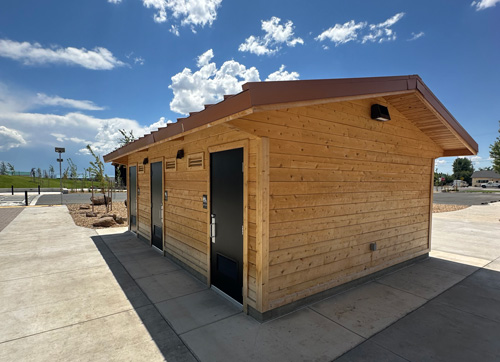
He added that the offering is an “extremely water-efficient flush restroom that will be pumped out by a pump truck after thousands of uses. It’s also moveable with a forklift, making it easy to set and relocate in a park, parking lot or on a wide sidewalk.”
Duncan’s company offers a prefabricated, heavily ventilated, plumbed sidewalk restroom designed to encourage fast use and discourage misuse. “These buildings are increasing in popularity, and they feature many vandal-proof elements,” Duncan said. “The buildings are made entirely of mild steel, with all-steel fixtures and occupancy lights.”
In Illinois, the Fox Valley Park District maintains 172 parks in three communities, including Aurora, Illinois’ second largest city by population. Jerad Campbell is director of operations at FVPD, and he described vandalism as a “sad situation. Toilet rooms are a daily and weekly recipient of vandalism, misuse and abuse. A significant amount of staff time and resources are required to combat this, and ultimately, it’s our residents and guests who suffer/experience the impacts of vandalism. Our committed staff remain focused and report, document and address as items arise.”
As far as basic restroom maintenance, Campbell said that “multiple crews visit each location on a schedule, which includes disinfection, cleaning, stocking, pressure washing, general maintenance and so on. Each location has water and cleaning supplies, and we also have a hot water pressure washer that gets deployed to locations to aid in the deep cleaning and efficiency.”
Campbell said most of their restrooms have been built on site to match the specific topography, location and site conditions of the individual park or property. And while staff have constructed some structures over the years, most construction has been via third-party contractors recently. “For newer installations or construction, everything would be conducted through a sealed bid/public bid opening process, typically as part of a greater overall park renovation.” He added that they’ve recently purchased two waterless vault units but have yet to deploy them.
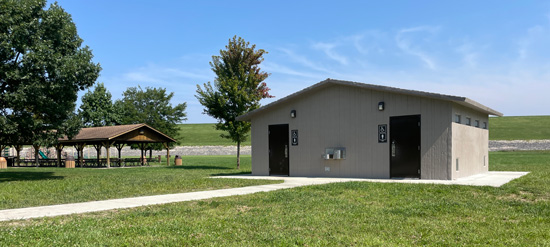
Aesthetics are a huge consideration, according to Campbell, as some restrooms sit in neighborhoods or community parks, as well as regional locations. “We must be sensitive to our neighbors and ideally would like the… structures to blend in with the feel of each specific park” and offer a “less institutional” appearance. “Focusing solely on aesthetics generally means you need to reduce/sacrifice durability and increase maintenance intervals and considerations, so it’s important for us to try to achieve a middle ground when possible. For example, a CMU block structure is far more durable than something with cedar or siding, but the appearance of each has its place.”
He said that while they strive for continuity, each site does vary in fixtures and design. “We utilize stainless-steel mirrors, commercial-grade sinks, lavs, urinals, toilets, etc. Durable doors, light fixtures, hand dryers, etc. Low-flow where we can, touchless in many applications,” though he said these are not without their issues.
The district also has an annual contract for porta-potties, “which ranges across 30 to 50 sites depending on time of season, what athletics are currently happening, special events and so on.” They also own a restroom trailer that permanently resides at a popular regional destination. “It has water and sewer hookups, but in theory could be a traveling roadshow if it ever needed to be.”
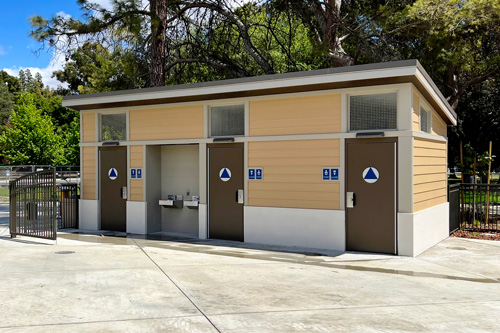
Campbell said they also strive to meet or exceed ADA compliance. “New builds receive ADA standards integrated at construction. Old sites we try to bring into compliance. We currently have an ADA transition plan that drives the improvement and priority repairs to keep things in compliance.”
Regarding restroom layout in recent years, Young said there has been a shift to select floor plans with single-occupant structures as compared to multi-occupancy, helping restrooms become more inclusive by offering private and gender-neutral spaces. If multi-occupant plans are a better fit, “it’s very common for customers to add on a private family restroom to the building,” helping to meet everyone’s needs with a private, secure, single-occupant restroom. “For interior fixtures, we’ve seen an increase in… adult changing stations, especially at parks embracing accessibility and inclusivity.”
Earlywine said there are dozens of ways restrooms can be more accessible and believes ADA and even state standards that exceed ADA don’t go far enough to accommodate everyone. “I’m not aware of any standards in the U.S. that require powered door openers for restrooms or adult-sized changing tables, let alone the adjustable-height tables that may be necessary for some.” He doesn’t sense that increasing accessibility is a priority, even where the cost might be more justifiable, “such as a nice area that’s wheelchair friendly.
“Folks should consider the restroom when (labeling) a recreational space—such as a playground—as inclusive,” Earlywine continued. “People with disabilities also need restrooms, arguably more so because heading home or a few blocks to another restroom isn’t as fast or easy. If the restroom isn’t suitable for them, they may not stay as long as they’d like or may not come at all.”
As far as added features, extra storage is common. “It’s been mentioned to me by repeat customers that because these buildings are so secure, they utilize part of the chase for secure storage in parks, etc.,” said Apple. “Some of the larger buildings are being modified particularly to dedicate square footage to storage.”
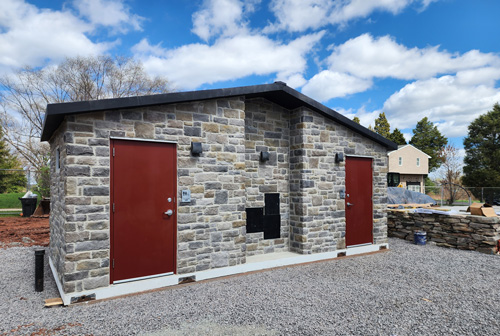
Added Duncan, “For longevity purposes, it’s a really good idea to, at a minimum, have a storage space that houses the plumbing instead of hiding (it) in the walls. If the customer wants to store more than a mop and supplies in that space, they may choose to make it larger.”
Young said their modular construction enables them to make multifunctional spaces, and additional storage is the most requested add-on. One reason is “since restrooms are commonly located at parks and public areas, lawn mowers, larger equipment and supplies can easily be stored on site. To make it even better, we often include a garage door to allow easy access for vehicle storage too.”
Zentarsky said they’ve seen a dramatic increase in adding restroom/concession buildings to new or existing sports fields that “draw large groups of people who might want food while watching but aren’t near a public building.”
Apple echoed this and said, “our buildings are designed so that the serving area is separated from the restroom for sanitary reasons.”
“Adding concessions space to restrooms is a great use of space and funding,” said Duncan. “Customers will save money by combining their public structures into a single building. In addition, an increase in splash pads and waterparks have formed a new demand for shower buildings with locker space, concessions, ticketing windows and chemical storage.”
Added Zentarsky, “Shower buildings are pretty common. Typically they’re located in campgrounds, at parks on a lake or other water, and more frequently at spray and dog parks.”
Earlywine said that while many customers want their restroom structures to blend in with the surroundings—often because the restroom’s appearance is not a priority—other customers see the restroom as an “opportunity to add beauty to their park. The restroom might be the only structure in sight, so it might be the most practical option for adding a pleasant architectural piece to the landscape.” RM