


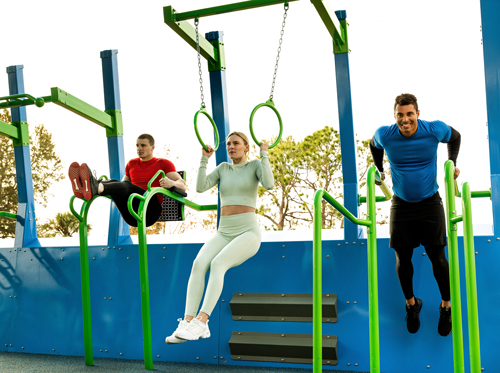
Whether it’s children, teens, adults or seniors, being physically active provides an array of benefits for body, mind and spirit. And while some people naturally gravitate toward physical fitness, including it in their regular routines, many others benefit from getting that extra little nudge. Fortunately, many park, recreation and fitness leaders are encouraging their community members to get healthy levels of physical activity through programming opportunities and amenities like playgrounds, outdoor gyms and fitness trails.
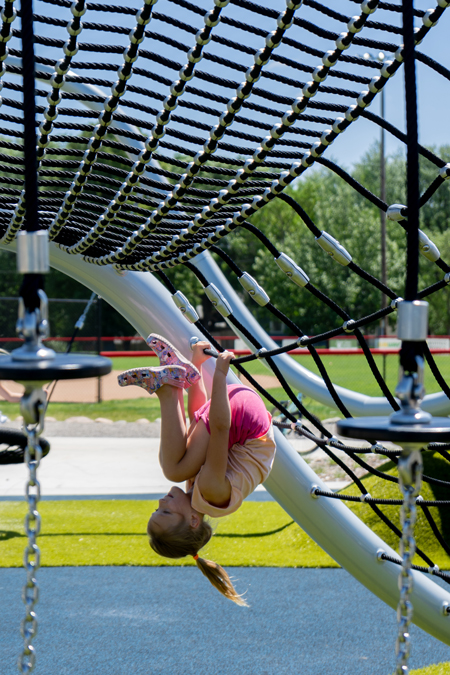
Anne-Marie Spencer is corporate vice president of marketing for a Chattanooga, Tenn.-headquartered company that oversees a portfolio of brands providing products and services to the play and recreation industries. They’re also committed to outreach, research and education, and Spencer mentioned their Adult Fitness National Demonstration Site program as an example. “We help customers design evidence-based fitness spaces, then are able to provide data reports that highlight important factors like number of users, length of visit, whether they plan to repeat their sessions, level of activity they reached, demographic breakdown, reasons for visiting and more.”
Spencer said they can even provide health estimations to show how much the community may save in physical and meta health care costs by the usage of rec and fitness spaces. “This helps parks departments show the validity in advancing health, which can potentially lead to increased budgets and the elevation of these spaces as valid resources to promote community wellness.”
As far as youth, Spencer discussed their Play On! program, featuring “125 standards-based activities that can be done on the playground,” and park programmers or teachers can lead active sessions with a number of children at the same time. She discussed a research study evaluating the program, where teachers noted that during the sessions, all students were active simultaneously as opposed to waiting for a turn, and “even children who didn’t enjoy typical physical education loved (the program) because play is perceived as fun rather than exercise.”
Each session includes a warm-up, the main session, and a wrap up, Spencer explained. “The program also includes send-home guides in English and Spanish to inform families about the program, note the importance of continuing healthy behaviors at home, and provide an introduction to encourage families to participate in shared activities on evenings and during weekends.” She added that they love to build school playgrounds that can be used for PE as well, as it “maximizes the school’s investment and helps make physical exercise more fun.”
Sarah Lisiecki is the communications and education manager for a manufacturer of playground, recreation and fitness products based in Fond du Lac, Wis. She said that as schools face reduced PE and sports programming, outdoor fitness areas can serva as creative, budget-friendly ways to support student wellness. “These spaces promote physical activity during recess, before and after school and even during class time through movement breaks or brain boosts.
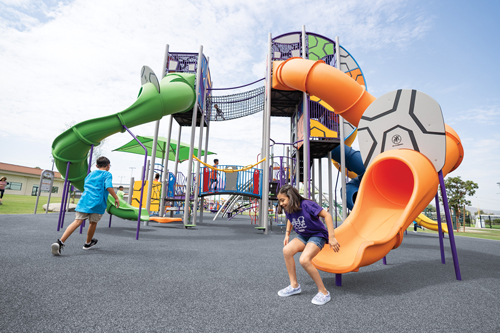
“We’re also seeing more school/community partnerships where these fitness areas serve dual purposes—for students during the day and the public during evenings and weekends,” she continued. “It’s a smart way to maximize impact and create equitable access to fitness for all. A well-designed outdoor fitness space is a long-term investment in community health and engagement.”
Allison Abel is director of marketing for an Anaheim, Calif.-based provider of outdoor fitness equipment. She said that adding this equipment to school campuses can go a long way toward improving teen’s health and habits. “Youth age out of playgrounds by the age of 12, leaving them with few outlets for their desire to play. Schools leveraging amenities like ninja courses and obstacle courses make exercise fun and less intimidating, better engaging students who wouldn’t be as enticed to get moving through traditional sports.”
She agreed that making exercise feel like play allows students to build healthy habits they may carry forward. “Even if schools decide to go a more traditional route with outdoor fitness equipment that more closely aligns with units found in indoor gyms, this still sets the tone for healthier futures by giving graduates confidence as they walk into the gym in the future, as they’ll be familiar with similar exercises.”
YMCAs serve a critical service by providing fitness opportunities for anyone, including those in underserved communities who might not have access to safe parks, trails or playgrounds. “In many of our communities across the country based in larger cities or urban centers, the Ys serve as the hub for fitness opportunities,” said Jennifer Gilburg, director of health and wellness strategy at YMCA of the USA. “From youth-focused Fit Zones to fitness classes for our healthy agers, the Y provides fitness programs and services that support people at every stage of their wellness journey.”
Meredith Griffin is director of sports and competitive events strategy at YMCA of the USA, and she said that while individual and hybrid sports (individuals compete in events as part of a team) are popular, “the Y is well known for team sports and the community they create for both children and adults.” She said the Y is a great place for “sport sampling,” where children can learn and play different sports across different seasons of the year. And recently, they’re seeing “more and more adults coming to play sports together and enjoy community.”
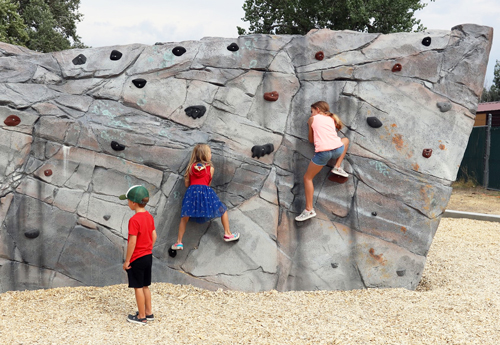
Adult team sports include basketball, soccer, hockey, tennis and pickleball. Youth sports include flag football, volleyball, soccer and basketball. And in addition to local Y leagues, the Y provides opportunities to compete at state, regional and national events. And there are outdoor activities such as cycling, hiking, running, wall climbing, racquetball and swimming, including instruction and group trips.
There are also efforts at the Y to increase adaptive sports programs, according to Griffin, to include even more people. “It’s been a recent focus among Y sports leaders across the U.S., with many of them partnering with organizations like Move United and Miracle League, to provide more adaptive sports opportunities in their local communities.”
Other specialized programs aim to get more people moving as well, including a partnership with the LIVESTRONG Foundation, a physical activity-based cancer survivorship program. “This small group program takes place in a supportive environment and focuses on building strength through physical activity and social opportunities, strengthening both mind and body,” said Mamta Gahkar, director of chronic disease and healthy aging strategy at YMCA of the USA. She also mentioned the Healthy Weight and your Child program, to “address childhood obesity through education around healthy eating and access to physical activity for both children and the adults in their home supporting them.”
For seniors, “Most Ys offer both land- and aquatics-based fitness classes for healthy agers,” said Gilburg. “These classes are focused on maintaining and increasing mobility, falls prevention, arthritis management, prolonging independent living, and increasing flexibility and strength to support everyday activities.”
And while most Ys offer both individual and small group personal training opportunities, Gilburg said group fitness offerings are most popular. “People are hardwired to connect, and participating in group-based fitness offerings provides individuals with the opportunity to engage in a shared experience.” Group exercise classes include cardio, strength, cycle, dance, yoga classes and more, and Gilburg said the offerings are “seeing great successes.”
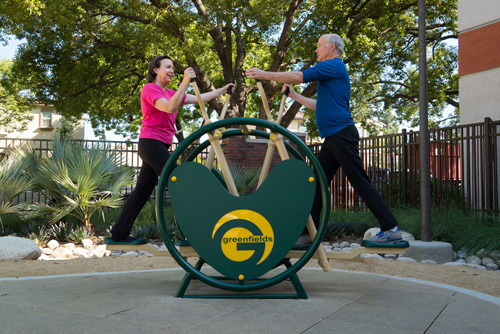
In fact, parks, recreation and fitness organizations oftentimes seize on the mindset of socialization when trying to get their community members active. “Just about every activity seems more approachable when you have a loved one to do it with, (and) outdoor fitness is no different,” said Abel. And whether working out with a friend or someone they just met, she said that having fitness equipment that fosters interaction often makes exercise more fun for visitors, “encouraging them to work out longer and more consistently.” And she pointed out that social interaction “comes with a long list of mental and physical health benefits.”
Abel said the majority of their projects are unique, as they want to design outdoor fitness zones that meet the specific needs of a community. “This includes selecting units that will be the most appealing to the neighboring community and laying them out in a way that encourages interaction between people of diverse abilities.”
And while regular visitors utilize outdoor fitness zones for personal workouts, “some of the most frequently used fresh-air gyms are the ones with consistent groups or classes that meet together to use the equipment,” according to Abel. “Additionally, we make our equipment more inviting to those who are new to their fitness journeys by providing instructional videos that can be accessed through our app or by scanning a QR code label included on each unit.”
Spencer said they also “collaborate on priorities for each community,” as they can be very different, from traditional workout-based opportunities to family-friendly fitness options. “We’ve seen a lot of interest in obstacle courses; we designed ours using evidence-based practices to ensure there are a variety of ways to master each obstacle, and you don’t have to be a super athlete to use the equipment.” She said this way, people can complete the course in a way that feels fun and achievable for them, “as well as learn new techniques from other people who may approach it differently.
“We can even create timed 40-yard dash runs with two lanes and timers,” Spencer continued, which can lead to “new friendships made amongst participants. They are truly intergenerational; it’s not uncommon to see parents and children competing together, and that’s really exciting and rewarding to observe.”
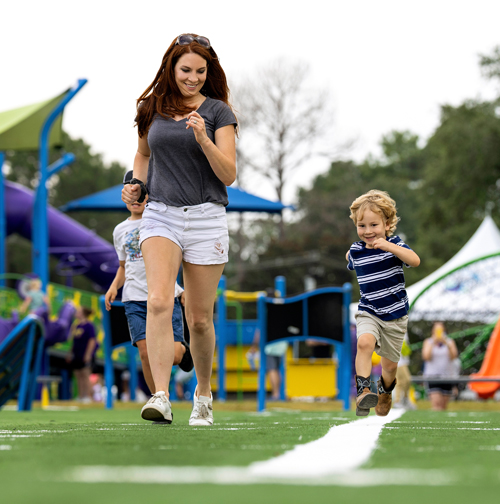
“We work closely with customers from parks and recreation, schools, municipalities and other organizations to create spaces that go beyond traditional play and promote whole-child development, including physical activity and physical literacy,” said Lisiecki. She explained that movement is foundational to a child’s growth and long-term health, and developing physical literacy—“the motivation, confidence and competence to move”—is key to building lifelong healthy habits.
“Fitness playgrounds are intentionally designed to merge play and fun with physical challenge,” Lisiecki said. And in addition to climbers and motion play, her company offers a fitness circuit designed for those 13 and older, and a fitness course, with versions for ages 5 to 12 and 13-plus, helping users build strength, coordination and endurance. She said these amenities appeal to teens and adults as well as kids, and pointed out that in the U.S., “approximately one in five adolescents have obesity, with the prevalence increasing with age.”
She said they’ve seen growing interest in multigenerational fitness solutions, as outdoor fitness is “inclusive, approachable and accessible. We also hear from communities who are incorporating this equipment into group fitness programming, school PE extensions, wellness initiatives and park-led challenges. It creates a welcoming and versatile space for everything from high-intensity workouts to light movement, all without the barriers of a gym setting and with the added bonus of time outdoors in community.”
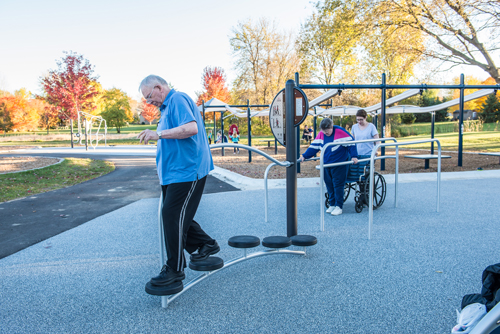
“The selection of units depends largely on the community members that project planners are trying to engage, but will nearly always encourage a multigenerational experience,” said Abel. For instance, she said their ninja-style courses cater more to teens while their low-impact series is ideal for seniors. The “calisthenics rigs” can be used by any fitness levels but tend to attract more experienced users. And their adjustable resistance units allow visitors to select their intensity level and are “great companions to playgrounds so that parents and siblings can work out while young ones play nearby.
“Wheelchair-accessible units enable people with mobility impairments to exercise alongside their able-bodied friends without requiring them to transfer from their chair,” continued Abel. “Further, many of our units facilitate multiple users at one time, and some even face toward one another to encourage social interaction.” She also recommended installing shade over fitness zones, and providing “other site amenities such as trash receptacles and bike racks provide further convenience to users. Put them all together and you can create a holistic fitness destination with a great potential to enhance the health of the community.”
In the Chicago suburb of St. Charles, Ill., Pottawatomie Park features an outdoor gym—adjacent to an inclusive playground—with equipment focused on cardio and strength conditioning. Some machines are wheelchair accessible. Other opportunities for fitness in the park include a softball field hosting local leagues, tennis and pickleball courts, a nine-hole golf course, outdoor swimming pool, sand volleyball court, kayak and pedal boat rentals along the Fox River, a second playground including a large fort for climbing on, and plenty of open space for frisbee, soccer or tossing a football.
The park’s outdoor gym sits along a trail—which is connected to other trail systems in town—making the equipment a popular stop for trail users. “Whenever the spirit moves you to go running or walking, it’s easy to find a trail in a park or natural area in St. Charles,” said Erika Young, public relations and marketing manager for the park district. “Many parks feature signs that indicate walking loops so you can track your steps. For those who’d rather not walk alone, (there’s) a free walking club on the second and fourth Thursdays of the month,” held in varying locations. “Or grab a bike and pedal along the trails. In winter, these same trails are perfect for cross-country skiing and snowshoeing,” with snowshoe rentals available.
The park district also oversees a recreation center, community center and sportsplex, offering myriad fitness opportunities including kids’ and adults’ sports, rowing, indoor walking, aquatics, and many health and fitness programs from aerobics to Zumba. “Not only are trails, paths and open-play areas ready whenever you are, park district programs are conveniently offered during mornings, afternoons and evenings to accommodate even the most demanding schedules,” said Young.
Additionally, St. Charles has recently started designating certain interconnected streets as bike routes, painting arrows and symbols, and alerting motorists.
Spencer explained that bike infrastructure is “only as good as its connectivity, and there needs to be planning to ensure it makes sense.” She said they’ve created a resource called Shift into Gear, which includes case studies from 15 different perspectives, helping stakeholders plan and design interconnected networks, “turning advocacy into action.” Additionally, “we help communities add bike-friendly amenities like bike parking, shelters, repair stations, lockers, even delineators and wheel stops for on-street applications.”
St. Charles also has a skatepark, disc golf course, ice skating rinks and three dog parks, which Spencer said are “great places to get exercise, with dogs as the catalyst. Where agility-based equipment is included, owners run alongside their dogs, instructing on technique.” She said they’re also “super social” and a catalyst for activity beyond the dog park. “I’ve seen dog parents make plans to meet up and walk their dogs outside of the park or plan dog play dates.”
Spencer said that swimming and water exercise also deserve attention, offering many benefits: “It’s easy on the joints, water resistance provides great muscle development opportunities, it can increase aerobic activity and is a great all-around exercise that serves people of all ages and abilities.”
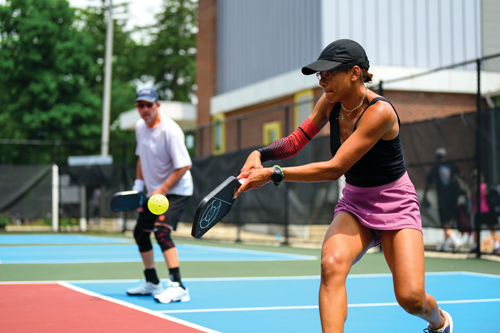
Lisiecki’s company offers sports equipment, and she pointed out that both traditional and non-traditional sports elements are strong drivers of physical activity and community. “We’re seeing parks and schools continue to add basketball hoops, soccer goals, volleyball courts, pickleball and more because these offer instant, familiar ways for people to get moving.
“At the same time, games like Gaga ball, cornhole and P6Ball are surging in popularity because they’re easy to learn, inclusive and a lot of fun,” continued Lisiecki. “They offer movement and social interaction without requiring formal teams or leagues—though they can—making them ideal for anyone who may not gravitate toward traditional sports. These types of activities help communities reach more people, create space for casual physical activity and build environments that welcome everyone.” RM