


The arrow is pointing up for natural and synthetic fields use worldwide, fueled by increased sports participation and sports tourism and technological advancements in both materials and turf management, according to data and anecdotes.
According to the “Natural Turf Market Size & Insights Report,” the global natural turf market is projected to grow from $3.19 billion in 2025 to $4.34 billion by 2034, at a compound annual growth rate (CAGR) of about 3.5%.
“Natural turf will continue to evolve through advancements in resource conservation and infrastructure support systems,” said Rich Arave, a senior project manager at Stantec who helps clients with sportsturf decisions and design.
“Innovations such as smart irrigation technologies, drought-resistant grass varieties and eco-friendly maintenance practices are becoming standard. These improvements aim to reduce water usage, minimize chemical inputs and enhance turf resilience, making natural grass a more sustainable option for sports facilities.”
Arave said the outlook for synthetic turf is even brighter, driven by the trend of converting natural fields to synthetic surfaces for durability and year-round usability. The global synthetic turf market was valued at $8.3 billion in 2023 and is expected to reach $13.1 billion by 2032, growing at a CAGR of 5.2%, according to the “Natural Turf Market Size & Insights Report.”
The expected boost is due to increased participation in youth and select-level sports leading to sports complexes investing in multi-sport synthetic fields. Technological improvements addressing heat retention and enhancing player safety help reduce traditional fears of synthetic turf, Arave said.
“The future of sports turf management will be shaped by performance, sustainability and economics,” said Arave. “Synthetic turf will dominate high-use, multi-sport venues, while natural turf will remain relevant for premium competition fields and eco-conscious projects. Both sectors will benefit from innovations that reduce resource consumption and improve playability.”
Rick Krysztof is vice president and general manager of a firm that sells and installs synthetic turf. He’s seen those improvements up close over 23 years in the business. “During this timespan, it went from a luxury to have an artificial turf field in most cases to a must-have for most schools, colleges, private facilities and even many parks and recreation departments,” he said.
“Now the question is not installing a field. It’s ‘Do we move forward with adding a second and third?’ Especially for baseball, softball, lacrosse applications that need to start very early in spring in climates where winter weather is lingering.”
Krysztof said organizations that are mulling over the decision to install synthetic turf fields should consider usage frequency. The more fields that are needed to satisfy school and community demand, the more synthetic fields make sense, he said.
The demand for play at all ages has steadily increased year over year, he said, as football, soccer, field hockey, lacrosse and rugby are being joined in some states by varsity girls’ flag football. A typical high school will have varsity, JV and modified teams for most sports for both boys and girls in addition to gym classes and other rentals for tournaments.
“Are you currently limiting hours of use, rentals and applying additional restrictions due to your primary field being natural?” said Krysztof. “If so, you should look hard at a synthetic turf field.”
He emphasized that the choice isn’t either natural or synthetic. He believes having at least one quality artificial turf field helps keep natural grass fields in playing condition. When the weather is bad, the natural turf fields can get a break by increased use of artificial fields, allowing proper maintenance and recovery time for the grass fields.
“The best overall facilities have a combination of grass and an artificial field when space allows,” Krysztof said. “It really comes down to hours of use combined with your staff’s ability to maintain a grass field relevant to the climate where the field is located.”
Krysztof tells potential clients who are concerned about the safety of synthetic fields that the goal of the synthetic turf industry is to install fields on par with the nicest natural grass fields in the world and are testing accordingly by respected, certified independent laboratories. Some examples of the tests performed include vertical deformation, rotational resistance, shock attenuation, and others to make sure the system falls within established safety zones.
“If you are installing a system with a proven track record and testing behind it, your athletes will have a very safe field,” he said.
Arave said choosing the right field type involves more than just cost. While financial ability was once the main factor, today’s considerations also include annual usable hours, the level of play, sport-specific preferences, and whether the sport’s season aligns with natural grass growth cycles.
Natural turf can be a cost-effective option or a premium solution depending on design and maintenance, said Arave. Basic natural turf fields with native soils have the lowest construction cost but are highly affected by weather and require downtime for drainage and recovery. Enhancements like sand bases and subgrade drainage improve playability but add complexity, including the need for irrigation. Seasonal dormancy and turf recovery time also limit availability. High-performance natural turf fields demand skilled grounds crews and consistent care, making them best suited for competition or limited-use fields, he said.
“Synthetic turf has a higher upfront cost but offers consistent playability and increased usable hours,” Arave said. “It can be used shortly after rain and supports year-round play, making it ideal for high-demand programs. Maintenance is still required, but less than natural turf.
“Heat retention from infill materials has been a concern, but manufacturers now offer cooler alternatives. Synthetic turf is especially beneficial for leagues with frequent practices and tournaments, while lighter-use programs may find natural turf sufficient.
“The decision depends on your organization’s goals, budget and usage patterns,” said Arave. For occasional games and practices, natural turf may work well. For heavy schedules and multi-sport use, synthetic turf often provides better long-term value.
Krysztof said once a client decides to install a synthetic field, he advises choosing a system that meets the facility’s unique needs for safety, playability and durability based on the sports the field will be used for. This includes specific fiber types, heights, face weights, infill type and mix ratios, possibly adding a shock pad and other factors.
Once all the system details are worked out, a well-thought-out striping plan is critical, he said. “You want to make sure the striping, colors and exact dimensions are dialed in to the specific needs of that particular field,” said Krysztof. “If you think you may add another sport in the future, I usually recommend considering adding it permanently at the time of install because it’s a lot harder and more expensive to do it after the fact. Of course it can be painted, but there is a lot of time, effort and cost to doing that as well. It usually eclipses what the cost would have been to install the lines permanently in only a couple of seasons.”
Maintenance of synthetic fields is another factor clients need to consider, said Krysztof. He said there is about five hours of maintenance per month that typically includes the following:
- Picking up/blowing off debris as needed.
- Filling hot spots with infill, which vary by sport. “The most common example would be filling the crease areas for lacrosse where the goalies kick the fill out in a very concentrated area. You would ‘chicken feed’ infill into these areas and lightly rake the fill to restore the infill to proper levels.”
- Grooming the field with your turf vendor’s recommended equipment once every three to four weeks depending on use or per the turf vendor’s written maintenance directions.
“Some owners also opt to enter into a maintenance contract with their turf vendor or artificial turf maintenance company certified by their turf vendor. Magnets can also be run to pick up various metals from helmet snaps, earrings, bobby pins, etc., that can accumulate over time.”
In addition, “A yearly inspection by a qualified representative of your turf vendor is never a bad idea,” said Krysztof.
Just as Krysztof is a synthetic turf advocate, Zach Holm, the turf care manager for the Central Park Conservancy in New York City, leans toward natural turf, though he acknowledged that there are situations when synthetic turf is valuable.
“Synthetic fields absolutely have a place in modern sports field management, especially in communities where active recreation is a priority,” said Holm. “I believe every town that values recreation should have at least one synthetic field, but it should be viewed as a tool to help manage overall use, not as a replacement for natural grass.”
Holm said synthetic turf provides a dependable surface during times when natural grass fields need rest or recovery, particularly for municipalities operating under tight budgets. At the highest professional levels, natural grass fields sustain heavy use in cold periods, but that’s achieved through intensive inputs, resources and staff—conditions that simply aren’t feasible for most towns or schools. However, natural grass can sustain heavy use when there are favorable growing conditions.
“In my opinion what we often see isn’t a demand for synthetic turf, it’s a response to a lack of management of natural grass,” Holm said. “Many of the facilities making that transition don’t have a dedicated field manager, even though synthetic systems still require maintenance.”
Natural grass, when properly managed, delivers environmental and human benefits that synthetic turf simply cannot—cooler temperatures, stormwater infiltration and carbon sequestration, said Holm. The goal shouldn’t be replacing grass with plastic, he said; it should be using all available tools, including synthetic fields, to create a balanced, sustainable recreation system.
As a natural turf champion, Holm is excited about the evolution of sportsturf management as well as its future. Technologically, precision tools have given sports field managers more options in maintaining safe, playable sports fields. Moisture meters, GPS-guided sprayers, data-driven irrigation systems and drone imaging now allow managers to make informed, targeted decisions rather than relying solely on visual observation or routine scheduling.
Chemically, there’s been a pressure to shift away from routine pesticide use toward integrated pest management (IPM) strategies and biological or cultural controls, Holm said. Many products today focus on soil health, water efficiency and plant resilience rather than quick fixes.
“No matter how much science and technology you use, success always comes down to fundamentals and communication,” Holm said. “Good agronomy can’t happen in isolation—you need buy-in from your team, your leadership and your users.”
Holm said one of the most important lessons he’s learned is that it’s better to plan ahead than to play catchup. Preventive maintenance, timely applications and sticking to a schedule always outperform emergency fixes.
Another lesson is that the best fields are managed, not “maintained.” That means constantly observing, adjusting and making small decisions every day that add up over time. For example, multiple sports need multiple managements, he said.
“Different sports stress fields in unique ways,” said Holm. “Soccer demands uniform stands of turf for consistent ball roll in athlete to field interaction. Baseball and softball require precise transitions between turf and infield, with attention to lips and moisture in the clay. Those differences drive mowing heights, fertility programs, overseeding schedules, and even how you manage rest and rotation. The fundamentals are the same: safe, consistent playing conditions.”
Above all, said Holm, communication is everything. “Whether it’s coaches, administrators or the public, managing expectations avoids most problems before they start,” he said. “Clear communication turns potential conflicts into opportunities to educate and collaborate.”
Communication with staff is as crucial as it is with people outside the grounds department, said Nate Williamson, lead grounds supervisor at the University of Northwestern–St. Paul in Roseville, Minn.
Williamson said staffing has been an increasing challenge as it seems there are fewer young people willing to take on manual labor. In addition to creativity with pay increases within his budget, he’s worked hard to accommodate people’s busy schedules.
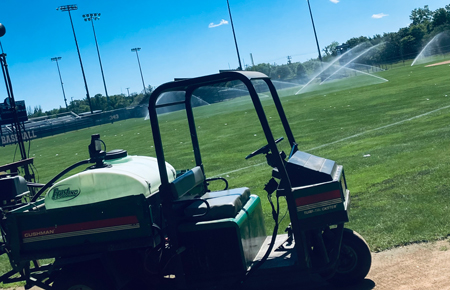
“The key we have found in our scenario is finding out what people are good at and what daily task they enjoy, and putting them in a position to accomplish our goals while doing the work,” he said. “The other way is finding out ways to make the work environment inviting to where people want to come to work every day. I have found with the younger generations that as much as they want to get paid more, they want an enjoyable crew to work with every day.”
Williamson said that while it’s a great time for those who seek careers in turf management, with improved science and data and plenty of support from higher education, the industry needs to do better with sharing the hard-won experience lessons learned by elder practitioners.
“The secrets of growing grass are really not secret,” he said. “You can look on YouTube for how to properly maintain your lawn. It’s the finer details and tricks of the trade that only come with years that really are valuable to pass down to the younger managers. Teaching them how to manage time and labor efficiently because we have less and less of it every year. Setting a fertility schedule and being open to changing it on the fly based on weather, events or any number of other reasons. Learning how to adapt, problem-solve and execute.
“I think every grounds manager could raise their hand and say, ‘We tried this, it doesn’t make sense, but it worked and we rolled with it.’ The resiliency and relentless attitude can only be experienced outside of the classroom and in the field.”
“Within our own staff, it’s always rewarding to see the more experienced employees teaching and mentoring the newer or less experienced team members,” said Casey Carrick, assistant athletic director of facilities and turf management at the University of North Carolina. “That kind of knowledge sharing helps everyone grow and keeps our staff strong.”
In that spirit, Williamson shared some of the natural turf field management practices he’s refined over the years:
1. “The main one I have always held true is selecting a good seed mixture for overseeding. There are hundreds of seed cultivars among every type of variety. Researching and choosing a blend that is going to be beneficial for your location is very important. You have to look at things like weather, soil, usage and budget. Typically there will be a germination percentage on a commercial bag of grass seed. This percentage is calculated based on ideal conditions. Very rare in the public setting do you get ideal conditions for growing grass. Proper seeding technique and care after seeding is crucial for success. I also believe in building a seed bank in your surface. Seed can survive years without germinating in your soil and eventually will be used in recovering turf after heavy traffic. Seed heavy and often to see results.”
2. “Water usage and conservation has been a hot topic across the entire green industry for many years now. Smarter irrigation programming has helped along with irrigation design. I have adopted two different ways that we conserve water over the course of a growing season. These are not groundbreaking but rather common practices among many turf managers—water less. Now this is not the most aesthetically pleasing method as your grass will turn a little brown and dry. Water just enough to keep your grass from going dormant but not too much to where your roots stop pushing deeper in the soil. You have to stress your turf out a little to get those roots to go search for water deeper in the soil. Grass plants are incredibly resilient and will always come back. You have to challenge that grass plant to find the water. Year after year of pushing the roots will yield your grass staying greener during drought conditions. Fall aeration also helps promote good root depth.” RM