


By Daniele Doerge
Maintaining the health and safety of users—be they amateurs or trained athletes—is one of the top priorities for recreation management professionals everywhere.
This involves a range of critical activities, from regular maintenance to popular equipment, to maintaining facility cleanliness, to engaging with the community, to procuring equipment and more. And for facilities that maintain outdoor equipment and playing surfaces—like pickleball or tennis—one increasingly important consideration is a facility’s ability to maintain safety under increasingly warm summertime conditions.
While you can’t control the weather, you can control some of the technologies you deploy to beat the heat, and the right sports surface can make a significant difference in an athlete’s ability to keep cool and meet their potential. New performance characteristics, durability and more can elevate the athletic experience at your park or facility.
Harnessing the Power of Solar Reflectivity
One key feature to look for when selecting a sports surface coating—whether you’re building a new court or overhauling an existing one—is its solar reflective index (SRI). SRI measures the surface’s ability to effectively reflect solar rays and to mitigate the associated heat when the sun is shining on a hot summer day.
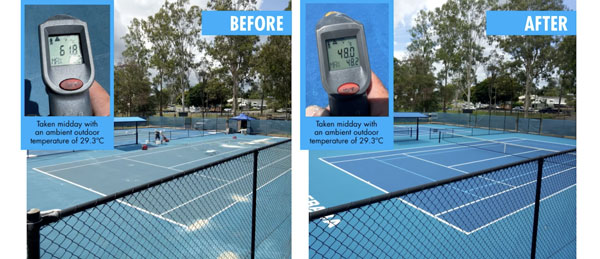
In fact, reflective surfaces are becoming more popular in a range of applications—including industrial rooftops, parking lots and others—to mitigate the creation of heat sinks. Heat sinks are created in outdoor built environments that become hotter than the natural surrounding environments, and preventing them can keep local climates cooler and more comfortable.
So, it should be no surprise that such surfaces can also have a positive impact on outdoor sports areas. Consider a tennis court, which can become significantly hotter than the ambient air temperature when the sun is shining, potentially reaching up to 140 degrees Fahrenheit on a hot day. The heated court surface further radiates heat back into the surrounding air, creating a hotter microclimate around the court.
For athletes, such conditions can lead to faster dehydration, increased heart rates and greater fatigue. Excessive heat can also increase the risk of heat-related illnesses and pose challenges to overall player health and safety. Heat stress, muscle fatigue and cramping, and inhibited cognitive function are all risks associated with playing in high-heat conditions.
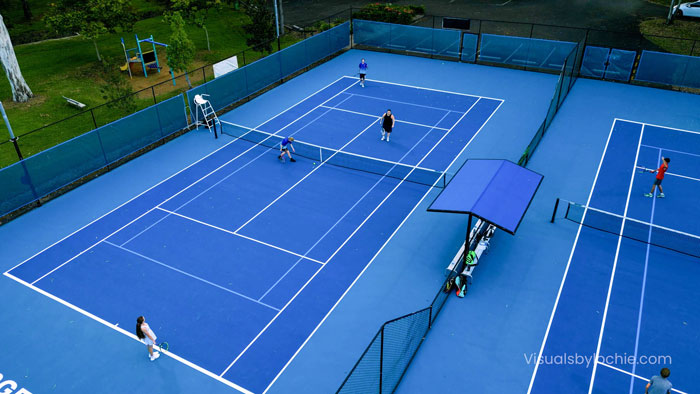
It’s why a surface that can reflect a certain amount of sunlight can help keep on-court temperatures more desirable, even at full sun exposure. But here, a careful balance must be struck. The surface must not be so reflective that it impacts player visibility, and striking the right balance involves considering color coordination. While traditional tennis courts have tended to historically be darker greens and terracotta reds, customization reigns supreme throughout modern sports surface applications. Consider that grays and blues are popular among newly proliferating pickleball courts. An experienced surface supplier should be able to assist you in achieving the right option.
Other Ways to Maximize Player Comfort
A sports surface that can help drop the temperature is just one of the ways today’s technologies can help maximize player safety and comfort, and for recreation managers, it’s worth exploring all the options that may be available.
For example, some surface solutions can deliver enhanced shock absorption in the right applications via advanced cushioning technologies. These systems incorporate acrylic resins and rubber granules that are designed to absorb impact and redistribute pressure, enabling a desirable feel for the player without compromising durability. The resulting balance of shock absorption can make a major difference for today’s top-line recreational facilities.
Again, balance is important here. Too soft a surface can impact the bounce of the ball, leading to adverse playing conditions. Excessive cushioning can contribute to the greater likelihood a player may experience an injury while playing such as a rolled ankle. An ideal system should see players not noticing much of a difference during gameplay—but it can help alleviate some of the next-day soreness that can occur after playing on a hard court.
Shock-absorbing systems can be applied to a variety of surfaces, but they’re worth strategic application for recreation managers. Consider that pickleball remains one of the most popular recreational sports in America, in part for its “anyone can play” approachability. A cushioned system can be especially advantageous here, further enabling access for players of any skill or age.
Ultimately, your choice of sports surface can make a difference—both for your facility’s reputation and the players who use it. It’s worth your proactive investigation into whether a reflective sports surface is right for your next project, helping to best enable local athletes to meet their full potential while staying safe and cool. RM
ABOUT THE AUTHOR
Daniele Doerge is the marketing manager for California Sports Surfaces, a division of ICP Building Solutions Group. To learn more, visit www.californiasportssurfaces.com.