



One of the first ways parents can start to release their kids into the wild is by visiting playgrounds that are a step above the basic: equipment and designs that offer more diverse physical and mental challenges, sometimes set into an area’s natural topography.
Risky or adventurous play is an important part of early childhood, said Meredith Gutheinz, senior director of operations at Penobscot Bay YMCA in Rockport, Maine. When children have the chance to climb, balance, explore and test their limits, they build confidence and learn what their bodies are capable of. “Being able to move through an environment without a parent’s watchful and often nervous eye gives kids space to trust themselves, make choices and push a little beyond their comfort zone,” said Gutheinz. “These experiences help children regulate their sensory and emotional needs, develop problem-solving skills and gain independence. In safe but challenging play spaces, kids learn how to assess risk, manage big feelings and build resilience, skills that carry over well beyond the playground.”
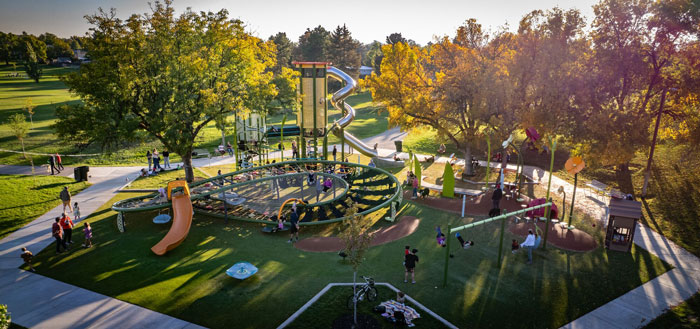
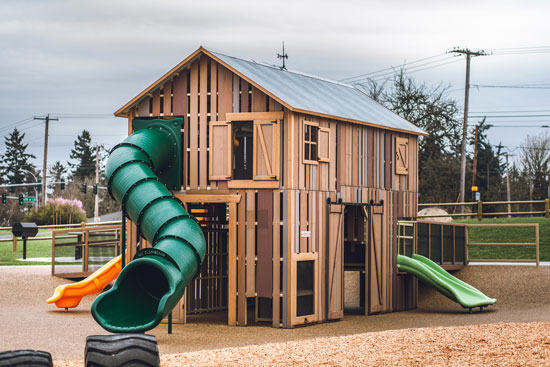
The town of Edgewood, Wash., chose this path for its Edgewood Community Park, set on 18 acres of former agricultural land and transformed into a welcoming, inclusive destination that reflects the community’s rural roots while meeting the recreation needs of a growing population.
Located in Pierce County between Tacoma, Milton and North Puyallup, the park was designed to serve as both a neighborhood gathering place and a regional draw, according to Brian Levenhagen, chair of the Edgewood’s parks and recreation advisory board for almost 15 years in a volunteer capacity. Levenhagen is also deputy director of parks, recreation and community services for the nearby city of Kent, Wash. The City of Edgewood staff played the main role in building the park, Levenhagen said. The parks and rec advisory board played a key role in getting buy-in from elected officials and generating public support for the park. Levenhagen wrote the two grants that totaled $1 million, support that was key in securing cooperation from city council to build the park.
“The primary goals were to create a high-quality play environment, preserve key natural features, and ensure accessibility for users of all ages and abilities,” Levenhagen said.
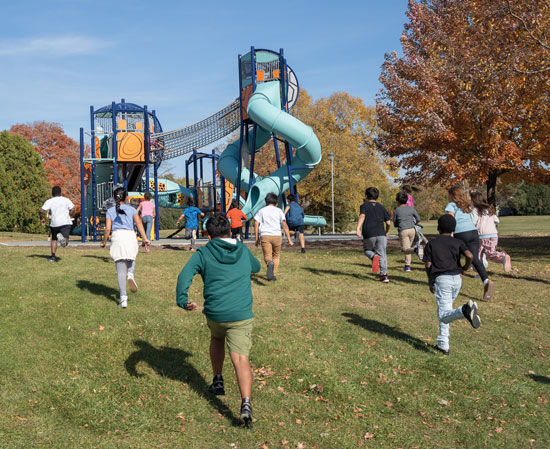
The park’s design was shaped by the land itself, Levenhagen said. A landscape architecture firm worked with the site’s existing topography, placing major active and passive amenities on the east side of the property to minimize grading, enhance wetland areas and improve accessibility. A gently sloped, accessible loop trail through the meadow provides an engaging walking experience while reinforcing the park’s pastoral
character.
“The playground design highlights Edgewood’s agricultural history through playful, immersive features, a two-story barn play structure and farm-inspired climbing elements,” Levenhagen said. “A scavenger hunt built into the barn adds an extra layer of interaction, encouraging exploration and repeat visits. My kids’ favorite part of the playground is the real tractor, modified into a piece of play equipment—it’s always more fun playing on the real thing.”
As accessibility and inclusion were key requirements from the start for the playground, it features two ramps into the barn, a variety of play types and thoughtful surfacing choices to help ensure the space works for a wide range of users, Levenhagen said.
“Another challenge was creating a large, immersive play structure that encouraged exploration while remaining safe and functional,” he said. “This was addressed through multiple access points, clear circulation paths and durable, well-tested play components.”
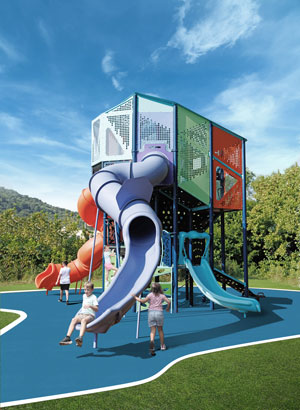
Community collaboration played a significant role throughout the project, Levenhagen said. Residents shared ideas, priorities and feedback that helped shape both the overall vision and the details of the park experience. A playground equipment partner brought the ideas for the custom playground from previous projects, while the landscape architect, recognizing the budget challenges the city faced, provided a lot of free redesign work to ensure the park could be built with existing budget constraints.
Balancing accessibility, environmental preservation and budget constraints was one of the project’s primary challenges, said Levenhagen. The varied terrain and presence of wetland areas required careful planning to ensure the park could be both usable and environmentally responsible.
“The $1 million grants from the Washington State Recreation and Conservation Office provided critical flexibility, allowing the project team to incorporate inclusive features such as poured-in-place rubber surfacing in high-use areas while using engineered wood fiber elsewhere to manage costs,” said Levenhagen.
Chris McGarvey, president of the representative for the playground equipment company that supplied Edgewood Community, said the Edgewood project fits the trend of more adventurous places for kids of all abilities to play and explore. “The playground has continued evolving to be less about how to transfer children up and down platforms and more about creating immersive landscapes for play—oftentimes with elements directly inspired by the communities that call those playgrounds home,” he said. “The aspect of adventure comes with providing unstructured play and challenge to a much higher degree.”

McGarvey said new construction resources and methods have enhanced the trend. “More than ever planners can dream bigger when it comes to the scope and scale of their projects,” said McGarvey. “Materials like sculptured concrete can be formed to mimic nature and imagination alike, while tangles of rope allow children to ascend to higher heights than ever before, and natural materials like real wood provide children anywhere an even stronger connection with nature.”
Since opening, Edgewood Community Park has seen consistently high use and enthusiastic feedback, Levenhagen said. “The shelter is used for parties whenever the weather is nice and sometimes when it’s not,” he said. “You can almost always expect to run into someone else you know when you go to the park, often resulting in spontaneous playdates for my kids with friends from school. Inclusive features have been particularly well received, including the variety of swing options, accessible surfaces and quieter spaces within the play barn for children who need a sensory break. Early results show the park is not only meeting its original goals, but exceeding expectations as a true community destination.”
Community means all ages and abilities, and the past couple decades have seen the twin trends of adventure play and accessibility pair up and mesh. More and more, accessibility is standard for new playgrounds, said Sarah Lisiecki, communications and education specialist for one of the industry’s leaders in accessible equipment. “Playgrounds have shifted to being more exploratory and child-directed with designs that invite curiosity, problem-solving and independent play,” Lisiecki said. “There is a greater emphasis on layered experiences that encourage kids to test limits, build confidence and return again and again to discover something new.”

Her company has designed and manufactured options like a loop that combines a transfer point, climber and slide into a continuous experience. It gives children who transfer from mobility devices greater control over how they move and play, said Lisiecki, as multiple entry points allow kids of different abilities and comfort levels to engage, progress and participate together, choosing how they use their upper bodies, legs or both to navigate the experience independently.
“This kind of universal design brings everyone into the same play moment rather than separating experiences,” Lisiecki said. “Adventure is no longer about height alone. It is about choice, challenge and the freedom for every child to define the way they want to play.”
Lisiecki’s company also designed an electronic play system that satisfies kids’ interest in digital gaming in an outdoor setting, encouraging activity and teamwork. It has also been adapted to include kids of all abilities. Lisiecki said all versions of the electronic play system benefit cognitive skills like problem solving; strategic thinking; creative thinking; cognitive planning; sensory stimulation including proprioception, tactile and visual aspects; social and emotional skills through cooperation, imaginative play, social skill development and turn-taking; and motor skills using eye-hand coordination, motor planning and agility.
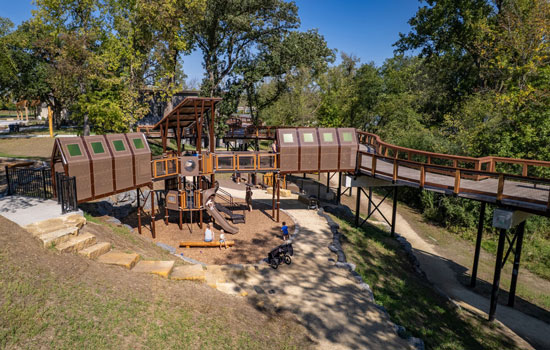
Lisiecki said another series of play systems are jam-packed with climbing challenges in different scalable layouts for customizable combinations that serve different ages, abilities and preferences. “Adventure play offers something different: firsthand experiences where children move their bodies, make decisions, test boundaries and feel the outcome in real time,” she said. “That kind of engagement cannot be replicated in any other way.”
Not only are playground projects trending toward more adventure, choice, inclusiveness and creativity, they are approached with heightened urgency since the pandemic, said Lindsay Robinson, sales manager for commercial sales for an equipment designer and manufacturer. “COVID reinforced the importance of outdoor play for health, connection and development,” Robinson said. “Many organizations accelerated playground investments. I also think this made them realize this could be a better investment for the future vs. normal amenities.”
Because more and more playgrounds are built for flexibility, scalability and customization, budget restrictions can be accommodated, Robinson said. “Lower budgets typically try to focus on maximizing play on smaller designs, whereas higher budgets are often only limited by space,” she said. “So they tend to be larger designs that are packed full of accessories. In both cases, the goal remains the same: meaningful, adventurous play.
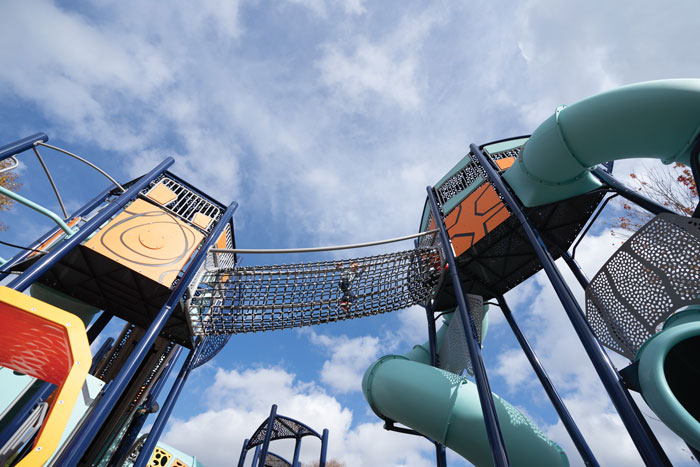
“Successful projects begin with clarity of site conditions, dimensions and budget parameters, but the process is collaborative. Having dimensions, details about ages and site-specific information makes this a smoother process.”
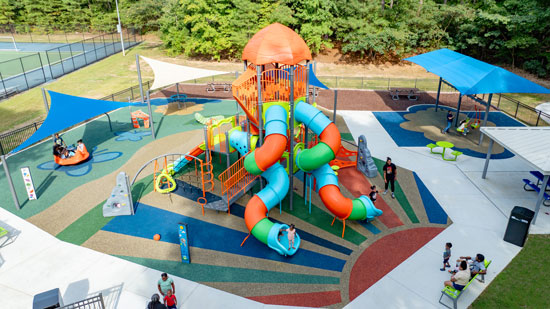
Kevin Kinsley is brand leader for his company’s playground division that provides a unique take on playground surfacing and level-changing options like mounds, mounds with tunnels, mounds with balance beams between them and mounds with slides attached. The company specializes in artificial turf surfacing, so its playground applications include the surfacing throughout a playground, certified for accessibility as well as all the usual safety certifications for impact and cushioning that comes with artificial turf for sports fields.
Kinsley said from a materials and technology standpoint, innovations in synthetic turf systems, accessible surfacing and engineered shock pads have made it possible to deliver consistent, safe mobility for wheelchairs, walkers and other assistive devices. These advancements eliminate many of the barriers created by older surfacing materials that were uneven, unstable or prone to deterioration.
At the same time, the focus on inclusive design has transformed how these spaces are used: Designers are intentionally creating environments where kids can roll, crawl, sit in groups, socialize and explore without restrictions—not just on equipment, but across the entire play area.
The turf can be customized using seven available colors, making for vibrant areas. The turf has anti-microbial protections and as static shock is a real concern for children with electronic medical devices like cochlear implants, the turf has anti-static electricity protection as well. Maintenance consists of twice-a-year grooming, Kinsley said.
“Over the past decade playground design has shifted decisively toward adventure, exploration and inclusive, multi-sensory play—and surfacing has had to keep pace,” Kinsley said. “What we’re seeing now is an elevated understanding that surfacing is foundational to inclusion. When the ground itself is accessible, the entire space becomes more engaging and more equitable.”
The engineered mounds introduce undulating terrain that encourages climbing, rolling, balancing and imaginative exploration—while a safe, unitary surface ensures accessibility for children of all abilities, said Kinsley. In addition to the bridges and tunnels and slides that can be paired with mounds, the mounds can also be arranged in different configurations side-by-side in shapes like crescents and zig zags. The company can design obstacle courses as well.
Kinsley said the fresh take on playground surfacing and obstacle options doesn’t require any special qualifications from potential clients. “Before potential customers call, it’s important for them to understand that the playground surface is one of the most critical components of the overall design, and it should be considered from the very beginning of the planning process,” Kinsley said. “Too often, surfacing is treated as an afterthought, and by the time a decision is made, budget constraints lead to lower-cost options like mulch or loose-fill materials.
“While these surfaces may appear less expensive upfront, they are harder to maintain, less safe, prone to displacement and erosion, and far less accessible for children with mobility devices. By planning for a high-quality, unitary surface early, communities can ensure a playground that is durable, safe, inclusive and truly engaging for all children, while avoiding costly retrofits or compromises later in the project.”
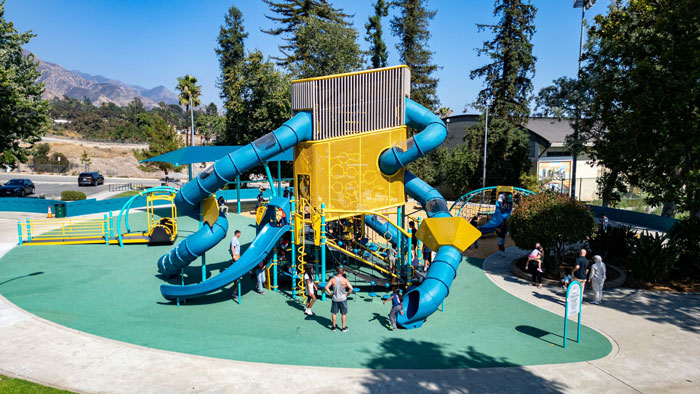
Kinsley hopes communities interested in creative and inclusive play will begin to prioritize play area surfacing.
He said a high-quality synthetic turf system dramatically increases playability, inviting children to fully engage with the environment—rolling, sliding, tumbling, doing somersaults and gymnastics or simply sitting comfortably in groups. “Unlike harder or less consistent surfaces, synthetic turf supports safe, confident movement and encourages the kind of whole-body, ground-level exploration that is critical for child development, motor skills, social interaction and sensory play,” Kinsley said. “When communities want to create playgrounds that are more inclusive, more usable and more fun, the right surface is where meaningful play truly begins.”
The outlook for adventure playground design and materials is bright, said Robinson and Lisiecki.
“The future of playground design is increasingly nature-inspired, site-responsive and challenge-driven,” said Robinson. “Adventure-based play will continue to evolve as a core component of resilient communities, supporting confidence, creativity and physical development through intentional design.”
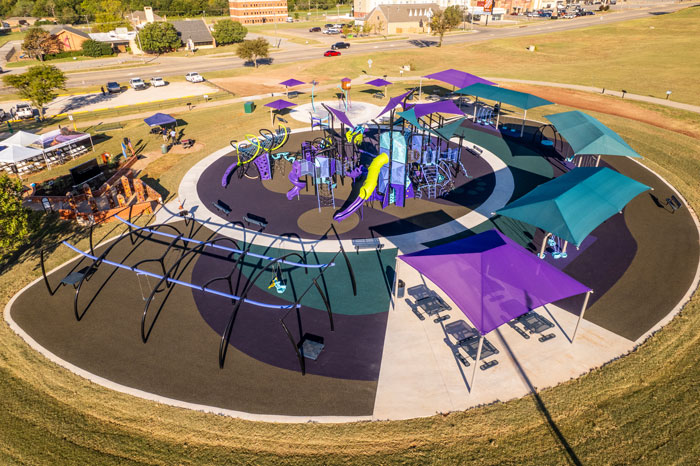
Lisiecki said adventure play continues to grow as communities better understand the important benefits it brings. These environments support physical development, confidence-building and social connection, while also creating places people want to return to again and again. When play offers challenge and choice, it holds attention longer and invites repeat visits, creating destinations for communities to gather and be outside together.
“Digital experiences, by nature, are secondhand; they are observed and not lived,” said Lisiecki. “Adventure play offers something different: firsthand experiences where children love their bodies, make decisions, test boundaries and feel the outcome in real time. That kind of engagement cannot be replicated in any other way.
“Looking ahead, adventure-focused play will continue to be driven by innovation, creativity and open-ended experiences. The focus is less on directing play and more on making space for it, creating environments where children direct the play and they can explore, imagine and build confidence through first-hand adventure.” RM