


Communities face a multitude of growing environmental challenges relating to flood risks, groundwater management, urban heat islands, biodiversity loss and other negative effects. In this landscape, parks can have a positive impact beyond the recreational, sports and fitness opportunities they provide. When planned thoughtfully, parks can be critical infrastructure for building community resilience against these growing threats.
For park managers, this need also creates opportunity—a chance to argue effectively for funding for multi-benefit park spaces that address these issues while also expanding valued natural and recreational amenities that improve residents’ quality of life.
Fighting the Floods
In the U.S., a key issue more parks are facing, and helping to combat, is flooding. The issue is being exacerbated by a variety of factors that include sea level rise in coastal areas, more frequent and more extreme storm events, and the ongoing removal of natural water-absorbing terrains for development. The latter has reduced our acreage of resilience-boosting natural areas while increasing impervious surfacing in the U.S. to such an extent that some of our 100-year flood models are growing out of date.
“Parks can play a fantastic role in terms of helping to mitigate flooding,” said Chris Hardy, associate principal and landscape architect for the design firm Sasaki. “A lot of our park systems were pushed down into flood plains historically in metropolitan areas in the United States, because that was the land that was left over and that had the amenity of being on the waterfront.” This often puts parks at the front lines of these issues—and makes them uniquely poised to help address flooding effectively.
Hardy noted that a variety of park projects his firm has worked on started in response to a devastating flood. “And then we come in to help create a more resilient space that happens to be a public amenity most of the time, and it can be a water-receiving landscape when it needs to be,” Hardy said.
One example is the Smale Riverfront Park in Cincinnati, designed explicitly to be able to flood, with all of the higher fit and finish amenities lifted well above the floodplain, while areas likely to be affected by annual flooding are designed to be easily power-washed after a heavy storm.
Another is the firm’s current work helping Asheville, N.C., rebuild its public parks and greenways along five miles of the French Broad River that were devastated by 2024’s Tropical Storm Helene. “In that case, there’s the opportunity to build back the park to withstand flooding and mitigate some of the hazards that come with it,” Hardy said. This effort includes designs that help keep structures from being torn up and washing downstream and that prevent banks from eroding and adding more sediment into the water load. It also includes the creation of higher-elevation refuge spaces that people can access easily in the event of a high-speed flood.
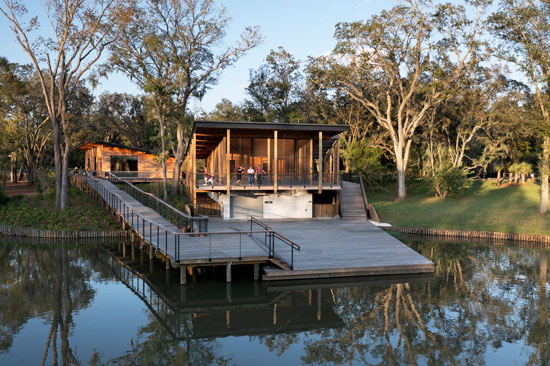
“On a smaller scale, parks can help mitigate and ameliorate high-flow events by being able to absorb as much water as possible and either capture it, detain it, infiltrate it, or slow or clean the water and then release it,” Hardy said. An example of a park accomplishing this is Bonnet Springs Park in Lakeland, Fla., which was built onto a former flood control ditch and brownfield site that had previously been guiding low-quality water into a wetland area and into Lake Bonnet.
“We diverted that off-site stormwater into some pretty significant infrastructure, trash separators, and then passed it through a flow-through wetland, so that we could reduce the nutrient counts and reduce the sediment,” Hardy said. “So, when it’s finally released into the wetlands and the lake, it’s contributing to the water quality of the system and not degrading the water quality.”

The park also offers ecological benefits through native plants and an onsite Nature Center teaching about the ecology of central Florida with amenities that include a classroom, exhibition space and boat rental facilities. The park has also become the new home of the Florida Children’s Museum, offers walking paths that include a lagoon boardwalk and canopy walk amid mature oak trees, a nature playground and vegetable gardens—making it a good example of a park that enhances resilience along with culture and ecological understanding.
Green infrastructure such as native plants and flow-through wetlands can help mitigate flooding and water-quality issues, in many cases at lower cost than more technical, grey infrastructure approaches requiring high-cost buildouts like cisterns. But sometimes both are needed.
“We did a cost-benefit for green infrastructure and found a two-to-one payback in a place like New York City,” said Amy Chester, director for Rebuild by Design, an organization that works with communities and local governments to solve environmental and economic challenges with solutions that strengthen infrastructure and protect lives and livelihoods. “But green infrastructure only works effectively for the regular rainstorms … for the bigger flooding, you’re going to need a more sophisticated approach,” Chester said.
The Case of Hoboken
She noted the example of one of several parks Rebuild by Design worked on with the city of Hoboken, N.J., ResilienCity Park, which includes a holding tank that pumps water from a 20-block area nearby and holds that flooding underneath the park. “Neighborhood parks can play a huge role in reducing flooding for not just what falls on them, but actually pumping and storing storm water for everyone that’s around it,” Chester said.
ResilienCity Park has transformed a 5.4-acre contaminated plot in a deindustrializing neighborhood into Hoboken’s largest park, featuring a large multi-sport playing field, great lawn, central terrace, park pavilion, fitness loop, splash pad, ice rink, basketball court, playgrounds and other amenities. It also manages up to 2 million gallons of stormwater with gardens designed to filter and drain water within 24 hours of a storm, plus a large subsurface tank and filtration system that collects and stores the water to reduce flooding and combined sewer overflows to the Hudson River. Runoff from the pavilion and paved surfaces is also collected into cisterns for reuse as irrigation and toilet flushing to minimize the unnecessary use of potable water.
For Hoboken, this approach was part of a much larger, comprehensive water management strategy intended to address ongoing flooding threats first highlighted by Superstorm Sandy. Four parks have been built in the dense, urban city so far as part of the Hudson River Project that seeks to manage stormwater from flooding and surge along the Hudson River by combining four approaches:
- Resist with hard infrastructure including bulkheads, walls and berms that create coastal barriers during extremely high tides and storm surge events.
- Delay through urban green infrastructure that slows stormwater runoff.
- Store water using green and grey infrastructure improvement such as bio-retention basins, swales and green roofs.
- Discharge through enhancements to sewer lines, outfalls and pumping stations that reduce combined sewage overflows and manage flooding.
Even with all these enhancements, Hoboken can’t completely eliminate flooding impacts. But according to Caleb Stratton, business administrator and chief resilience officer for the city of Hoboken, eight years of data shows that the city can now handle 89% of rainfall events and modify 88% of the coastal flood plain to reduce flood risk from coastal storm surges.
“Because we have those assets in place, when we do have a flood, we’re reducing the extent of flooding, we’re reducing the depth of flooding, we’re reducing the consequence of flooding,” Stratton said. “There’s less damage, and we’re recovering faster from storm events.”
The city is planning further improvements over time that will continue to increase park spaces, connect existing park spaces through greenways, and separate out more of the sewer infrastructure that is currently combined in certain neighborhoods.
In Hoboken, the urgent need for stormwater management has also brought a flood of funding that makes the new parks and accompanying recreational amenities possible. “In many cases in the last 100 years, the purpose of public spaces has evolved from quality of life and clean air to actual mitigation,” Stratton said. “I think if you’re not doing that within your public space planning, you’re missing an opportunity that’s existing in plain sight. And I think that usually the cost of those investments are not so significant that they can’t be incorporated into a project that’s already on the way and planned.”
For Hoboken, it was the impact of two back-to-tack storm events—one heavy rainfall and one coastal storm surge—that really sold the community on the need for a comprehensive vision for fighting future flood events. “It was a huge pain point for the community, and so we leveraged that into hundreds of millions of dollars of investments over the last decade, a critical part of that being park space on the waterfront,” Stratton said.
To date, four new parks have been built, with another under construction and financing secured for a sixth park. Extensive community engagement is undertaken with each project to ensure that the parks include the recreational amenities residents want.
“Underlying that, the community’s like ‘Build all the water infrastructure you can possibly build, do whatever you can,’” Stratton said. That element has created overwhelming support from the storm-ravaged community while also helping the city gain support from the EPA, New Jersey Infrastructure Bank and other sources to fund the projects at little to no cost.
Ready to Adapt
Flooding is just one of many environmental threats facing parks—and that parks may be able to combat with good design. The Climate-Park-Change website from the National Recreation and Park Association (NRPA) and Sasaki, available at climateparkchange.net, offers strategies that help parks find solutions to better fight a variety of threats, including:
- Natural disasters such as wildfires, landslides, extended drought, inland flooding and extreme wind events.
- Abnormal meteorological disruptions such as heat waves, reduced annual rain and extreme precipitation events.
- Environmental effects such as diminishing snowpack, invasive species, erosion, water-quality issues and air pollution.
The site also offers a variety of tips for environmentally friendly park management to help parks better support ecology, conserve water, and reduce waste and energy use.
Parks as Ecosystem Infrastructure
Parks can also be ground zero in many communities for native plantings that double as green infrastructure to sponge up excess rain, mitigate urban heat islands and provide valuable tree-canopy shade. But they also can be viewed as ecosystem infrastructure that supports healthy food webs.
The Homegrown National Park (homegrownnationalpark.org) movement encourages people to preserve native species and restore habitat in the places we live and work by adding native plants and reducing invasive ones everywhere we live, work, learn and play. And this approach in parks also contributes to resilience.
Krista De Cooke, strategic partnership and science lead for Homegrown National Park, notes that native plants are foundational to resilient landscapes because they’re adapted to local soils, climate and seasonal patterns.
“In parks, this translates to plantings that are better able to handle flooding, drought and temperature extremes while continuing to provide ecosystem services,” De Cooke said. “Native plants also support far more biodiversity than non-native ornamentals, particularly insects, which are the base of the terrestrial food web. When parks use native plants, they are not just greening space, they are actively rebuilding ecological function.”
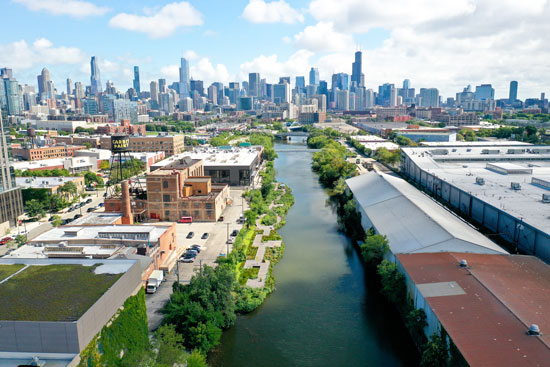
When it comes to canopy trees for heat mitigation, De Cooke recommends that parks prioritize native tree species that support high insect biomass, are resilient to projected future climate conditions, and are not already overrepresented in the community.
While the Homegrown National Park website makes it easy to search for keystone plants in your ecoregion that can best support ecological function, De Cooke also recommends that park managers work with landscape professionals and architects who understand ecology and function, not just aesthetics.
“Asking questions about experience with native plant communities, soil preparation, long-term management plans and success metrics beyond visual appeal can be very revealing,” De Cooke said. “A strong practitioner should be able to talk about how a planting will function five, 10 or 20 years down the line, not just how it will look in the first season.”
Hardy notes that in many cases, our society has normalized the mown lawn as a cue of care, but that unnecessary lawn areas come with downsides. “Mowing and blowing is the default maintenance, and that actually takes a lot of time, a lot of fuel and a lot of equipment,” Hardy said. “If we focus on the composition of native plant communities that can be self-maintaining and self-persisting in that environment once they’re established, that can really dramatically change the maintenance profile in our public spaces. And it can have the benefits of creating more habitat that has meaningful value for local species.”
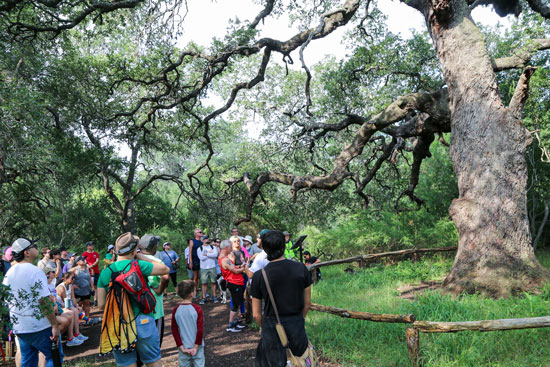
And, as De Cooke notes, creating this meaningful habitat in park spaces can have big impact. “Local parks play an outsized role in addressing habitat fragmentation because they often function as ecological hubs within developed areas,” De Cooke said. “When parks plant native and connect those plantings to surrounding neighborhoods, campuses or residential areas, they help create corridors that allow wildlife to move and persist.”
In terms of park design, Hardy notes the need to make sure that native design is done in a sensitive way to make sure that cues of care are understood and the community doesn’t view an ecologically valuable prairie restoration as a patch of weeds. “Maybe we have a mow strip around the prairie meadow, and signage around the prairie meadow highlighting the additional benefits for the overall ecology and that community,” Hardy said.
The hardest steps can often be keeping invasives out at first. “There’s usually a maintenance curve where the highest-input time period is during establishment, when it’s a lot of work to fight back the invasives,” Hardy said. “But once the native plant community is well-established, that curve of effort dramatically plummets and it goes below the equivalent of mowing and blowing a turf lawn.”
Beyond these plantings, De Cooke noted that parks can support biodiversity through other measures that include wildlife-friendly lighting, reducing unnecessary night illumination, providing clean water sources, installing bird-friendly window treatments on park buildings, and managing dead wood and leaf litter thoughtfully. “Often the biggest gains come not from adding new features, but from removing practices that unintentionally harm wildlife,” De Cooke said.
Connecting Habitats
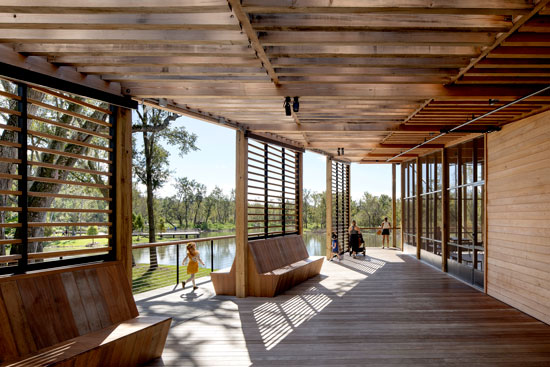
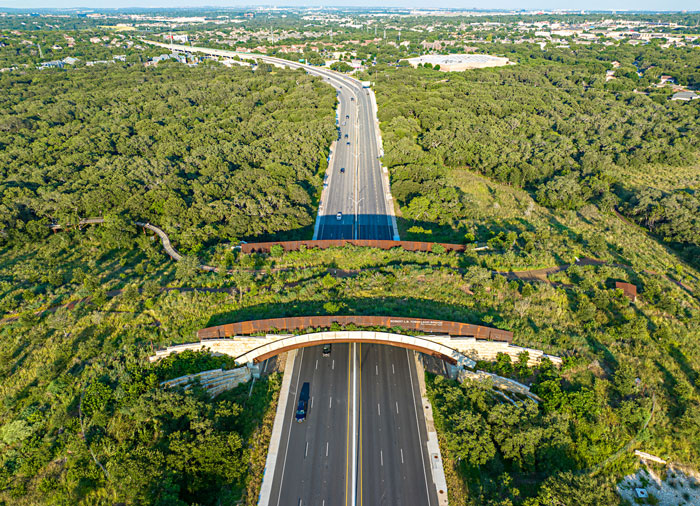
In some cases, park designs are incorporating some of these elements and going to even greater lengths to support wildlife. Such is the case in Texas with San Antonio’s Phil Hardberger Park, a 330-acre park that was once split in half by the six lanes of the Wurzbach Parkway. As of 2020, those sections have been connected by the Robert L.B. Tobin Land Bridge above the parkway, reducing traffic collisions with wildlife and providing an opportunity for safe crossings by both people and wildlife. To date, raccoons, opossum, rabbits, white-tailed deer, coyotes, bobcats and gray foxes have been among the growing list of bridge users.
The bridge is also designed to capture water. “We’ve got a 250,000-gallon rainwater catchment system embedded on the southern side of the park underground,” said Grant Ellis, natural resource manager for San Antonio Parks and Recreation. “Water that runs off from the park is captured and reused for irrigation and to help with the maintenance of the bridge in times of drought.”
Ellis noted challenges getting some of the many native plants and trees surviving on the land bridge — even ones that did well elsewhere in the park—due to a period of extreme drought and the fact that the land bridge experienced increased heat because of increased hot air flow exacerbated by the major road below.
“Instead of coming back and trying to force specific trees to grow on the bridge, we’ve let the bridge tell us what will grow,” Ellis said. “And I think that’s important as climates begin to shift and areas experience more extreme weather patterns. We may just have to be more adaptable in how we address them and wait and see what the land is telling us, rather than try to impose our will upon these areas.” In the case of the land bridge, those survivors and volunteers were especially hardy species such as native palo verde and persimmon trees.
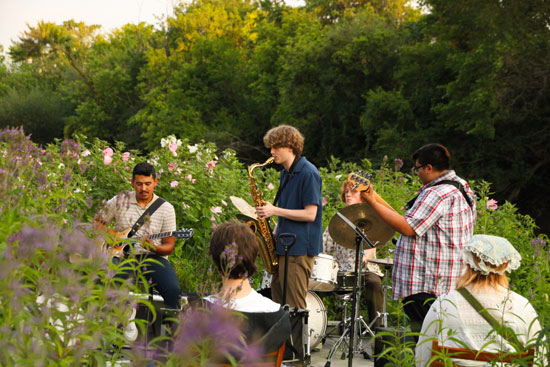
In addition to the land bridge connecting formerly fragmented habitats in the park itself, Phil Hardberger Park also connects people and habitats as a stop along the 20-mile Salado Creek Greenway as part of the parks department’s growing greenway trail system. “We’re also building trails and buying land on other creeks within San Antonio specifically to preserve the floodplain land,” said Brandon Ross, capital programs manager for San Antonio Parks and Recreation.
As part of this effort, the city is also taking advantage of opportunities to acquire land adjacent to the trails to enhance conservation, increase connectivity for wildlife, improve recreational amenities, and help mitigate flash flooding that can occur in the floodplain during heavy rains.
Phil Hardberger Park itself features a variety of other biodiversity-enhancing features, including a bird water feature that provided a dependable year-round source of water for birds and other animals. Water for the rock structure is collected from the adjacent Salado Outdoor Classroom and stored in a dedicated 3,900-gallon storage tank. The park also features a butterfly garden featuring Texas-native pollinator plants. Through its Native Plant Wildscape Demonstration Garden, the park also teaches the community about native Texas plants to encourage everyone to plant for wildlife in their own urban and rural landscapes.
Combining Community and Ecology
De Cooke notes that parks are uniquely positioned to make an impact through efforts like these that pair native planting with education and programming. Programming opportunities can include interpretive signage highlighting keystone native plants, guided walks focused on seasonal ecology, native plant sales, seed collection workshops, or partnerships with schools and community groups. “These programs help visitors understand that native landscapes are intentional and valuable, not unkempt or unfinished,” De Cooke said.
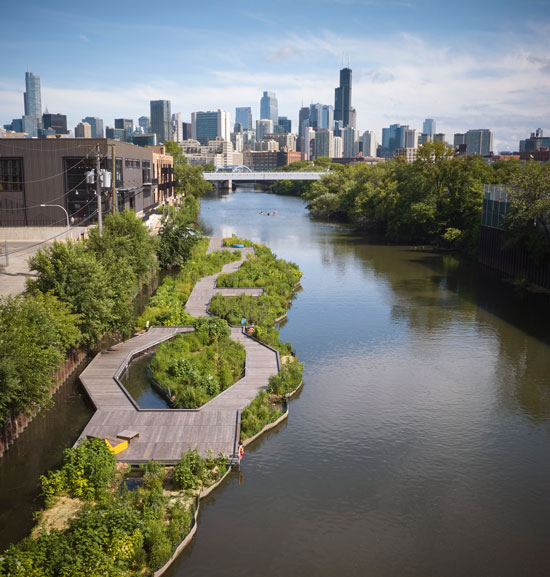
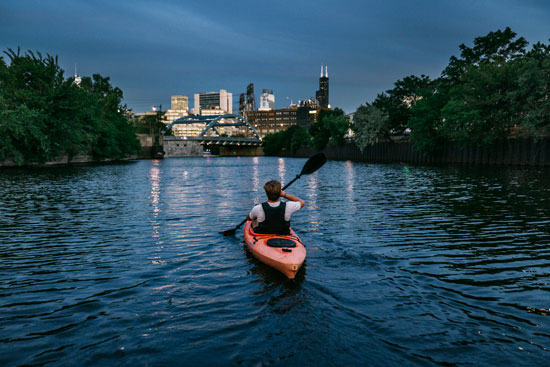
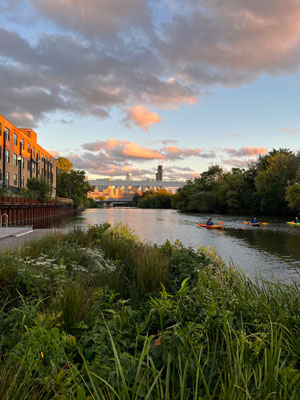
At Chicago’s Wild Mile, a pontoon-based floating eco-park, the floating and currently 700-foot-long, ADA-accessible space is open to the public 24/7 and used as a space for recreation, education and research as well as community gatherings. Native wetland plants can grow through the physical framework and get nutrients directly from the Chicago River, filtering the water while reducing nutrient pollution. The structure additionally includes submerged portions that house restoration projects for endangered freshwater mussels. The native wetland species provide habitat for birds, small mammals and reptiles while the underwater roots serve as a nursery for local fish species.
The structure itself is anchored to both the river floor and seawall, enabling it to move up and down and survive even dramatic flooding. Plans for further expansion include a mostly funded plan to add an on-land micro-park at the far end of the existing Wild Mile.
Urban Rivers, the organization behind the Wild Mile, has also expanded further north on the river with additional floating gardens in other areas, including Bubbly Creek, which was once a dumping ground for the meatpacking industry featured in Upton Sinclair’s “The Jungle.”
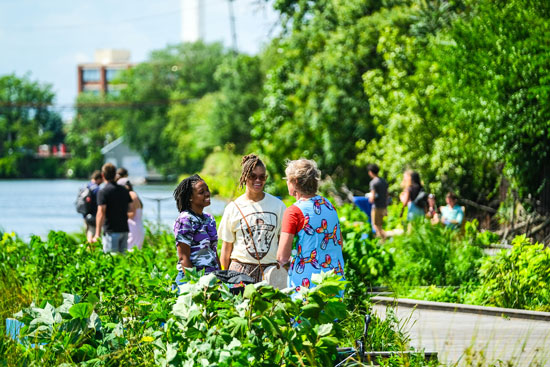
“Right now, we just have floating wetlands there. Those are great ecologically but really limit the amount of community engagement we can do in that area since we don’t have a boardwalk attached,” said Sage Rossman, communications manager for Urban Rivers. “Since those communities have been disproportionately excluded from river access, it’s really crucial that we invest our time and energy into creating community access.”
Engaging with the community on resilience-focused projects is essential. Since projects with environmental benefits can hold greater volunteer appeal, these projects can generate enthusiastic volunteer support in addition to unconventional sources of funding. But doing so effectively can require some adaptability on the part of parks managers too.
As Rossman said of the Urban Rivers projects, “None of this would exist without our volunteers, and our volunteers wouldn’t be a part of it if we didn’t do everything super transparently, give them total agency in the things they’re excited about, and invite them into every step of the process. What you lose in control and structure, you get back 100 times over in community, creativity and a widespread ride-or-die mentality toward this work.” RM