

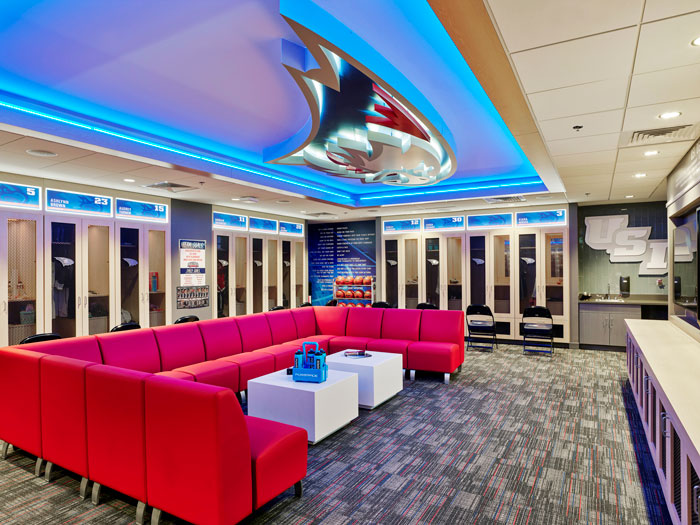
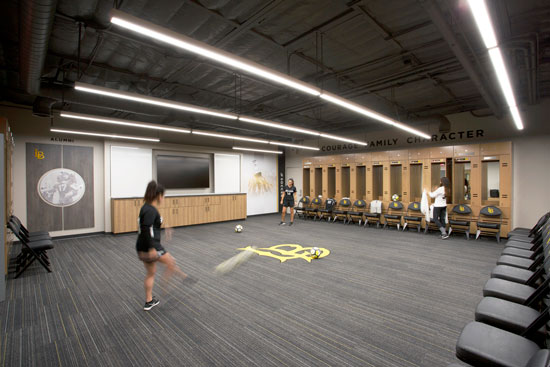
Locker room design has transformed dramatically in the past decade. Issues of privacy, gender identity and occupant comfort dictate where things go, how traffic flows, what materials are used and which technology levels are appropriate.
“Locker rooms are no longer just functional spaces,” said Jen Hocherman, a principal with SV Design. “They are now spaces that are aesthetically pleasing, multifunctional and have more options for privacy, and simultaneously have more sight lines for open areas. The use of these locker rooms has changed significantly.
“Gone are the days of gang showers, gender disparity and long periods of time spent socializing in locker rooms. The new locker rooms of today’s best practice designs have open areas with good visibility, they have private spaces for changing and showering, and they allow for easy flow of circulation from fitness spaces through locker rooms.”
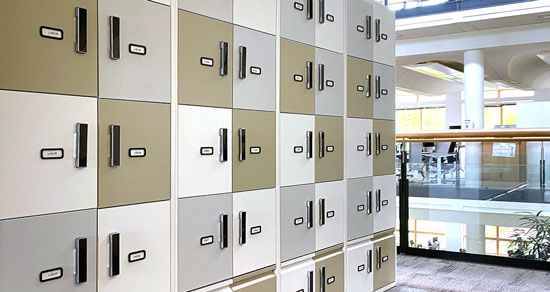
Hocherman said one of the key changes she’s seen is the merging of durability and aesthetics. Materials have been elevated over the years to be able to provide a more beautiful option using very functional materials. Some examples include more durable grout that makes a tile wall or floor easier to maintain, she said. Lock types have also evolved; there are the old standard lockers that require users to bring their own combination lock, but Hocherman said more and more clients are opting for digital locks that make operations easier.
Accessories and plumbing fixtures are now often touchless, she said, partly as a result of COVID restrictions. Avoiding tight narrow spaces where people are in close proximity is now a standard as well.
Hocherman said the most important information her company needs from potential clients considering a rebuild or new construction is about the user group.
“How will the user group make the best use of a new space?” she said. “How will growth affect the numbers of people using your locker rooms? What are the priorities of the user group—flexibility, privacy and/or maximizing the number of people who can utilize the locker room at once?
“With that base information, an architect who specializes in locker rooms can provide you with design options to consider that will maximize the available space to create optimal functionality and aesthetics.”
Bethany Gelbrich, a sports and recreation architect at CannonDesign, said the dominant shift in locker room design traces back to wellness. “The focus used to be on sterile, hard surfaces, but now these spaces need to exude wellness and hospitality,” Gelbrich said. “We are selecting materials that are both durable and enhance the atmosphere related to wellness. We are infusing lounge furniture into locker room spaces to create spaces for relaxation and socialization.”
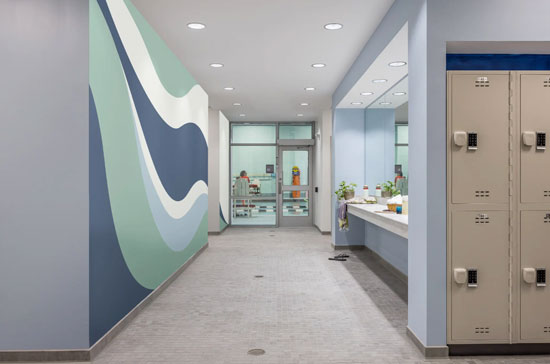
Gelbrich said certain organizations are also focused on adding all-gender locker rooms that have individual, private showers and changing areas with access to adjacent shared lounges or workspaces, increasing and incorporating privacy with wellness.
Ubiquitous personal tech devices have also demanded acknowledgement in design, said Gelbrich.
“Users are bringing more technology into locker rooms—phones, iPads, etc.—so we need to design to meet that shift,” she said. “Today’s locker rooms are likely to have power for personal device charging and wireless access points to boost signals for connectivity.
“At the same time, the audio-visual needs in locker rooms are also growing. It is common to see locker rooms with TVs and video displays that users can enjoy.”
While upgraded surfaces and technological advances can increase costs, Gelbrich said smaller budgets can accommodate plenty of locker room options.
“There is a continuum of possibilities when designing locker rooms,” she said. “Some clients can achieve their goals with material upgrades, new lighting systems and/or environmental graphics. Others may be looking to take those steps and add recovery spaces, saunas, cold tubs and nutrition areas. We see all these design ideas emerging and can help our clients find the solutions that best optimize their space.”
Gelbrich said her favorite information from potential clients is financial. “It is most important to establish a budget and vision for your project,” she said. “Having those identified at the outset strengthens the design process. Those guideposts anchor the creative solutions we create.”
Client trends toward a clean and minimalistic design of features for locks and other hardware guides the work of vendors like lock manufacturers, said Matt Welty, a vice president for a leading manufacturer and supplier of locks for lockers.
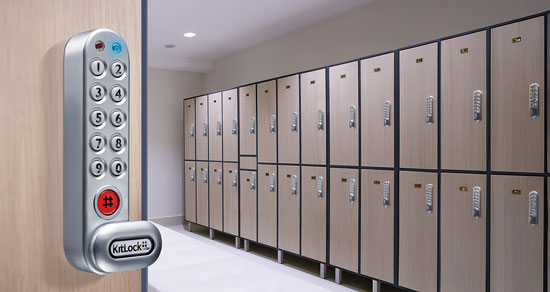
Welty said this shift to unobtrusive and low-profile hardware and simplified locking systems has helped to change user expectations, maintenance practices, safety standards and design trends.
“Keeping the locker room clean and fully operational with minimal man hours is more important now than it ever has been,” he said. “Providing access to lockers with no credentials, like keys and fobs, etc., is expected more often.”
Lower budgets would include those changes that would result in not only minimal spending, Welty said, but minimal downtime as well. With regard to access control in locker rooms, that could mean replacing old locks with simple mechanical keyless locks, which could eliminate bulky padlocks and improve the user experience immediately.
“A higher-end remodel would include an advanced technology integration to the entire locker room,” Welty said. “Each locker may be equipped with a lock that is more technical and provides time-controlled management for its users. This type of rebuild is less about replacing parts and more about creating a premium-level environment for patrons.”
Locker room managers put a huge focus on cleanliness post-COVID, Welty said, affecting lock choices to those that could be cleaned easily and with coatings that help deter germs. “The post-pandemic expectations for cleanliness have skyrocketed,” he said. “Now, cleanliness can have a direct effect on the gym members’ satisfaction and willingness to return.”
Welty said when searching for a lock partner, clients should know their facility’s specific needs and what they want their locker room to look like. “Each facility operates differently, so your locking solutions must be designed to perform appropriately,” he said. “We have our line of mechanical and electronic solutions for locker rooms that are great for different needs. Knowing how many lockers, how many patrons access those lockers, and how you want your locker room to function are just some of the questions that we will ask to get a better understanding so that we can provide the most ideal solution for the application.”

All these design and fixtures companies are essential for facility managers and operators contemplating new construction or remodeling of a building or locker rooms, but on the end user side, there’s so much more to locker room decisions. Member surveys and crafting a plan for locker room disruption and downtime are two of the most important, said Gerald MacKillop Jr., chief operations officer for YMCA of the North Shore, in Beverly, Mass.
In his decade on the job, MacKillop has overseen multiple locker room renovations and builds. His most recent project is in the Greater Beverly facility, one of seven YMCAs the organization oversees.
Through multiple expansion projects, the building was originally designed to serve about 10,000 members, he said. Today, it serves more than 15,000. “With that growth, especially the increase in family participation, the old family locker room was simply not keeping up with how members actually used the Y on a day-to-day basis,” MacKillop said. “This renovation wasn’t just a refresh; it was a purposeful redesign. We knew we needed a space that matched the demands of today and was built for tomorrow.”
MacKillop said just as important was his team’s recognizing a genuine opportunity to enhance the experience for people with physical disabilities, making it more welcoming and functional. “We raised our standard for accessibility and ADA compliance, and we approached it with the mindset of exceeding requirements wherever we could,” he said.
From a practical recreation-design standpoint, MacKillop’s team focused on the real-life moments that happen in a busy community facility. How to make it easier for a parent bringing one, two or even three kids to swim lessons? Do they have enough room? Is the flow intuitive? Are there changing and restroom options that reduce stress and improve privacy? And for a member who uses a wheelchair, can they enter the space and move through it comfortably, independently and with dignity?
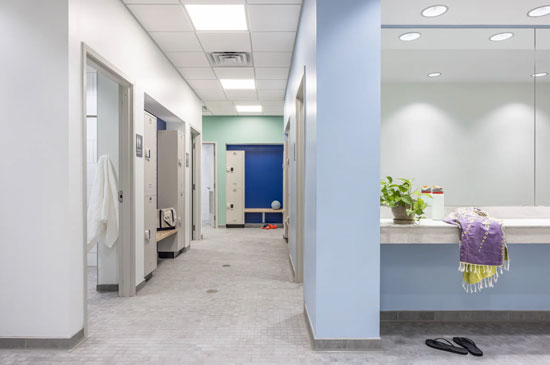
“The feedback we’ve received since reopening has been very encouraging,” said MacKillop. “Members consistently comment on how thoughtful the layout feels, how much easier it is to manage kids and gear, and how welcoming the space is for a wider range of abilities. Ultimately, the outcome we hoped for was a locker room that supports families, improves the overall member experience and reflects the inclusive values of the YMCA, and we’re proud of what the community is telling us we achieved.”
This wasn’t MacKillop’s first locker room project—he’s seen the renovations of men’s and women’s locker rooms, and built locker rooms from the ground up—but he said what made this project different and especially instructive was the intentional decision to create a true community locker room with a strong focus on families and people with limited mobility.
“The biggest lesson I would share with anyone considering a transformative locker room project is this: Talk to the people who will use the space every single day before you finalize anything,” MacKillop said. “For us, that meant engaging families and, in particular, members with limited mobility early in the process to help inform what the end result should actually look and feel like, not just what we thought it should be.”
That engagement was incredibly valuable, he said. Giving members the opportunity to “explore” the space conceptually during design, and then again once it was built, provided insights the team simply couldn’t have gained any other way.
“And quite honestly, even with all that planning, we still had a few misses once the space was in use,” he said. “The difference was that we were listening closely, recognizing where intended functionality fell short, and making adjustments quickly. What made this project successful was building with real intentionality, choosing the right materials, focusing on durability and function, and grounding decisions in member feedback rather than assumptions.”
Those lessons are now shaping how the collective approaches other projects as well, MacKillop said. “We’re applying the same principles at our Lynch/Van Otterloo YMCA in Marblehead, and with each renovation, we’re learning more and getting closer to what ‘right’ looks like,” he said.
The journey to “right” involved plenty of thought and intention toward goals, said MacKillop. “Our guiding principle from the start was simple: Families and people with physical disabilities should feel genuinely welcome and supported in this space,” he said. “Once we spent time listening to what families and members with limited mobility actually needed, the design decisions became much clearer, and in many ways, the layout started to ‘design itself.’”
MacKillop said the team prioritized flow, privacy and independence. That meant wide, easy-to-navigate corridors, fully enclosed shower and restroom rooms, and placing benches and lockers immediately outside those rooms so members could move through the changing experience comfortably and efficiently.
“We also made intentional choices around inclusive features, adult changing tables, appropriate mirror and sink heights, toilet heights, door weight and hardware, and, where it made sense, door openers, so the space works for people with different levels of mobility,” said MacKillop.
A key part of the process was making sure the people they were designing for had a voice in the design, he said.
“We didn’t want to assume; we wanted input from families and from members who would benefit most from improved accessibility, so the final result reflected real needs, not just good intentions.”
For materials decisions, MacKillop said durability was non-negotiable for a high-traffic environment used by thousands of members week in and week out. The team selected finishes and fixtures that could stand up to heavy daily use, moisture and constant cleaning while still feeling warm and inviting.
“And of course, all of this had to fit within a responsible budget,” said MacKillop. “We were disciplined about where we invested and where we simplified. With an intentional focus on flow, functionality and durability, we scaled back on some of the more elaborate design elements so we could deliver a space that performs exceptionally well and serves members every single day.”
Everyone loves refreshes and new areas, but that long-term gain comes with the short-term pain of restricted or no access while work is being done. McKillop said with a membership base as large as at the Greater Beverly location, and with both competitive and recreational swim programs running every day, the team knew this renovation would change the daily experience for a lot of people.
“Anytime you introduce a friction point into normal operations, challenges are inevitable, so we treated disruption management as a core part of the project, not an afterthought,” he said.
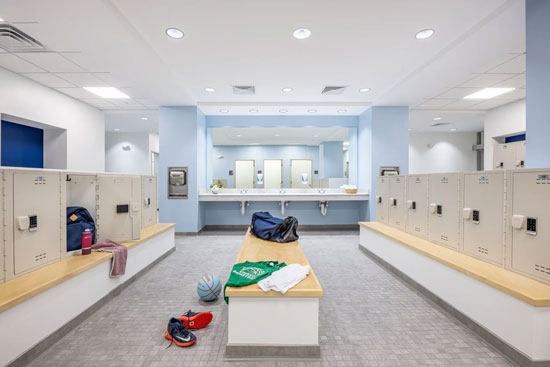
First, the team built a detailed operational plan in advance. It partnered closely with regional support teams to map out how members would move through the building, how swim operations would function, and where the pressure points would likely be. That planning helped them stay proactive instead of reactive, MacKillop said.
“Second, we leaned hard into communication and transparency,” MacKillop said. “We pride ourselves on being communicative, collaborative and trustworthy, and we carried that same commitment to our members throughout construction. We sent frequent updates on progress, timelines and any delays so people weren’t guessing or surprised. Even when the update was, ‘Here’s what’s taking longer,’ transparency mattered.”
Finally, the team focused on practical solutions that protected the member experience, especially for swimmers. It encouraged members to “come ready to swim,” said MacKillop, and many did. It also added temporary changing stalls on the pool deck so kids and families weren’t leaving the facility wet and cold after lessons or practice. MacKillop said small adjustments like that made a big difference in day-to-day comfort.
“At the end of the day, we’re very grateful for the patience and support our members showed,” he said. “The renovation asked a lot of them in the short term, and their understanding helped us deliver a long-term improvement that we can all be proud of.”
MacKillop said the best lesson he’s learned through all his locker room projects is good advice for any part of facility operations: “If there’s one mindset I’d encourage readers to adopt, it’s this: Every project should be better than the last,” he said. “We’re constantly learning, making the best decisions we can with the information we have, and then putting those lessons into practice. That’s how you create spaces that truly serve your community.” RM