


By Birju Kadakia
Artificial intelligence is everywhere. It is changing how we search for information, how we communicate, and how work gets done. In many ways, it has pulled us further onto our screens than ever before.
Yet one space has remained grounded in something deeply human: parks and recreation.
Parks and recreation departments are the heartbeat of community life. They are where co-workers meet for a tennis match after work, kids learn teamwork on the baseball field, families gather for birthday parties, and seniors find routine and connection through bingo night. Even as technology accelerates around us, the need for accessible, community-driven recreation has never been stronger.
At the same time, a disconnect has become hard to ignore. While most industries have modernized their technology, parks and recreation has often been left behind. You can get a burrito delivered in 15 minutes, yet registering for a class or reserving a picnic table can still feel unnecessarily difficult.
That gap is where AI can make a real difference—not by replacing people, but by rebuilding the systems that support them.
A Gap Between Purpose and Technology
I’ve spent my career leading product teams at companies built on modern, scalable technology. When I began working closely with parks and recreation professionals, I was struck by how much time outdated systems demanded from people whose jobs are centered on serving their communities.
Over the years, technology in this space has tried to keep up by adding more modules, more settings and more configuration. Ironically, that often resulted in more steps to complete simple tasks, not fewer.
Excessive clicks, duplicated data entry, manual reconciliation and constant phone calls became part of the daily routine. Time that could have been spent building programs or engaging residents was instead lost to managing software.
What my co-founder, Rachel Williams, and I saw was not a broken mission, but a broken system.
Earning Trust with AI
Caution around AI in parks and recreation is understandable. These teams are trusted stewards of public spaces, public funds and sensitive resident data. Any new technology must earn that trust.
When I recently surveyed parks and recreation staff about their comfort level with AI, most rated themselves very low for comfort, but high on excitement. That combination does not signal resistance; it signals a need for better education, clearer use cases and tools designed specifically for this environment.
It is also worth remembering that skepticism often accompanies transformative technology. The internet followed that same path and is now fundamental to how we live and work.
At the same time, there’s a lot of low-quality, auto-generated “AI slop” in the world today, which makes organizations understandably hesitant. Much of this concern stems from AI being used to generate content rather than to reduce operational burdens.
Large language models, or LLMs, and AI-powered systems enable natural, conversational interaction with technology. When paired with AI agents that can take action—not just provide answers—they allow software to evolve into true operational systems.
Used responsibly, AI augments human work rather than replacing it. It reduces administrative burden, handles repetitive tasks and gives time back to staff so they can focus on people, not processes.
AI That Solves Real Problems
Much of today’s AI conversation focuses on surface-level use cases. While generating descriptions or marketing copy can be helpful, it barely scratches the surface.
The real opportunity lies in operational impact. Imagine program guides translated automatically into multiple languages. Refunds and cancellations handled without manual follow-up. Waitlists updated in real time. Resident questions answered accurately without staff repeating the same responses all day.
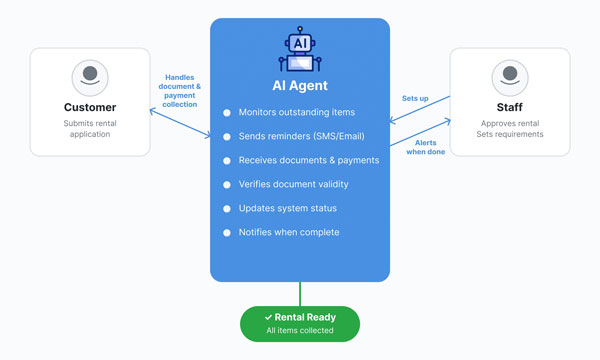
To illustrate a real example my team and I have explored, we looked at how an AI agent could automate customer outreach to collect documents and payments for a rental (shown in the image). Once staff approves a rental, there is often a long tail of coordination. An AI agent can manage that entire process: monitoring what is outstanding, sending personalized reminders, receiving and validating documents, and keeping records up to date. Staff are only notified when everything is ready for finalization.
When implemented thoughtfully, AI helps departments operate more efficiently, expand access and make recreation easier for residents to navigate. It improves both staff and community experiences at the same time.
As departments evaluate AI-powered software, the right questions matter: Does it solve your core operational challenges? Does it simplify workflows instead of
adding complexity? Does it help staff act on the data they already have? And will it continue to improve
over time?
Recreation technology should never feel stagnant. The right partner continues to evolve, incorporate feedback and improve alongside the communities it serves. If a product never changes, it eventually becomes part of the problem.
Technology That Supports Human Connection
I think of AI as a set of capable teammates designed to understand the realities of parks and recreation work. These tools take on the busywork, support residents and help teams move faster, while keeping core judgment and decision-making firmly in human hands.
The result is more time and clarity for staff, better service for residents and departments that can focus less on administration and more on building programs, relationships and community.
AI is moving quickly, and parks and recreation should not be forced to fall behind. With the right foundation, AI helps departments move from reactive administration to proactive community leadership.
It is time for technology that works as hard as the people who serve our communities every day. RM
ABOUT THE AUTHOR
With a background leading product teams at companies like Uber and The Athletic, CEO and Co-Founder Birju Kadakia now focuses on bringing modern, AI-powered technology to parks and recreation departments nationwide at Rec Technologies to help cities run better programs, grow revenue and increase participation. For more information, visit recreation.ai.