

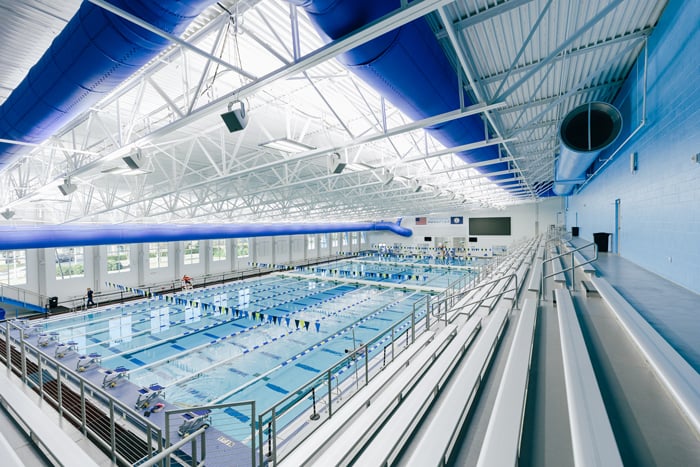
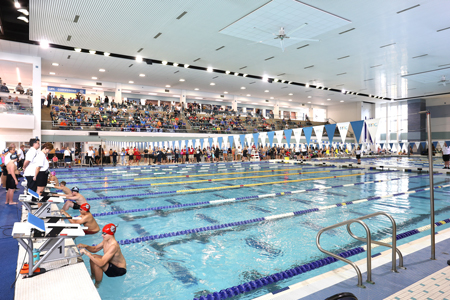
Competitive natatoriums are big buildings with pools customized to help swimmers and divers warm up, cool down and perform at their best in between, with all the support areas necessary and lots of spectator space. Electronic signage, videoboards and PA systems facilitate current and future competitions and garner revenue with ad space.
How the design of these busy locations has evolved helps us understand what’s needed for every aspect of big events to run smoothly for athletes, spectators and staff.
Natatorium design has adapted alongside changes in swimming as both a sport and a spectator experience, said Steve Crocker, director of sport swimming at aquatic planning, design and engineering firm Water Technology Inc.
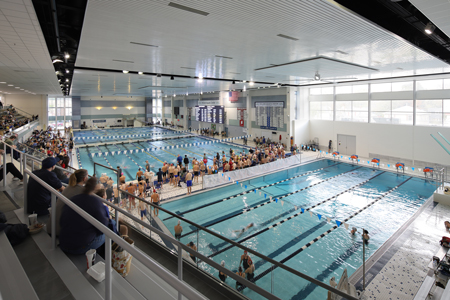
“Competitive swimming began long before modern natatoriums existed,” said Crocker. “Early aquatic facilities were primarily functional, and prioritized participation over facilities. Minimal pool deck space and limited spectator seating were common.”
Crocker said a great example of the early days of swim competition space is the 1904 Summer Olympics. Events were held in a temporary, manmade lake with docks and minimal spectator accommodations, focusing on the swimmers and not the overall experience. Over time, the Olympics helped standardize competition formats—most notably the 50-meter course—which became the foundation for modern pool design, said Crocker.
As expectations grew for spectators, athlete performance and facility operations, natatoriums evolved into highly specialized environments balancing competition, comfort and efficiency.
“Expectations around competition, viewing and facility management expanded,” he said. “As swimming became more formalized, standardized course lengths influenced overall pool design and dimensions. Spectator interest grew significantly in the mid-1900s, which further shaped how natatoriums were planned and built. In parallel, facility expectations increased across operations, athlete experience and environmental control.”
Changes in swimming technique and competition have had a direct impact on pool design, said Crocker. Since the 1980s, a larger portion of races takes place underwater. As a result, pools that were once commonly built at shallower depths are now expected to be significantly deeper to support modern racing techniques.
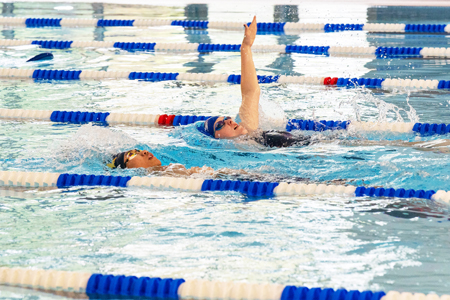
“As competitive swimming grew, so did innovation in design and engineering—design improvements such as deeper gutters, energy-quelling lane lines and increased pool depth contributed to improved swimmer experience and faster pools,” he said.
Out of the pools, universal locker rooms and changing rooms were not around 40 years ago, said Crocker, and now it’s an expectation. The facilities today take into account inclusivity, caregiver access, parents with multiple kids, etc.
“At the same time, swimming has become more of a spectator-focused experience,” Crocker said. “Features such as large video display boards and increased production value have elevated the audience experience. What was once a relatively subdued event now includes dramatic introductions and presentations on par with professional sports.”
The Air in There
Maddie Monroe, a project manager with architect and design company Counsilman-Hunsaker, said personal experience has given her a more intimate view of natatorium shapeshifting. Monroe grew up as a YMCA swimmer and swam mostly in 1970s- and 1980s-era pools.
“And while many of those pools may have been designed to meet all the necessary pool requirements when they were built, they didn’t provide the athlete experience we try to create in natatorium design today,” she said. “Many of those natatorium spaces were designed with no windows, were dimly lit and lacked spectator comfort. Additionally, swimmers typically always left weekend swim meets with everyone’s favorite ‘swimmers’ lung’ sickness.
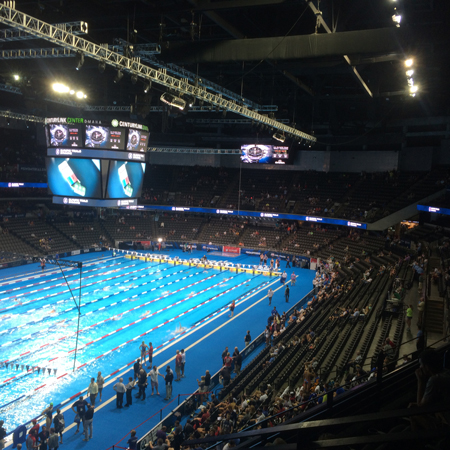
“With advances in technology and better design tools, such as 3-D modeling, allowing for better coordination and computational fluid dynamics (CFD) analysis, which has aided in HVAC and pool recirculation design, natatorium projects have transformed into spaces that are welcoming and healthy, and places community members want to frequent.”
Crocker said early facilities relied heavily on large volumes of outside air. Energy code changes in the 1990s altered how air could be managed, which initially contributed to reduced air quality.
“There was a concerted effort within the industry to successfully address these challenges through significant advances in air-handling technology,” he said. “Air quality improvements near the water surface have also helped swimmers remain healthier, expanding participation in the sport.”
Monroe said that just as air and water quality are hand in glove, advances in pool filtration and chemical treatment have further aided mechanical, electrical, plumbing (MEP) designers in designing better natatorium spaces.
Brian Beckler, a senior principal at architectural firm Ohlson Lavoie Corp., said safer air and water is maintained with energy-efficient equipment as a triple threat of technology. “Advancements in pool equipment and mechanical systems now allow facilities to operate more efficiently while reducing lifecycle cost,” he said. “Enhanced filtration systems help minimize chloramines, which not only improves water quality but also increases HVAC efficiency and overall indoor air quality.
“Ultraviolet disinfection systems can eliminate up to 99.99% of bacteria, viruses and parasites, substantially reducing the need for chlorine. This results in clearer water, less eye and skin irritation for users, fewer airborne chloramines and lower maintenance demands.”
Faster & Faster
Alecia Stegenga, project manager with Aquatic Design Group, said design features meant solely for competition purposes hit a turning point in the late 1970s—not only for faster water, but also to make more space for spectators. As the popularity of indoor competition pools grew, designs began to feature large elevated seating with capacity for thousands of fans.
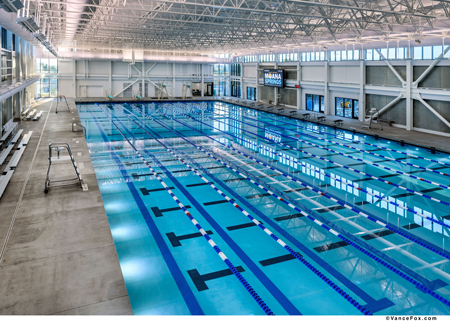
“This was our true ‘Industrial Revolution’ for water: moving from simple tanks to precision-engineered environments designed to kill waves and break records,” she said.
Stegenga said when organizations are looking to build a new competition facility, a main point of focus is to have a “record-breaking” facility, where the speed of the racers is the primary goal. New natatoriums are heavily influenced by the latest technology and design philosophies, most in service to building what she calls “21st century speed machines.”
“In the high-stakes world of competitive swimming, we are designing for ‘quiet water,’” she said. “Every gutter, every lane line and even the 3-meter depth is mathematically calculated to dissipate the energy of a wake. We aren’t just building pools, we’re building aquatic drag strips.”
Features of these new pools include standard all-deep pools, deep gutters, specialty competitive equipment, timing systems with video scoreboards, movable bulkheads, movable floors and anti-wave lane lines.
“Competition pool clients are asking for a fast, efficient pool that meets the ever-changing demands of worldwide competition,” said Stegenga, and multi- sport and multifunction pools are commonplace in today’s aquatic designs.
“Creating flexible pools that can accommodate disparate programs is crucial in the success of competition pools,” she said. “The growing popularity of water polo has contributed to the growth of competition pools. Yesterday’s 8-lane by 25-yard pool is today’s 38-meter—up to 15 lane—by 25-yard pool.”
Also on the rise is an increase in the design of stretch 50-meter spools with multiple bulkheads, said Stegenga. This design accommodates 25-yard, 25-meter and 50-meter swimming, multiple water polo courses, competitive diving and artistic swimming.
Beyond Competition
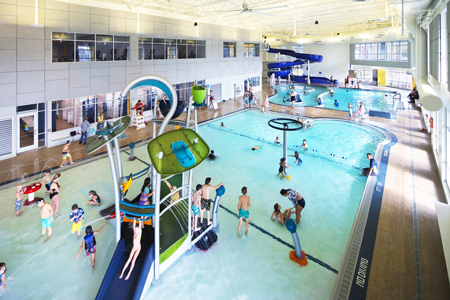
While faster pools are important to competitive swimming, and flexibility is important to accommodate myriad competitive sports, many modern natatoriums attempt to bridge the gap between competition pools and community pools, and incorporate amenities for all members of a community, said Stegenga. These aquatic spaces include therapy pools, recreational pools, multipurpose pools, spas and more.
“These spaces are built to support the entire community and increase revenue opportunities,” said Stegenga. “Innovative funding models—ranging from municipal bonds to specific amenity taxes on tourism and cannabis—are fueling these different aquatic centers. These facilities leverage diverse water features to serve as comprehensive hubs for public health and multi-generational wellness.”
Amanda Duimstra is the director of just such a hybrid facility, the Holland Aquatic Center in Holland, Mich. She said the location is a community center that consists of nine pools, as well as a dryland community wellness center. The pools include a 50-meter competitive pool, 25-yard warm-up/cool-down pool, 25-yard instructional pool, 20-yard community lap pool, therapy pool, and recreational lazy river and splash pool. Everything is indoors and open year-round, seven days per week.
“Our facility users range from seniors in need of warm water, to athletes looking for training facilities, to small children learning to swim,” said Duimstra. “Programming supports instructional use, competitive training and competition, and community recreation and wellness.”
Duimstra said community feedback during the initial design phase indicated that the community and recreational users wanted to be able to use the facilities while the pool was hosting large competitive events. “This feedback also indicated there was a large demographic that wanted warmer water for recreational and wellness,” she said. “Last, but not least, we understood that the instructional programming we provide has great support from our community and continuing to teach thousands of kids to swim every year was going to continue to be the heart of our mission.”
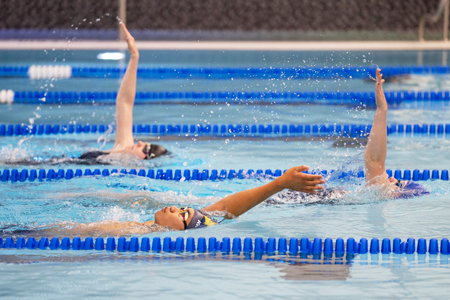
The two biggest differences between the 50-meter complex natatorium and the community pool space are pool temperatures and changing facilities, Duimstra said. Athletes and competitive events require cooler water at about 80 degrees, while community users are most comfortable in 85-degree water.
Also, the 50-meter natatorium is accessed using standard men’s and women’s locker room facilities, while Duimstra said the community space is best served with universal changing rooms so those who want more privacy, those that are changing as a family, or those who need an assistant can move through the changing spaces together.
“We have multiple pools that are capable of serving several different demographics,” Duimstra said. “Depending on the time of day or day of the week, pools can be scheduled to serve the greatest need. Being able to shift the pool activities throughout the day works really well for us.”
Resource Conservation & Other Trends
“We are entering an era of the ‘decarbonized natatorium,’” Stegenga said. “With new regulations pushing us away from traditional gas boilers, the cutting edge is now in geothermal loops and high-performance heat pumps. We’re proving that a facility can be both a high-performance athletic venue and a responsible, energy-neutral citizen. Evolving technology has also been incorporated into natatoriums through automation and controllers that help provide better water and air quality, and reduce water use, gas use and electric demand.”
An ongoing trend is designing a flexible aquatic center with operable walls and ceilings to marry aesthetics with energy efficiency and air quality, said Stegenga. “By blurring the line between indoor and outdoor spaces, these designs cultivate a healthier atmosphere for both athletes and staff while significantly slashing overhead,” she said. “When the weather cooperates, these ‘breathable’ buildings allow energy-intensive HVAC and dehumidification systems to ramp down, letting nature handle the climate control.”
For water-related energy savings, variable frequency drive (VFD) pumps optimize performance by adjusting motor speeds to match demand, significantly lowering energy consumption, said Beckler. “Modern dehumidification systems more effectively manage high humidity levels, protecting building materials and improving occupant comfort,” Beckler said. “In addition, heat recovery systems capture thermal energy from exhausted air and transfer it to incoming fresh air, reducing heating loads and overall utility costs.”
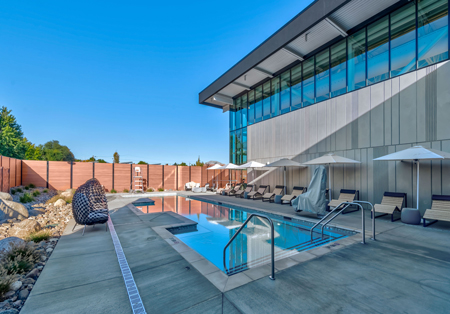
Beckler said more clients are requesting access to outdoor spaces for socializing and events, while Monroe said there have been more requests for design that incorporates Safe Sport principles.
“Especially at facilities with large quantities of age-group athletes,” said Monroe. “Athlete safety has always been a concern, but we have seen a more detailed approach to ensure industry-best circulation through the natatorium as a whole, allowing for better separation between the athletes, coaches, officials and spectators.”
Build Your Design Partnership
Finding the right design partner is crucial to a smooth process and client and consumer happiness and Crocker said there are steps to ensuring this. “In my opinion, there are three leading best practices that help inform better decisions and set realistic expectations: One, understand your client’s program; effective collaboration begins with a clear understanding of the client’s program and goals,” he said. “Two, help your client understand possibilities. It is important to help clients understand the full range of possibilities for their facility, including how design decisions affect both competition and daily use.
“Finally, learn from what’s out there. Visiting and touring other natatoriums allows clients to learn from existing facilities, including what has worked well and what has presented challenges.”
Stegenga said the best designs start with hiring a team of architects and engineers who are familiar with the specific demands and challenges of natatoriums and aquatic centers. “From there, the best practices focus on the conversations: talking with the client to ensure you have the best picture of what they’re hoping to see, talking with stakeholders to ensure their needs are being met in the design, and talking with financial stakeholders to ensure funding is available for the amenities envisioned,” she said.
Monroe said her goal when working with clients is always to design the pool to best fit the client’s needs.
“I always want to educate clients on all of their options for them to pick the best fit for them,” she said. “A good example is how our timing systems are designed. We want to accommodate how the client wants to set up their meets within the pool and stage their officials, volunteers and staff, whether that be on the pool deck or in a dedicated pool office or timing room. All of those are crucial conversations we have during design to ensure our pools meet all their needs.”
Beckler said whether the focus is competition, recreation, wellness or a combination of uses, aligning early on vision, performance standards and community priorities sets the foundation for success. Equally important is maintaining transparency around budget, costs and schedule. “Natatoriums are complex, highly technical facilities, and being realistic about construction costs, operational implications and timelines helps build trust and avoid surprises,” he said. “Early conversations about day-to-day maintenance and operations are critical, as long-term staffing, water chemistry management and energy use will directly influence design decisions.”
A balanced, well-coordinated program is also essential, said Beckler. This includes thoughtfully planning each body of water, pool equipment systems, locker rooms and accessible changing rooms, adequate deck space for athletes and families, and support spaces such as multipurpose rooms, coaches’ offices, meet management areas, spectator seating, storage and access to outdoor space. Every component should work together to support both peak events and daily use.
“Finally, developing a clear list of alternates and cost options provides flexibility during bidding, while proactively addressing acoustics and integrated technology ensures the facility performs well and delivers a high-quality user experience,” he said. “Together, these practices create a collaborative, transparent process that leads to durable, efficient and community-focused natatoriums.”
None of the designers feel that the industry has reached a peak of natatorium design, with so much innovation ongoing and athlete and client needs changing.
“I expect that future natatorium design will focus on increased flexibility, particularly in pool configuration,” said Crocker. “Concepts the industry has dabbled in but could easily become pinnacle evolutions include adjustable or reconfigurable pool floors that allow for different lane layouts, event types or aquatic sports. This give facilities so much versatility leading to increased life usage.” RM