

Recreation and community centers are increasingly important central hubs where community members gather for a wide variety of activities. And the design of these buildings keeps advancing to better support that purpose. At the same time, architects are also making these centers more sustainable, flexible and responsive to the changing needs of their multigenerational patrons. This article shares insights from leading architects who are designing recreation and community centers for municipalities, K-12 schools and universities on some of the most important trends they are including in their newest projects.
Multigenerational, Multi-Use Spaces
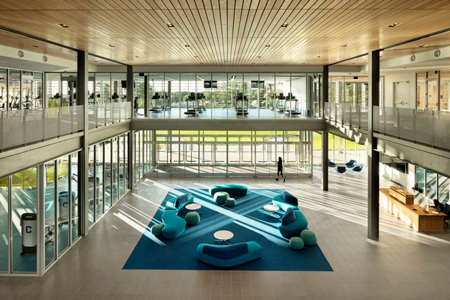
One trend that continues to be more prominent in community and recreation centers is a focus on making them valued programming and social spaces that appeal to patrons of all ages.
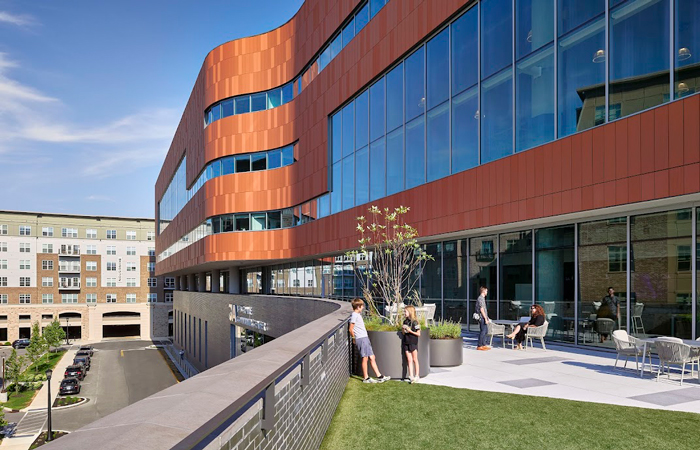
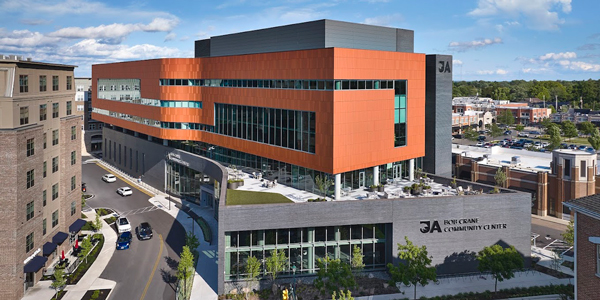
Keith Hall, Columbus managing principal and owner of MSA Design, recently collaborated with Perkins&Will on such a center in Upper Arlington, Ohio—the Bob Crane Community Center—made to be as multigenerational and inclusive as possible. “It’s a place where everybody is welcome no matter where they’re coming from within the community, and in many cases, outside the community,” Hall said.
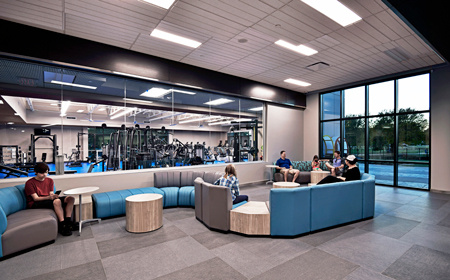
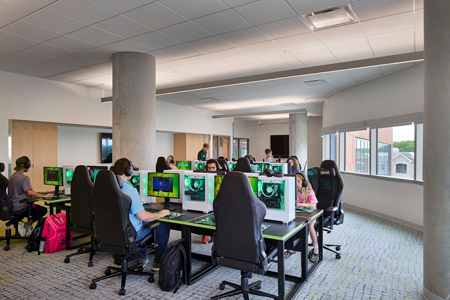
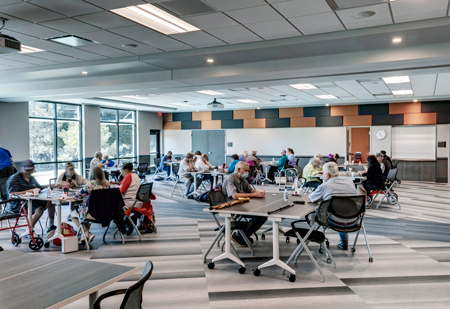
Within the center, one floor features teen amenities that include an esports area and an area to hang out and watch TV, as well as a separate area for seniors that includes billiards, shuffleboard and other amenities similar to what the seniors enjoyed at their previous senior center.
“And what we have found out now a year later is that the seniors, the teens and even preteens are utilizing the billiards and shuffleboard area and socializing together,” Hall said. “And that, to me, is the heart and soul of what a community center is about.”
The center also includes an indoor playground for younger kids that is strategically located on the front edge of the project and often open to non-members of the facility from the community. Also near a café, a party room and the center’s aquatics offerings, the playground and surrounding amenities allow for several rental package options for birthday parties for kids from 2 to 7 years old.
“There’s a pressure on municipalities to do some sort of revenue generation within their facilities to offset community programming they want to offer that may not necessarily pay off,” said Brent Ross, senior associate and sports, recreation and entertainment practice leader for Perkins&Will. “So we’ve also seen things like golf simulators or other elements that could be rented out associated with those party rooms.”
To ensure broader appeal, Ross is also seeing the incorporation of more passive spaces that hold appeal for people in the community who just aren’t interested in sports or leagues.
Emily Parris, associate principal for Sasaki, is also seeing this in her design work for university recreation centers. “From an entry perspective, we are really looking to divest from the aura of a gym or a fitness center and invest more in it being a place where people overlap for wellness,” Parris said. “Having really calm lighting and really careful space organization makes people feel gently welcomed and encourages people to spend time in those entry moments, whether it’s a lounge or just a desk where you can interact and talk to somebody.”
Flexible Environments
At the under-construction Recreation and Wellness Center at the PK-12 Brimmer and May School in Newton, Mass., outside of Boston, flexibility is a key element of the design that is increasingly seen in new rec centers.
“They needed a new gym, but it’s really for everybody, not just the student-athletes,” said Carla Ceruzzi, an associate principle at Sasaki who often works on K-12 projects. “So there’s wellness, there’s a couple of classrooms, and everything needed to do double or triple duty.”
That includes a room that can be used as a traditional classroom or for activities like dance or yoga. The classrooms all feature a removable divider that can keep each space as one larger classroom or split them into two smaller classes. And the spaces also accommodate wellness classes, fitness, a nurse’s office and other activities. “It’s a long list of uses, but it’s not a long list of rooms—it’s just being flexible,” Ceruzzi said. The gym area featuring retractable seating will likewise also be used as a venue for graduation, prom and all kinds of other events that the school is unable to do on campus currently.
The Brimmer and May School also intentionally included sheltered outdoor space where people feel comfortable and where parents can talk after they’ve dropped their kids off. “After-school activities and kids’ sports are also an opportunity for the parents to meet one another and the families and strengthen the overall school community,” Ceruzzi said.
In a senior center that’s now under construction, Stephen Springs, senior principal of Brinkley Sargent Wiginton Architects, is likewise using lots of moveable walls that are all acoustically rated to enable the spaces to be used for large events, small events and all different sorts of programming.
“A lot of times movable partitions are known for not being very acoustically helpful, and there’s two factors,” Springs said. One is specifying a high-quality, highly rated acoustical partition. Another is how the partition, ceiling and mechanical systems are detailed. “Just because your sound isn’t going through the wall doesn’t mean it can’t just go right over the top of it,” Springs said. “It sounds really dumb, but you’d be surprised how often we see acoustical partitions that have open ceilings above them. So you just wasted all that money on that partition from an acoustical standpoint.”
If designed properly, however, these elements can offer true flexibility that works. “Within reason, you can program them like they’re independent real rooms, and you can open them up and have a giant room for a big event, and it’s easy,” Springs said.
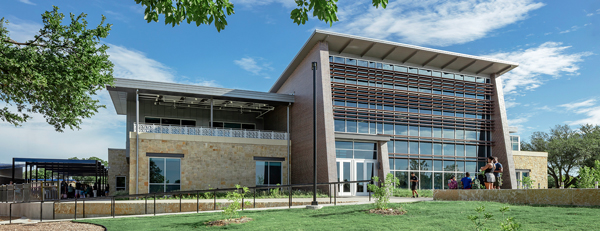
Springs also noted the growing trend of a different kind of multiuse environment—shared buildings hosting combined functions such as at the East Arlington Library and Rec Center in Arlington, Texas. It includes a front desk that’s shared between the library and recreation departments, creating operational efficiencies and other benefits. “People who went to the library would get exposed to rec programs they didn’t know existed, and vice versa,” Springs said. “So it was very good for that community from an exposure-to-programming standpoint.
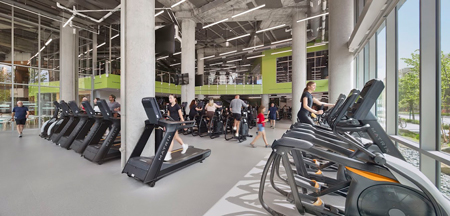
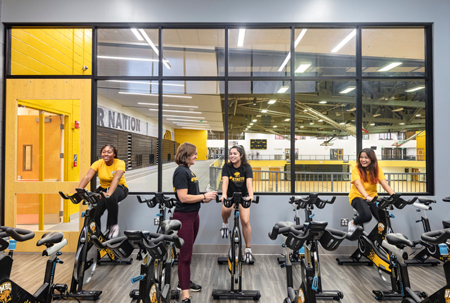
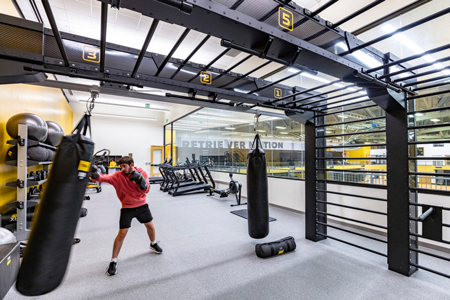
In the university environment, Parris highlighted another example of increased flexibility in the University of Maryland, Baltimore County Retrievers Activity Center. That project renovated an older basketball-focused rec center to add a jogging track, more than 20,000 square feet of expanded fitness space, increased daylighting and transparency, and numerous areas featuring vibrant pockets of activity.
“It has a bunch of different neighborhoods instead of bigger exercise rooms where they could specialize some of those areas through equipment,” Parris said. The spaces allow the university to offer very specialized classes in spinning or Pilates or boxing for smaller groups to attract broader audiences while also making the center more future-proof. “It’s also easier to say, OK, five years has gone by and nobody’s doing Zumba, so let’s outfit this room to be F45 or something else that’s a little more in tune with the student body,” Parris said.
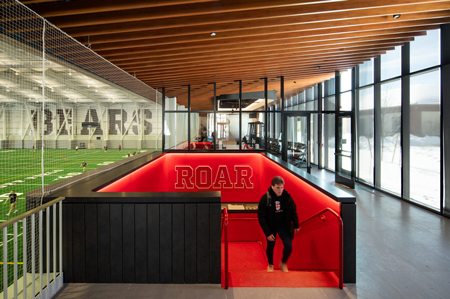
Another design trend giving universities and communities more programmatic flexibility is the building of more large indoor turf facilities, such as recent projects Parris worked on at Brown University and Cornell University. These facilities vastly enhance programming opportunities, especially during the winter, when Parris notes that Brown’s facility will be open 20 hours a day.
“The varsity teams will come in, but when they leave, that space can be divided into four different sections of field turf hosting four different rec spaces,” Parris said. “Most of the day, there’s half or more of that facility, including the weight rooms, that’s open to anybody to come in and move … you can come in and actually play soccer or play frisbee or try to kick a field goal because you’ve never done that before.”
These facilities can also be relatively cost-effective because the high-ceilinged buildings in northern climates can get away with using air circulation instead of air conditioning. In recent indoor turf facilities at Brown, Cornell and Dartmouth, the design just uses gravel crushed stone with a concussion pad and then the turf sitting right on top of it. “It ends up being a huge cost saver, just given the scale of the space,” Parris said. “But it also ends up having the turf perform better. If you run across the indoor space and spill Gatorade, it filters down to the ground like it would on an outside field. We don’t have a slab underneath there holding moisture.”
Brand Identity
Recreation centers across all markets are also increasingly committing to new levels of branding. At the Bob Crane Community Center, that’s accomplished with the use of the city’s iconic Golden Bear reflected in both the city logo and in the Parks & Recreation identity that’s seen across the community center and its programs.
For Deer Park, Texas, Springs recently worked on a project that replaced an old outdoor pool with a new indoor one that will be attached to an existing recreation center. The result is a new entry experience for patrons of both the new pool and the existing rec center. “They didn’t have the budget to also renovate the original rec center, but it still allowed us to put a completely different face on the building and a new presentation to the community,” Springs said.
For the indoor pool, the project enhanced the branding through material choices and inexpensive vinyl graphics created by a graphic designer to execute a rainforest theme. The project is in a disadvantaged part of town and will help patrons learn to swim while the theming intentionally reinforces a fun, leisure-focused environment.
“A lot of my municipal clients don’t necessarily embrace theming because it can kind of date a place, but they really did here because they wanted to get a little bit more of a waterpark destination feel into the building, even though it’s a municipal rec center,” Springs said. In addition to allowing for theming on a tight budget, the vinyl graphics also allay fears of the pool theme becoming dated because they can be removed or replaced easily at any time.
Sustainability
Sustainability, unsurprisingly, continues to be a growing priority for local community, recreation and wellness centers. And for those that can afford the upfront cost, rooftop solar panels and energy-efficient building designs can often offer a long-term benefit not only to the environment but also in terms of operational costs due to reduced energy bills.
“Solar is probably going to work best in the southern areas; we do incorporate geothermal fields and high-performance and energy-efficient envelopes and systems,” said Frank Parisi, managing principal and sports and recreation market leader for Williams Architects. He also noted that low-VOC materials are also a strong priority and consideration in all new designs for his firm.
But solar installations are also increasingly seen in other regions like the Midwest. For instance, the Oak Park Community Recreation Center that debuted in 2023 produces all its energy onsite using building-mounted photovoltaic arrays tied to a battery system as the facility pursues a net-zero goal. The panels are placed on the roof and wall as well as on a parking lot canopy, and triple-glazed windows also enhance energy efficiency as the building pursues net-zero energy usage.
The Bob Crane Community Center in Ohio features 400 rooftop solar panels that will offset more than $50,000 in energy costs annually while also reducing emissions by 215 tons each year. The Bob Crane and Oak Park projects both feature real-time dashboards in their lobbies that highlight energy usage and savings.
Other sustainability features in the Bob Crane Community Center include heating of the pool water using flat-plate heat exchangers instead of a separate gas heater, water-reducing features such as low-flow plumbing fixtures and cooling towers, and the use of natural materials.
The center’s vertical design in an urban environment also contributes to sustainability. “Usually these are sprawling facilities, but we can do this in a dense fabric, which saves land,” said Bryan Schabel, design director and principal at Perkins&Will. “It provides better adjacencies to urban communities, and I think that it becomes more of a shared asset just because it’s in a more dense situation. As opposed to having to drive someplace, you’re walking someplace.”
While buildings are becoming more and more sustainable, the focus on earning certifications like LEED to prove it are becoming less of a priority. “I think LEED certification, probably in the early ’90s, was probably a launching point to making everyone be conscientious,” Parisi said. But now local codes and industry standards have improved to make the accreditation itself sometimes less of a priority. “Probably every building that comes out of our office is [equivalent to] LEED certified in one form or another, whether I get accreditation or not, because the codes and the standards you have in the industry basically dictate that,” Parisi added.
What Parisi is seeing more of is demand from clients for net-zero buildings and noted that it’s important to discuss those goals with the client in the planning phase to ensure that those considerations are part of an integrative approach to the design and its sustainability.
“If I have a mission to actually save energy, and that reduces building energy costs and therefore your operational cost, guess where I can put the money? I can put it into additional programming,” Parisi said.
Springs is likewise seeing less demand for LEED-certified buildings in certain markets. “A lot of what we used to do special for LEED has become codified and old LEED is now current sort-of baseline,” Springs said. “So the new LEED is kind of pushing the envelope outside of certain markets that have truly embraced it and has maybe pushed some cities that are more conservative outside of their comfort zone.”
Springs also noted that in the past, LEED has rejected his use of regenerative media filters for pool projects based on the notion that points have to be awarded based on a broader strategy than buying this widget or that widget.
“But to me, the most no-brainer technology out there is regenerative media filtration. It’s a very green thing and it’s not for everyone,” Springs said. “Your traditional pool operators that are used to high-rate sand filtration want to do that because it’s what they know. But a more progressive department that’s willing to go to regenerative media can save a tremendous amount of water, and consequently, a tremendous amount of effluent just by adopting that technology.”
Springs also noted that his firm’s work in the North Texas market focuses on energy-efficient elements such as reflective roofs, higher R-values in the walls and use of more efficient systems. While LEED standards emerged from a baseline of office buildings, energy efficiency is even more important for rec centers with longer hours and even more essential for natatoriums.
“Rec centers don’t operate like an office building, and a natatorium is never off,” Springs said. “It’s operating 24/7/365. Strategies that save money operationally from an energy standpoint save even more in buildings that have continuous operation because they never have the opportunity to shut down. Every dollar you save per hour on energy in a natatorium means you’re saving twice as much money overall as you’d save in an office building.”
Outdoor Amenities
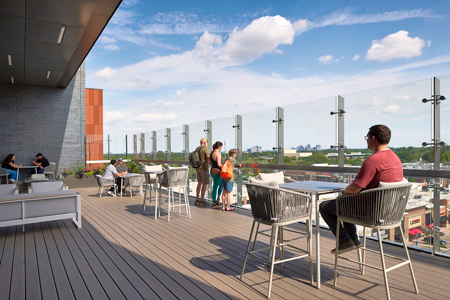
As buildings become more sustainable, designers are also connecting them more to the outside whenever possible, whether that means locating them near local trails or including outdoor fitness areas. “One thing that we’ve been trying to incorporate is outdoor training areas that are totally connected to the indoor component of the fitness,” Parisi said.
In addition to literal connections to the outdoors, biophilic designs that let more light in are also a growing priority. Ceruzzi noted the importance of including good natural light into large gym spaces to make them a nice place to be for several hours during the day. But it has to be done right. “We pay very close attention to doing sun studies, making sure that we aren’t compromising the performance of a basketball court. Where we’re adding the windows, and what type of glass, really matters,”
she said.
Designing for access to sunlight and greenery is increasingly also considered a potential contributor to better mental and physical health. “If I go into a facility and the facility is lit with natural daylight, there is an uplifting effect that you have on wellness for an individual, whether you’re working out or in a communal space,” said Parisi.
Privacy and Connection
As people increasingly appreciate more hotel-lobby-like lounge and entry areas that allow for both quiet reflection and social interaction, they are also seeking more privacy when it comes to locker rooms. When budget allows, this includes the option for private rooms that might feature a toilet, changing area and shower.
“Frankly, people are just not entering into the traditional locker room and finding themselves comfortable, so they’re demanding a different type of facility,” Ross said. Many designers are seeing demand for cabana-style locker rooms with common areas for lockers or hooks and sometimes sinks.
For one recent project, Springs worked with a client who wanted to get rid of showers altogether. “They said that nobody showers, so all we have are just restrooms, with cubbies and nook express lockers out on the floor,” he said. “I’m curious to see how it operates over time, and whether they get criticized for that. But that’s some of your most expensive square footage because it’s so dense and full of plumbing, so it gave them the ability to put money elsewhere in the project for usable spaces.”
As with any other project, difficult budgetary choices are a part of any new recreation or community center design. But as recent design trends for these buildings show, investing in options that support community, flexibility and sustainability are a good bet to pay off in terms of payback and customer satisfaction over the long run. RM