


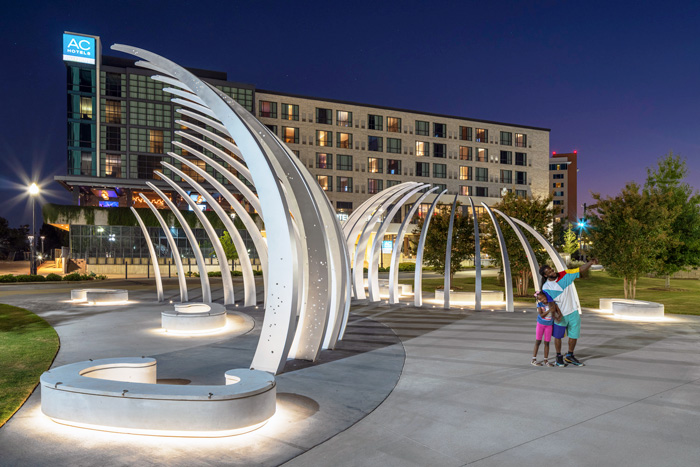
Landscape architects today are designing public park systems by incorporating surrounding environmental elements and community needs into their master plans. Much care is being taken to ensure that innovative design is not undertaken at the expense of local geography, community needs and inclusiveness, or the ability to maintain and sustain the space.
Insofar as design trends, several have emerged over the past decade, said Scott Crawford, principal, RDG Planning and Design. “One is ensuring that outdoor spaces and public access are made as flexible as possible. There are many examples of parks still being designed for one singular use, such as baseball or softball, but finding capital to support those spaces has become challenging. Today, we are finding that even those spaces for sports and recreation are being designed in such a way that they can be flexible open spaces used for a variety of different activities.
“From a purely design perspective,” Crawford continued, “The most common example of that is the orientation of what used to be semi-traditional wagon wheel layouts for hardball or softball, where all the dugouts and home plates were in a central area. That has almost been reversed now, where backstops oftentimes play into each other, and the outfield orientations allow for things like soccer, lacrosse, flag football, and rugby. All can be played in large open spaces. So flexibility and multi-use fields and park open spaces is a trend.”
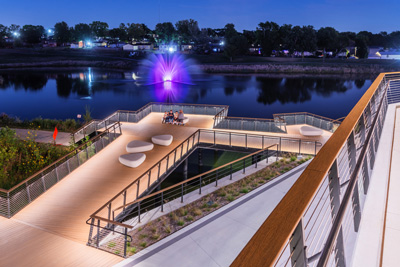
The overall resiliency of design and the sustainability of materials being used are other trends, as architects and engineers look for ways to limit the environmental impact of their park designs.
Sustainability, said Jennifer Cross, principal landscape architect with HDR Inc., “is inherently the underlying route of resiliency, but it is very much integrated into that component. I don’t think there is a project I have worked on that doesn’t include sustainability.”
Central to sustainability is a conversation with stakeholders about whether decisions made on materials, designs, or park improvements can withstand the next 25 years of use. “How do we think about using materials that are going to stand that test of time and public wear-and-tear in an outdoor environment?” Cross asked. “This is where we really begin to think about sustainability—utilizing spaces to create places that will be able to self-heal and be repaired as they get used.”
Sustainability is always in the conversation when it comes to park design, agreed Hana Ishikawa, design principal, Site-Design Group. “Codes and regulations keep changing as well. Stormwater ordinances over the years have gotten a lot more stringent,” for example.
Protecting and preserving land for public access, especially in rural areas where more land is available, is becoming more important, especially as communities grow and agricultural spaces are repurposed for conservation. Within rural areas, designers can take advantage of larger open spaces, whether these tracts of land fall within a county or state park system, Cross noted. Less productive rural spaces are being transformed into public-access conservation zones by local communities.
Funding Impacts
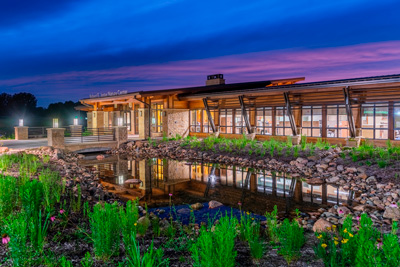
When thinking about landscape architecture in parks, designers face the challenge of “doing a whole lot more with less,” Cross said. “That is not necessarily a new trend, but it is a trend, even to the point where parks are expected to break even as far as their operations and maintenance.”
Ishikawa agreed. “Doing more with less is something architects always deal with,” she said. “The private-sector sources are shrinking in terms of how much budget they have; however, the public sector is getting a little better than pre-pandemic.”
Because federal and state community development grant opportunities are tight and highly scrutinized by authorities, “we are now seeing a different way that public parks are being built today versus how they were 20 years ago,” Crawford explained. “Twenty years ago, for the most part, parks were built with public funds, through a city, county, or some state funding program. But now, the majority of public park improvements over the past decade have trended more toward a public-private partnership—using private funds where a third portion might come from grants or other funding streams outside of the normal funding sources.
“The process that brings in donors or project partners to help with funding does tend to inform design of the park as well,” Crawford continued. “We have instances where we were hired by a nonprofit as the ones that were funding improvements on a public park, and they had a donor constituent with program desires that they wanted to see built within the park design. All of it in the end would be publicly accessible. This kind of partnership is a different approach to how parks have traditionally been built in the past. It works particularly well in tight, dense, urban spaces. As a funding mechanism, it is different from local, state, and federal grants, and it is a trend.”
Urban Innovations
As populations shift from rural to suburban or even more densely populated communities, the need for urban park planning and design also grows. But neighborhood needs in urban areas are becoming more challenging as cities look to redevelop areas where maybe there hasn’t been access to open green space.
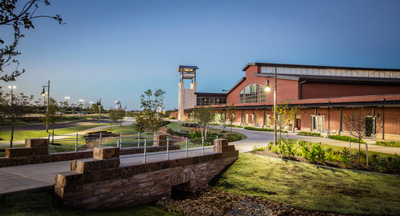
A classic case study in urban design is the Perkins&Will-designed Atlanta Beltline project, which won an award in 2024 from the American Society of Landscape Architects (ASLA). “We were contracted with Atlanta Beltline Inc., an entity affiliated with the City of Atlanta,” said Micah Lipscomb, landscape architect and senior associate with Perkins&Will. “The project originally started as a thesis of the urban designer Ryan Gravel, who studied at Georgia Tech University. There was a previous study about using the abandoned railroad lines for recreational trail use in the 1990s. Gravel championed the use of the corridor as a comprehensive redevelopment centered on light rail and a multi-use trail for recreation.”
Over several years the idea built public support, Atlanta Beltline Inc. was formed to advance the project, and a tax allocation district was formed to fund the project. Perkins&Will was hired in 2010 to complete the corridor design and complete construction documents for the Eastside Trail—the first section of multi-use trail in the corridor, Lipscomb said. “This was very successful, and it built enthusiasm for the project. We also were part of the team that designed and documented the Westside Trail, which opened in 2014. Since then, additional sections of multi-use trail have been constructed, with the goal of completing a loop around the city. The light rail/street cars that were envisioned have not been built yet.”
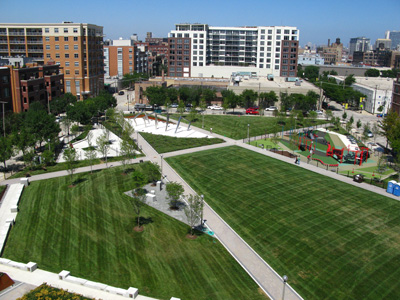
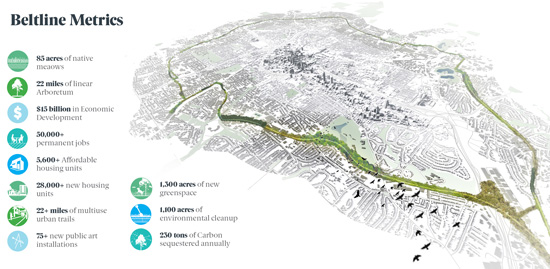
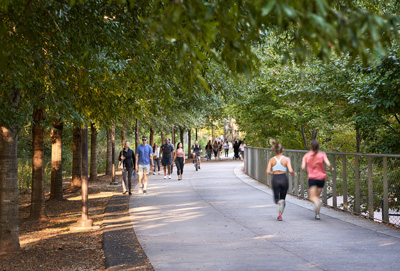
Connecting Atlanta, which has always been a car-dominated city, is a big part of the vision for the Atlanta Beltline project—the 22-mile corridor runs through 46 different neighborhoods in the city. Fifteen years into the project, approximately $766 million in public investment has led to more than $8.2 billion in private investment; and 3,833 of the planned 5,600 affordable housing units along the corridor have been constructed or preserved to date. The finished trail segments have set a new benchmark for public realm design and execution in Atlanta, inviting new and existing businesses to orient their storefronts to the activated greenways.
“Presently there is new development happening that is facing the Beltline, which is a pedestrian corridor currently. And now it is easier to safely go from one neighborhood to the next on a bike without interacting with cars, which is remarkable, considering where Atlanta was 15 years ago. I think that is a great aspect of the Beltline,” Lipscomb said.
As always with a project of such a scope, there were challenges. As designers approached the project, they looked to come up with a design and material palate that would be durable over time. It was also important to be distinctive, so that visitors arriving at the Beltline know they’re on the Beltline, and that it wasn’t just a concrete sidewalk. “That involved choices like the way the granite walls were designed, and stainless-steel guide rails. All the materials used were very simple, but very durable so that they could last decades,” Lipscomb explained. “I think we succeeded because the Beltline does have its own identity.”
But beyond durability and a stand-out appearance, designers also wanted to incorporate variety, which they achieved by incorporating art and nature. “The whole system is a linear arboretum, with variety in the types of trees and the way they are arranged throughout the corridor. That was a big driver in the design in terms of expressing a cohesive identity for the Beltline, but also offering opportunities for variety.
“The Beltline has catalyzed an altogether different type of development for Atlanta: dense, urban, pedestrian-focused, socially cohesive environments,” Lipscomb said. The 22-mile loop is scheduled for completion in 2030, but until then the project will continue to evolve a civic and cultural space that is rooted in the city’s history, deeply committed to its future well-being, and unlike any other Atlanta experience.
Engaging & Inclusive
While public health was a big driver of the Atlanta Beltline project, and indeed is a significant driver of many, if not most, public park projects, that can mean much more than getting people involved in physical activity outdoors. Creating social and community connections is another part of public health, and one that designers are increasingly taking into consideration as they plan parks and public spaces.
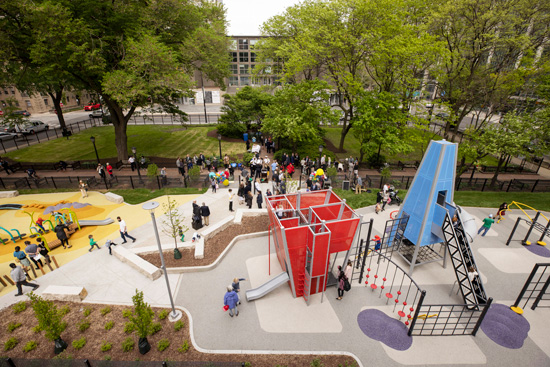
There is much talk among designers about initiatives to encourage many different groups and types of people to participate in the park experience, Ishikawa noted. “Twenty years ago, you’d have a few picnic tables, and seating areas with groups appealing to a wide variety and demographic. Now we talk about the one individual who might not fit into a demographic group setting.”
What if that individual is hard of hearing? What if that person was on the autism spectrum and doesn’t want to be around a lot of people? What about a family with a baby? What about a 12-year-old? What about middle-aged adults caring both for their young family along with their parents? As designers, when it comes to people and spaces, Ishikawa and her design teams are trying to include everybody in all scenarios that can happen in a space.
Meeting with stakeholder groups is usually key to understanding what people are looking for. Data can help designers make informed decisions and to have a transparent decision-making process. That transparency can help when stakeholders have questions about why some requests can or cannot be accommodated by the design. “We are doing more public outreach to ensure that everybody is understanding why or why not some park amenity is implemented into the park system,” Cross said
Accessibility and inclusion in play areas also continues to be a topic of discussion, Ishikawa said. “We work pretty hard on what is best for everybody.”
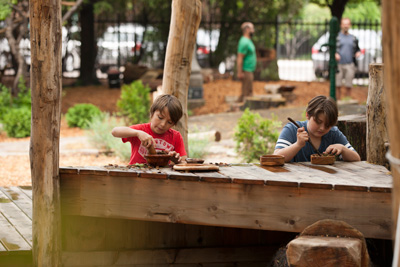
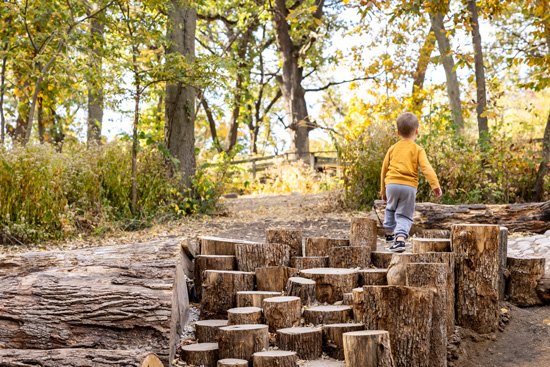
Nature play is another trend, and one where inclusion trends have been making inroads. “There has been a void in universal park design in nature play,” Cross said. “A just completed project, Acorn Acres in Bellevue Neb., is literally in a forest, and it is a play space for children. The client request was for it to be universally accessible and inclusive.”
The project began with treehouses built around a decade ago, but children using mobility devices were not able to climb and play. Now, ramps allow everyone to access the treehouse. “The result was a grandparent in a wheelchair was able to take her children into the treehouse and go in there with them,” Cross said. “She was so happy in the space because she could play with her grandchildren. I believe those are the moments that create those core memories for families to continue to stay outdoors.”
Technological Integration
Of course, with the advent of AI and the ongoing improvement of technologies and apps for not only designing but also managing and operating spaces, not to mention the public’s expectation when it comes to seamless connection, the integration of technology is one of the biggest trends in park landscape design. “That is, how do we incorporate Wi-Fi or other elements of technology into the experience?” Cross asked. “We are even starting to think about artificial intelligence and how that integrates into park design.”
Technology is a controversial point, Cross believes, because parks are meant to be the place where people go to have fun. However, from smartphones and e-readers to GoPros and more, most people these days are carrying their technology with them. And people expect to be able to use those technologies in the park.
As designers, Cross continued, “how do we ensure that we have spaces that provide shade and comfort, and places to charge devices, and all those things, at a bare minimum. People want to work out outdoors, bring their tablet, and take their calls in a place that has a little bit of sound attenuation—a space in the park where it is quiet and private.”
Designers are also talking about trying to get more park amenities off the grid, Ishikawa added. “Solar lighting is something a lot of our clients have asked for. Snow-melt systems are a big topic. Charging stations and having internet access, especially near university campuses. Places where students and faculties can plug in.”
Using AI is the start of a trend, Cross said. For example, AI can help park planning teams analyze where people are going using location analytics technology that provides insights into foot traffic patterns and consumer behavior. One such piece of software uses data from mobile devices to track how people move around and interact with different places, measuring how much time they spend in parks, where they are going, and how frequently they visit.
“There are some data metrics that we are beginning to see that can help inform us how we might design a park insofar as how frequently someone is coming and how much time they are spending there. This helps as we think about the size and scale of the park site.”
Cross recommends that municipalities think of a public park as a privately owned destination park. “How do we make sure parks have a variety of available activities? Using the data collected by using AI tools, we might discover that the average user is spending an hour in the park. But if you are looking to have an economic benefit, a return on investment, you’ll want people to spend time and money at a roller rink or the skating rink in a park. Or visit a community center to attend a class. This is one of the biggest things we are seeing parks asking us for: ‘How do we get people to spend more time or spend more dollars in the neighborhood so we can justify the cost of operation?’” RM