



It wasn’t so long ago that designing play spaces to be more inclusive was an up-and-coming trend, whereas these days it’s becoming more the norm.
“We see a strong trend toward design that encourages true inclusion—spaces that not only allow access, but also provide more challenging experiences to allow children of all abilities to truly play together in the same space,” said Sarah Shepherd, regional sales director for an international playground equipment manufacturer with a U.S. office in Greenville, S.C. “Elements are more focused on natural play and less prescriptive, with more innovative ways to access equipment and encourage thinking skills and creativity.”
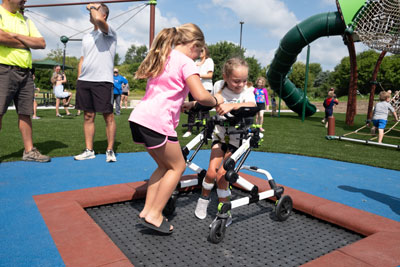
“One of the things we’ve heard—and that really resonated with us—is ‘inclusive design is really just good design,’” said Sarah Lisiecki, communications and education manager for a Fond du Lac, Wis.-headquartered playground designer and equipment manufacturer. “We’ve noticed a huge demand for more and more outdoor spaces that go beyond access and into inclusion.”
She said there are many reasons for making inclusive play a priority, including that it’s the law. “ADA requirements state that access to public recreation is a civil right. It’s also important because we know that play is a catalyst for learning, growing, developing, and engaging in the community. Creating spaces that bring everyone together requires considering who the ‘everyone’ is, and approaching design by listening to the voices, needs, and preferences of all people.”
Anne-Marie Spencer is corporate vice president of a Chattanooga, Tenn.-headquartered company with a portfolio of brands in the play and recreation space, and she explained that communities are also looking beyond the play structure to the total environment. “I like to compare it to an electrical conduit; if any part of the circuit is broken, the entire thing doesn’t work.”
This includes the route from the parking lot to the various recreation opportunities, including water fountains, restrooms, etc. “I’ve seen wonderful inclusive play equipment where the ADA entrance was placed incorrectly so that access was still limited,” Spencer said. “The entire environment needs to work.”
“As a former paraprofessional, I can confidently attest to the growing efforts by schools and other organizations to make playgrounds more inclusive,” said Jolie Ross, marketing coordinator at Shepherd’s company. “There’s been a noticeable shift toward designing spaces that welcome children of all abilities.”
“Schools are absolutely helping to lead the charge,” agreed Jill Moore, inclusive play specialist for a Delano, Minn.-based playground design firm and equipment manufacturer. She described a bill in Georgia that was recently signed into law, requiring that all elementary schools built after July 1, 2027, include universally designed playgrounds. “These spaces must meet specific criteria, including sensory-rich environments, minimum square footage, fencing, shaded areas, inclusive surfacing, and equipment like communication boards, accessible swings, and wheelchair-compatible play structures.

“A powerful example of school-driven inclusion can be found at Glen Lake Elementary in Minnesota,” continued Moore. “Serving a high population of students with special needs, the school’s inclusive playground was inspired and shaped by the students themselves—proof that meaningful inclusion often starts from the ground up.”
Moore said it’s essential to engage individuals with disabilities and their families, therapists, and educators early in the design process. “We strongly believe in the principle of ‘Nothing about us, without us.’ By giving end users a seat at the table, we’re not just designing for them, we’re designing with them. It creates space for authentic advocacy, and ensures the final environment truly reflects their needs and experiences.”
Moore, who uses a wheelchair, said that when she was growing up “the focus was often just on getting things done. But now, we recognize the power of asking, ‘What makes a great day for you?’ Or ‘What helps you feel included and successful?’ That’s where meaningful, inclusive design begins.”
Ross said they’ve seen a “significant and encouraging trend” toward collaboration between playground designers, therapists, and educators when developing inclusive play environments. “These partnerships are essential in ensuring that playgrounds are not only fun, but also accessible and beneficial for children of all abilities.”
She mentioned Puddle Jumper Park in Orange City, Iowa, as an example. “During its planning and construction, a physical therapist played an active role in the design process to ensure that the park would meet the physical and sensory needs of children with disabilities.”
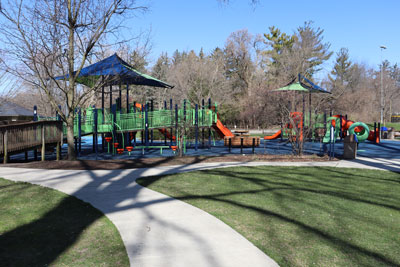
This kind of collaboration results in spaces that not only support physical development and emotional well-being, but also support social interaction, according to Ross. “Inclusive playgrounds provide opportunities for kids with special needs to connect with their peers in meaningful ways, breaking down social barriers, and promoting empathy and understanding from a young age. As communities continue to recognize the importance of accessible recreation, the involvement of professionals who understand child development and accessibility has become a vital component in shaping the future of playground design.”
“Elevating the voices of people who are sometimes unheard is the best way to make sure the space will really be one of joy, growth, and inclusion for all,” said Lisiecki. And along with listening to these voices, she said research has been a game-changer in inclusive play design, and this approach has led to products such as their slide/transfer/climber combination. “The combination of the climber and slide is crucial to helping children of all abilities have an adventure they can be excited about. If a child is able to transfer from their mobility device, this combination opens up a new world to them.”
The climber is ergonomically designed around the biometrics of using your upper body to transfer backward while in a seated position, explained Lisiecki. “The textured handrails that run alongside as you climb are a key feature that helps with this; they’re raised off the surface to a height that’s ideal for providing the most efficiency using mechanical advantage. Hand position and arm travel mimics that of a wheelchair user, while the slides are open for your elbows to clear as you move. The rubber belt provides traction as you climb, and the ramp allows you to take as many incremental steps as needed to reach the top.”

“We design inclusive spaces based on research with our Research Institute, and we work with many passionate scholars and experts in the field of disability to ensure guidelines are evidence-based,” said Spencer. She pointed to one resulting publication, the “7 Principles of Inclusive Playground Design,” offering guidelines focused solely on play environments. Understanding the effects that these principles had on buildings and infrastructure, their expert tailored them to focus on play, to “consider the needs of the whole child, whole environment, and whole community.”
Spencer said they work with communities to develop National Demonstration Sites, “play spaces built on these evidence-based principles, then our Data Service Lab works with them to gather data specific to their site so they understand the many positive ways it has affected the community.” The resulting reports share valuable insights like attendance data, levels of activity at the site, community vitality and health data, and “attendee input that can show the vital nature of these spaces and even help fund more spaces.”
As far as products, Spencer mentioned accessible tables that can be configured, from a Red Bud, Ill., manufacturer of site furnishings. “They put those with disabilities in the center of the action so that everyone is engaged. They also have pieces designed for stadiums and concession stands that are so versatile.”
Another way to expand play options is with themed instruments from a Chattanooga-based designer of outdoor musical instruments. “Music is fun, sensory, intergenerational, and when based on the pentatonic scale, requires no training to make beautiful sounds,” Spencer said. “The inclusive mallets were designed to make it easier for anyone to play.”
Moore said playground towers are a big trend currently, but she pointed out that not all towers are created equal. “If you’re adding one to your park, put it to the test: Does the accessible route actually lead to something rewarding? Can it take a child all the way to the top?”
She suggested looking for towers that offer multiple ways to ascend, like their new three-story tower for kids of all abilities. Its winding path is made from steel-reinforced cable netting, offering “flexible, responsive movement that’s especially beneficial for kids who thrive with active, varied experiences.” And in addition to climbing challenges, it’s “filled with engaging play events at every level, designed to keep the momentum going.”
She also mentioned their swing made from steel-reinforced netting, big enough for multiple users. “It’s designed to support kids with weaker core strength, by offering a comfortable, reclined seat. But it’s also just a super fun, social swing. Kids can lie back, share the ride and experience the full joy of swinging. Products like these are helping redefine what inclusive play can look like.”
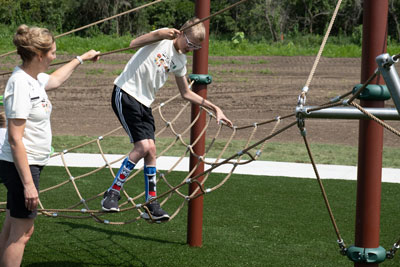
Rope play structures offer a uniquely inclusive and engaging experience, according to Ross, that supports the diverse needs of children across a broad spectrum of abilities. “These designs naturally encourage both physical exertion and cognitive development, providing challenges that are adaptable to each child’s comfort level and capabilities. Whether a child has physical disabilities or is neurodivergent, rope play creates opportunities for movement, problem solving, and social interaction in ways that are both accessible and enriching.”
She explained that while some traditional playground structures can restrict children with mobility issues to ramps or a single slide, rope-based play invites fluid movement and choice, allowing for climbing, swaying, balancing, and crawling, “promoting vestibular and proprioceptive input that supports motor skills, coordination, and body awareness. These are especially valuable for children with special needs, as such activities can improve both sensory integration and self-regulation.”
Ross added that even more static-seeming elements—like rope hammocks or nests—play an important role. “They provide a gentle, rhythmic motion that soothes and engages, making them ideal for children who may need a calming space or prefer quieter, less stimulating play. These features also support imaginative play and offer areas where children can perch, observe, and participate in their own way, at their own pace. By incorporating rope-based play into inclusive playground designs, we create not just more accessible spaces, but more equitable and thoughtful environments where every child can experience the joy and benefits of play, regardless of their abilities.”

Lisiecki described a play product offering a fort-like environment with a spinning seat, kick pad and a variety of activities that can be calming and allow the expression of stimming behaviors. “Having places for children to step away and plan their play experience, participate in onlooker or spectator play is important for an inclusive space,” said Lisiecki. “Children affected by autism spectrum disorder can find comfort in these spaces.”
There’s also custom fencing with activity panels for those who need more time to transition into the play area, providing “play opportunities and value around the perimeter of the space with games, sensory play, and cognitive opportunities.”
An inclusive spinner is another example of “a place where children can step away and play in a cozy environment but with purposeful sightlines. Spinning is often soothing to children, and having a space that feels enclosed to spin can make them feel comfortable,” Lisiecki said.
“Natural elements around playgrounds—like plants, sand, and water—can be incredibly regulating, especially for children with cognitive differences or those on the autism spectrum,” said Moore. “A shady retreat space can offer a calming break, while sand encourages open-ended creative play. Splash pads also offer tremendous value when it comes to inclusivity,” providing a “wide range of sensory experiences.”
Aside from play features, “Accessible amenities designed to meet the various needs of users of all ages and abilities should be incorporated throughout the environment to positively enhance play and recreation experiences and promote social inclusion,” said Spencer. This includes making drinking fountains and water bottle filling stations accessible. Accessible benches and picnic tables should be installed “on firm and stable surfaces along accessible routes, preferably under shade structures, shelters, or trees. Allow space for multiple individuals who use mobility devices to comfortably gather at the same table.
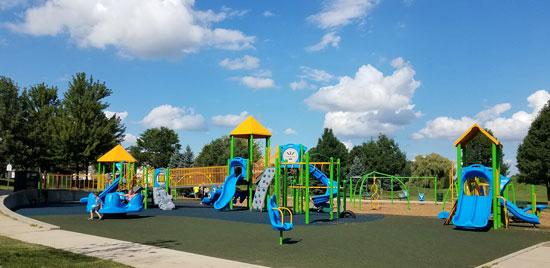
“Provide accessible restrooms, including a family/unisex toilet facility with at least one adult-sized changing table and… infant-sized changing table,” continued Spencer. “Restrooms should provide accessible sinks with touchless operation, hand-drying features within accessible reach ranges, signage with Braille characters and raised pictorial symbols at toilet room doors, and easy-to-operate restroom door locks.”
Added Moore, “sensory considerations—like avoiding motion-sensor toilets, which can be distressing for some—are also important.”
“Surfacing is critical as well,” Moore continued. “Materials like wood chips can be difficult for individuals with low muscle tone or mobility challenges to navigate, so unitary surfacing options are often preferred.” Additionally, “Fencing is another key element, especially for parks near roads or bodies of water.”
Lisiecki mentioned some design considerations, including play variety. “Having different types of play experiences is crucial to inclusion; it means everyone can create an experience that meets their needs, abilities, and preferences, and that no one is stigmatized into only certain types of play.” For example, children who don’t transfer from mobility devices should “be able to participate in creative play, musical play, sensory play, swinging, spinning, and have comfortable places to socialize and rest.”

Providing parallel pathways for play is a consideration. “How children get around the space is hugely important, and access to the most exciting elements is a must for inclusion,” said Lisiecki.
Additionally, play equity is important. “Similar play experiences for all children, representation of different cultures, races and abilities, access to different types of play, spaces that foster comfort, learning, socialization and development are all contributors to play equity.” This might include offering multiple ways to swing and spin, and providing different climbing opportunities for children of different ages and developmental stages.
Spencer pointed out that intergenerational play opportunities are important, when an environment encourages interaction between different ages. “Even looking beyond disability, consider a grandparent who may want to join their grandchild on a play structure; if the only way up is on components they may not feel comfortable with, they lose that precious opportunity. Give them a ramp and you create possibilities for making memories!”
Inclusivity means creating spaces where all caregivers—whether they have a disability, are aging, or face other mobility or sensory challenges—can fully engage with the children in their care, according to Moore. She said it’s important to design environments that are accessible, comforting, and welcoming for everyone. “As more older adults take on active caregiving roles, it’s increasingly important that playgrounds meet a broad range of needs, not just those of the children playing.”

When planning inclusive spaces, it’s critical to hear the voice of your community, according to Spencer, to understand what’s meaningful to them. “Occasionally, we’ve heard community representatives say they ‘really don’t have people with disabilities in the community,’ but when they hold public input forums or placemaking sessions, they learn this isn’t the case. If a park isn’t designed for inclusion, people with disabilities probably won’t use it, but that doesn’t mean they aren’t present.”
Many inclusive playground projects are sparked by grassroots efforts, said Moore, often beginning with families who are advocating for themselves or their children—sometimes after experiencing an inclusive playground elsewhere and realizing the difference it makes. “While these movements often start at the community level, we’re also seeing more parks departments recognize the value of inclusive play in creating welcoming spaces for everyone. It’s a powerful combination of grassroots advocacy and instituitional support that’s driving real change.”
“The best spaces are a reflection of the community, and taking everyone’s needs into account allows the best experience for all people,” said Lisiecki. “The more community members are involved, the more ownership they take in the space, and the more it reflects the diverse and unique needs of the people using it most.” RM