



Coaches can strategize, study opponents and make game plans. Athletes can work out, run drills and memorize plays. But when gameday arrives there are additional elements that need to perform at the top of their game if fans are to really have an exciting and immersive experience: lighting, scoreboards and sound. And nowadays, even visitors to smaller venues like high schools and park facilities are expecting flashing lights, booming sound and LED videoboard experiences.
Light It Up!
In 2025, the Western Michigan University (WMU) Broncos captured their first NCAA Division I men’s hockey championship, after an energizing season at their ice arena. And WMU operates several other indoor and outdoor facilities for their athletic programs, including Waldo Stadium, where the Broncos play football, which holds more than 30,000 spectators.
In 2021, the university, located in Kalamazoo, installed energy-saving LED lighting at the stadium, and Matt Kulik—assistant athletic director/facilities—said it’s been a huge advantage not only on game days but overall. “Our old lighting took five to 10 minutes to warm up; with LED it’s instant on and off. It also gives you the ability to do different things like flashing lights, search lights—some of those different effects.” He said another favorite feature is a phone app for controlling the lights, “so I don’t have to worry about someone turning them on and forgetting to turn them off.
“Another feature is there’s a lot less spillage of light into the surrounding neighborhoods,” Kulik continued. “Previously, we’d get complaints from neighbors not even that close to the stadium about glare in their windows. With LED lighting that’s no longer an issue.”
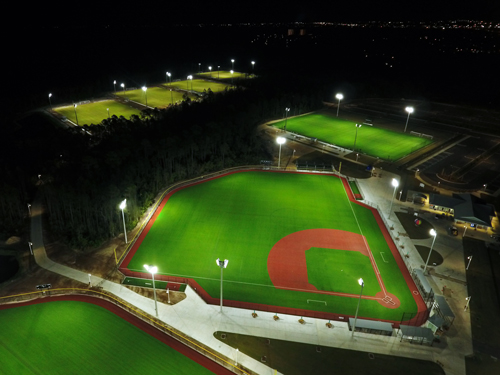
Patricia Del Rio is a lighting design engineer for a Hillsdale, Mich.-headquartered designer of sports lighting systems. She said they’re dedicated to minimizing light pollution and preventing light trespass, “especially when bordering sensitive habitats,” which they achieve by using shielded fixtures and managing lumen output. “Factors such as beam types, light angles, pole heights and pole placement significantly influence spill and glare. With improved glare reduction, specialized beam shapes and the latest TIR lens technology, we can illuminate the playing surface effectively while reducing light spill beyond the field.”
Sports lighting requires coverage of multi-directional aerial movement of ground-level sports, explained Del Rio, and field size, pole heights and setbacks, and class of play—ranging from social to professional—will affect the beam types and angles.
What’s more, different sports have different requirements. For instance, baseball infields require higher light levels than outfields. “In contrast, football and soccer fields require uniform lighting throughout the length of the field. Tennis and pickleball courts need high levels of even illumination throughout the court.”
Del Rio said the influx of retrofits and new-build design requests for tennis and pickleball courts has driven them to develop a system created specifically with golf, tennis and pickleball in mind. “Light fixtures can provide lighting to multiple courts or bays with one sleek pole design that includes the latest TIR LED lens technology.”
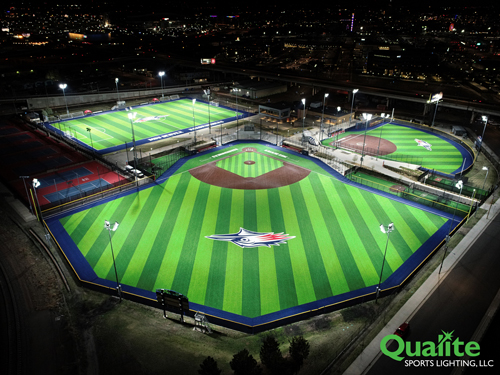
Advancements in digital technology are enabling continuous improvements in lighting products, according to Del Rio. She said there’s a growing demand for wireless remote control systems in parks, schools and recreational facilities, improving operational efficiency by allowing users to adjust light settings from a distance and incorporate entertainment features. “Clients can run their lighting via smartphones and tablets… whether from anywhere on the field or even from home. (Our) system enables users to control lights across multiple sports fields and set up flexible schedules tailored to their needs. The system is highly secure, with encrypted data sharing across all devices.”
Lighting systems are also becoming more engaging for players and spectators, said Del Rio. “Field lighting management and color options with dynamic effects that flash and scroll colors during the game for wave, score, applause and special events are aimed at significantly elevating the spectator experience.
“LED systems are inherently more energy-efficient due to less wasted light,” she continued. “Additionally, we include dimming as a standard feature, allowing customers to improve field lighting and decrease expenses.” She said retrofits can pose challenges where pole heights or locations may not be optimal, but with their new LED stadium lighting technology, “returning customers are seeing improvements in field visibility, less spill and less number of lights needed to achieve excellent lighting results.”
Indoor systems are typically easier to install and support than outdoor ones, according to Del Rio, “because they don’t need an IP65 rating. Installation and maintenance for indoor pickleball and tennis courts are generally less demanding, partly due to lower mounting heights. Nevertheless, key factors for indoor sports lighting design take into consideration floor and wall reflectivity values to ensure reduced glare.”
Kulik said they’ve installed LED lights at Read Fieldhouse, an approximately 5,500-seat multisport facility, and colored lighting is one of the enhanced features. “We do things like red, white and blue lighting for the national anthem. We can also use that in conjunction with our videoboards for a sponsored ad.”
Del Rio’s company also works with colleges and major and minor league professional sports franchises, and she said it’s important to consider whether games will be broadcast. She explained that most LED fixtures are powered by pulse modulation, with LEDS flashing on and off at a high “flash rate,” which controls the intensity of the light and allows for efficiency and finer control of the visible light. If it’s not fast enough or too close to the scan frequency of recording devices and cameras, it interferes with the recorded product. “We’ve taken steps to ensure our system is designed for stadium lighting, HDTV broadcasting, digital photography and slow-motion recording of fast-paced sports lighting in venues that host recreational to professional levels.”
Kulik said the NCAA lists their lighting standards for broadcast games, and “Prior to installing the new LED lighting in Waldo Stadium, if we were having a football game broadcast on ESPN or one of its subsidiaries, we’d need to bring in an additional lighting truck so that we could make it to the minimum amount of foot-candles needed for network television. After the LED upgrade, we no longer need to do that.”
Score!
In the stadium, Kulik said they have one static scoreboard and three videoboards which “show replay and created content. At normal football games you’ll see in-game recognitions, special tributes and things like that.” At the fieldhouse, there’s a four-sided center-hung video display, as well as two scorers table displays on the floor and ribbon boards at each end of the court, which are long, narrow LED displays often found along the fascia or concourses.
Kulik said the fieldhouse videoboard displays are “used very similarly to how we use them at the football stadium, but they have to be a little more multipurpose as they also serve gymnastics, volleyball and both of our basketball teams. Another function of this that has come up recently is statistical information; the ability of our stat keepers to broadcast statistical information from their laptops to these displays is something that our coaches and fans have now come to depend on.”
And what about some of the other athletic facilities at WMU? “Our soccer scoreboard is sport-specific as it has information like corner kicks, shots on goal, things like that,” said Kulik. “Our baseball and softball scoreboards are sport-specific. Hockey has three video displays throughout the arena along with a center-hung static scoreboard. Obviously, hockey has penalties and things like that, so we needed to have that specific information displayed all the time.”
Chris Kirn is owner and CEO of a Columbia, Ill.-based designer and manufacturer of indoor and outdoor digital scoreboards working nationwide, primarily with high schools, colleges and universities. “These are the schools and organizations with a growth mindset,” he said, “a drive to attract top student athletes, a winning spirit and a vision for creating new revenue opportunities to support their programs.”
Kirn said they offer solutions for both single-sport and multisport needs, as each venue is unique. For flexibility, they offer two software options, including a customizable, computer-based solution that integrates seamlessly with traditional scoreboard systems. “It’s perfect for schools that want unlimited design flexibility.” Additionally, a cloud-based, iPad-driven platform includes features like live video, instant replays, streaming and fan engagement tools. “Both options make it easy to switch between sports, ensuring a smooth, professional experience for any event.” And they’re both “designed to grow with you, so you can add new features as your needs evolve.”
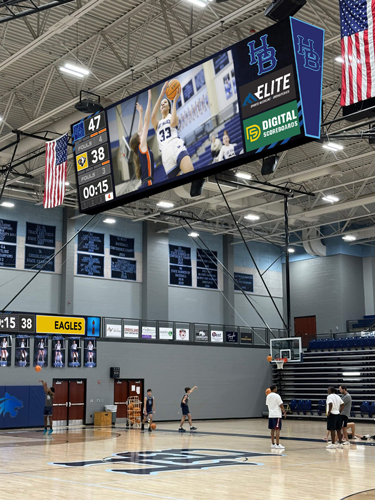
Videoboards are becoming a must-have, even for smaller venues, said Kirn. “They bring a big-league feel to local games and create unforgettable experiences for fans.” He mentioned some of the creative ways that customers use the boards, including showing instant replays to relive the action; highlighting player introductions and hype videos to energize the crowd; and engaging fans with fan cams and interactive prompts. “These displays are incredibly impactful for educators as well,” he added. “Teachers and coaches are able to use the displays for classes, practices and student activities.”
The boards also strengthen community connections and present new revenue opportunities, according to Kirn, who said it’s common for customers to use them for sponsorships and advertising, which can be “fantastic ways to offset costs and generate ongoing revenue. Our displays are designed with advertising in mind, allowing facilities to showcase static or animated ads, rotate sponsor logos and even run full video commercials. It’s a win-win: Schools and venues get financial support, and businesses get valuable visibility in front of engaged audiences.”
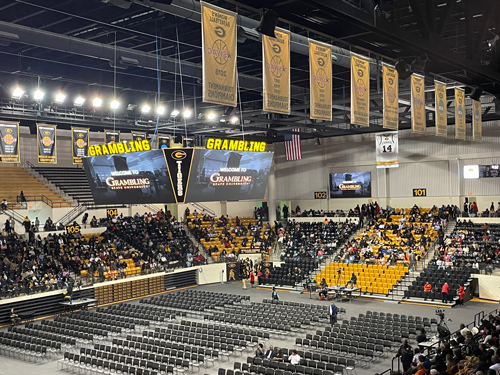
Kulik said they use their videoboards for revenue generation, particularly in their fieldhouse, and have sponsored ads in their stadium end zone displays as well when games are not in progress. “Also, we’ve sponsored ads running on our courtside tables throughout games. Mostly at our other facilities we’ll do sponsored ads on video displays when games are not in progress.”
Customizations are also common. “We’ve helped schools create scoreboards that truly reflect their identity, incorporating elements like school colors, mascots and branding,” said Kirn. “We’ve also added structural enhancements like trusses, static paneling and unique designs. These custom touches not only make the scoreboard stand out but also build school pride and a sense of community.”
Outdoor scoreboards come with unique challenges, like glare from the sun or changing light conditions. “That’s why our LED displays are built with ultra-high brightness ratings and contrast ratios,” said Kirn. And for larger outdoor venues, customers may choose to install multiple boards in strategic locations, ensuring everyone in the audience “has a clear view, no matter where they’re seated.”
Kirn described their live diagnostics monitoring system, which “continuously monitors key components like LED modules, power supplies, data communications, computer health, internet connectivity and even operating temperature.” And the auto-correction logic built into the system can address minor issues on its own. “If something requires attention, the system sends email alert notifications so you can stay ahead of any potential problems.”
Easy Listening
Indoors or outdoors, sound is a critical consideration and important part of the gameday experience, and every facility has its own physical characteristics to navigate. “Our sound systems are engineered and designed to be flexible, delivering clear dialogue for announcements and powerful audio for music and hype videos,” said Kirn. “We work closely with each customer to customize the setup based on their venue’s layout, ensuring the sound enhances the atmosphere and keeps fans engaged.”
Kulik said they’ve “run the gamut” on sound systems in their stadium. “We’ve figured out the best option for us is a mounted system that sits above the suites in our end zone. It’s taken a while to get the system dialed in, but I finally feel like we have it figured out. It’s amazing how one fan can say they didn’t hear something and another fan who’s 15 yards away will say it’s too loud.”
In their fieldhouse, Kulik said the speakers are mounted above the center-hung scoreboard. “One of the big complaints we get is that the coverage is lacking in some locations. Again, that’s a function of how the speakers are aligned and at what volume the audio is being played.”
Kulik said their soccer complex is in the middle of a business park, and when the sound system was installed, there were complaints from businesses about volume. They made some changes with speaker positioning so that sound wouldn’t leave the field of play. “It took working with an audio engineer to get it figured out, but it’s pretty impressive now; as you leave the complex you can no longer hear anything from the speakers.”
Aquatics Considerations
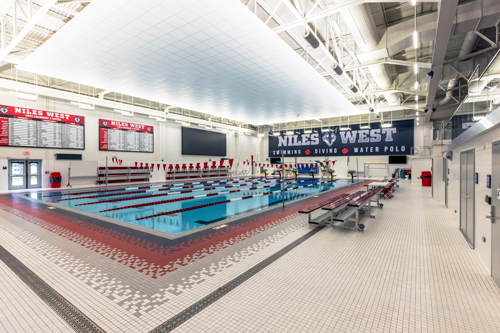
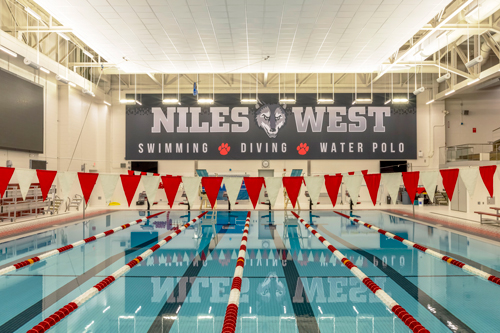
In the Chicago suburb of Skokie, Ill., the Niles West High School pool complex renovation was completed just in time for the 2024-2025 school year. Upgrades included a new lighting system in the 28,430-square-foot facility, which previously featured a metal halide (MH) system installed over the pool, according to Marcus Halleran, facilities manager at the school.
“MH lamps degrade over time, losing light output and color consistency, and typically only have 6,000 to 15,000 hours before the bulbs require replacement”, said Halleran. The dim lights made it difficult for spectators to see swimmers at meets, and the low light levels were a safety issue for lifeguards. Additionally, the bulbs required 10 to 15 minutes to cool down before they could be re-lit again, “which was very inconvenient.”
Design plans for the renovation specified indirect lighting above the pool’s perimeter to reflect off the drop ceiling, evenly distributing lighting over the pool. Halleran said the project included 32 120W LED luminaires supplied by a Kenosha, Wis.-headquartered lighting manufacturer, “that are engineered to perform brilliantly in high humidity, caustic and corrosive environments and hard-to-service areas, and include IP65-certified housing.”
To access the old lights, workers climbed on a non-compliant catwalk above the drop ceiling, posing safety concerns, according to Halleran. “If any glass were to fall into the pool during maintenance, the entire pool would need to be drained. Because natatorium fixtures are difficult to access, maintenance must be kept to a minimum.
“One way to address these issues is through the installation of LED luminaires,” he continued. “Indirect illumination is also recommended to reduce glare and veiling reflections, improving the clarity of underwater viewing and related safety.”
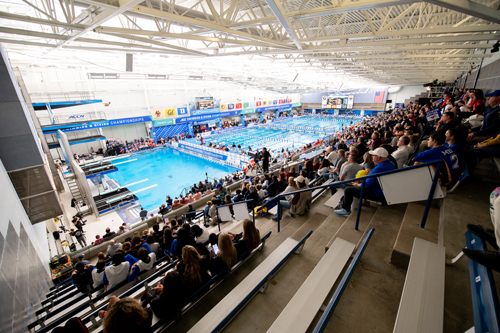
One of the top aquatic facilities in the nation, the Greensboro Aquatic Center (GAC) in North Carolina hosts high school and collegiate events, USA Swimming, USA Diving and US Water Polo meets, and myriad national and international competitions, as well as serving as a community pool. There are four pools total, with two video/audio boards in the main competition area, according to David Hoover, the center’s manager. “They can be used for any competition and are built to suit any format/request.
“For national events we work with major TV carriers and packagers who hook into our system and can control video replays,” Hoover continued. “For most meets, we just push through video/audio but can show our in-house STREAM of the meet. Lighting, sound and more specifically scoreboard specs are needed to host the high-profile events. We meet and exceed all specs for televised and national events on the lighting and sound component.”
Hoover said they use LED lighting in all four pools, which “not only save energy, but can be turned on/off instantly. It’s a huge factor for meets, specifically those on TV.” Lights can be controlled remotely or through on-site computers. “They can be programmed months out to assist with cost savings during slower times of the week and built to full lighting during meets and programs.”
The sound system at GAC has been upgraded, and Hoover said they’re working to update their original 15-year-old speakers. Multiple music sources are utilized that can be controlled by trained staff or the host’s announcers. “Our system is sourced to provide clear sound for everyone on deck and in the grandstands.”
Hoover said they have multiple sponsors that “we run through our master show, and we have hard panels that advertise on the scoreboard. They do provide ample revenue. We also offer scoreboard shout-outs for swimmers/parents to provide birthday or good luck messages.”
Staff Up
Trained personnel are onsite to operate the systems for all meets at GAC, said Hoover, and for the “larger, more national-scale meets, we bring in additional staff with a sole focus on scoreboard and sound management.” And he said scoreboard, light and sound systems can all be adapted into one, “but our lighting controls can be accessed on a secure website. The sound and scoreboard are controlled in the same production area.”
Kulik said they have two full-time people working in their productions department and some full-time temporary employees who run their videoboard.
Kirn’s company has a program offering lesson plans to students, providing them with “hands-on experience in areas like video production, graphic design and live event management,” helping schools to “maximize the value of their digital scoreboards. By integrating the scoreboard into the classroom, students gain real-world skills that can lead to careers in media, sports and entertainment. Schools enhance their gameday experience while giving students valuable learning opportunities.” RM