


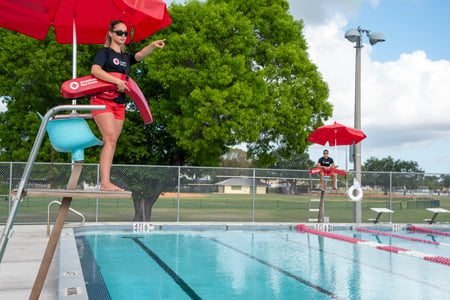
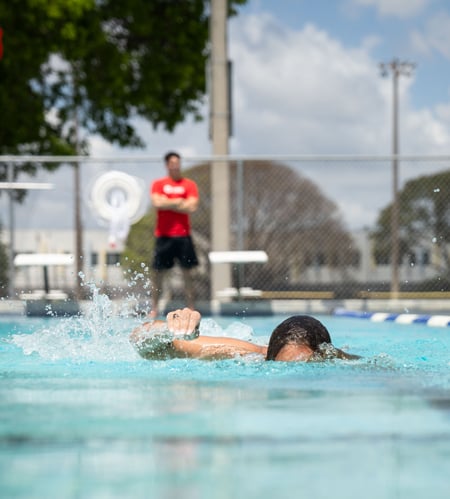
Photo Courtesy of American Red Cross
You can’t beat fun at the old swimming pool! But whether it’s a small outdoor community facility, a modern natatorium featuring diverse programming or a multi-pool aquatic complex, facility operators have much to consider as far as keeping visitors and staff safe. This includes water and air quality, facility safety and, above all, drowning prevention measures.
Juliene Hefter is executive director and CEO of the nonprofit Association of Aquatic Professionals (AOAP). She said most aquatic venues have Emergency Action Plans (EAP) and safety programs established, and for those that don’t, it’s imperative to develop them. “Having a plan ensures staff know their roles, can communicate effectively, and can quickly and correctly respond to a wide range of incidents, such as drownings, injuries or severe weather, minimizing chaos and helping mitigate risks.”
AOAP offers professional pool operator courses, and Hefter said safety considerations are integral to these offerings, “which should cover water chemistry and testing; equipment operation and maintenance—including pumps, filters and heaters; safety protocols and risk management; and regulatory compliance. Other key topics include filtration and circulation, daily maintenance procedures, and emergency procedures.”
It’s also common for facilities to engage third parties to conduct evaluations and audits to identify safety concerns and enhance emergency protocols, according to Hefter. “It also brings in a new perspective to the process to have ‘outside eyes’ reviewing your processes and
evaluate how your team is doing and if they’d be ready to react in an emergency situation.”
As Director of Research and Education at Aquatic Safety Research Group (ASRG), Rachel Griffiths has worked with both public and private facilities to develop and implement safety programs, and she stressed the importance of being proactive. “Whether it’s disaster preparedness or risk mitigation, help often isn’t summoned soon enough. When a disaster or tragedy strikes, safety strategies are often sought after the fact, sometimes only out of necessity or when there’s a lawsuit.” And while proactive preparation is often pushed to the back burner, sometimes due to funding concerns, “in the long run it’s more cost-effective to prevent accidents.”
Deep River Waterpark in Crown Point, Ind., is operated by Lake County’s Parks and Recreation Department. Chris Nawracaj is the waterpark’s manager, and he said they generally create their own safety plans as they believe they know their facility best, “unless it’s the manufacturer’s SOP (Standard Operating Procedure) for an attraction. Each slide comes with its own manufacturer guidelines that specify everything you need to check and do, down to which manufacturers produce tubes, rafts or ride vehicles that are approved for use on the slide and have been tested by the slide manufacturer.
“We review our safety plans every other year to make sure they’re still relevant and that key staff is aware of them and up to date,” Nawracaj continued. “You don’t ever want your safety plans to just be a binder on a dusty shelf somewhere; it always has to be a living, breathing, updated document.”
He added that while COVID shutdowns had plenty of negative impacts, “one good thing it did was force everyone to review, modify and update their safety plans.”
Nawracaj said they also have emergency plans that are water safety-specific, laying out procedures and how everyone is going to respond in very specific situations. “The water safety staff is always training on these scenarios in their in-service training. For the rest of the waterpark’s departments, safety training is provided during employee onboarding and will go over everything they need to know.”
ASRG offers an onsite evaluation and walk-through, conducted during regular facility operations with facility teams taking part, evaluating procedures and facility layout, and observing staff, noting strengths and weaknesses. Typical problem areas identified include pump rooms and chemical storage rooms, according to Tom Griffiths, ASRG founder. “Because these areas are hidden behind closed doors and the public doesn’t see what’s inside, the rooms are often loaded with incompatible chemicals, trip/slip hazards and electrical hazards.”
He said locker rooms often have slippery floors, and explained that many pools are guilty of “sign pollution,” posting all sorts of rules and regulations, “but at the same time, the most important warnings are camouflaged between less important rules.”
He also shared some positive trends they’ve been seeing, including automated cabinets for ring buoys and automated external defibrillators (AED). “When these cabinets are opened in an emergency, 911 is automatically called so the emergency response is fast-forwarded. Apps are also available to record and track training.”
Nawracaj said their lifeguarding agency will make two unannounced, unplanned visits over the course of the summer to audit the lifeguards. “Even I don’t know the exact day they’re showing up. Those are generally four-hour-plus audits where they visit the park like a patron,” observing the lifeguards. “Then once they make themselves known, they will audit all of our safety plans, as well as our performance on specific situations to make sure we’re following our posted plan.”
As for the rest of the facility, Nawracaj said their insurance company generally sends out an inspection company to do site inspections once or twice a year. “They’ll point out and make suggestions of things that they think we should do different, or things that they’ve noticed at other parks and facilities that are working for them.” As for other agencies, Nawracaj said they generally have annual inspections from the local fire department, state fire safety department, health inspector for food stands, and health inspector for pools.
The American Red Cross certifies more than 300,000 lifeguards across the U.S. annually, with many facilities utilizing their lifeguard training curriculum. Josh Rowland, senior product manager for aquatics with the Red Cross, explained that individuals can be trained at facilities accepting individual students or, alternatively, “many aquatic facilities train their employees in groups.”
Rowland said it’s important to ensure that facility operators are holding their guards to the standards outlined in nationally recognized lifeguarding programs. “Our shared goal should be consistency so that lifeguards are trained to prioritize prevention first and are fully prepared to respond effectively when emergencies do occur.” And he stressed the importance of continuous in-service training to keep skills sharp. “Our Scientific Advisory Council shows that skills degrade over time without practice. Our Lifeguard Management program offers resources to help facilities develop their own in-house, in-service training.”
Within the lifeguarding program, Rowland said they advise facilities about products and resources, and “discuss equipment that lifeguards should have available to them for aquatic emergencies.” He mentioned other offerings including speaking opportunities, including a presentation on how aquatic facilities can strengthen their operations through zone analysis. And their portfolio of water safety programming includes CPR for Professional Rescuers, Safety Training for Swim Coaches, and Lifeguard Management. There’s children’s programming, learn-to-swim programs and online courses including Water Safety for Parents and Caregivers. And their Aquatic Examiner Service offers a “thorough and unbiased review of a facility’s safety and lifeguarding practices, along with clear recommendations, coaching and practical resources for improvement.”
Hefter said that lifeguard training is evolving to “emphasize their roles as first responders. Continued education focuses on equipping them with skills beyond basic lifeguarding, making these positions more career-oriented and supportive of professional development.” She said lifeguards are increasingly recognized as first responders. And while the official classification varies by location and agency, this recognition is sought to “provide benefits, such as better healthcare and mental health support, and to elevate the profession.”
AOAP’s RESPECT program “aims to provide drowning prevention education tailored for facility operators and aquatic professionals to deliver throughout their communities,” explained Hefter. “We also see many fire departments and schools using our program.” The program makes available free downloadable materials and videos promoting drowning prevention strategies, as well as PowerPoint presentations and instructor guides. There are sections for parents and caregivers as well as for children. Additionally, AOAP has a swim lesson and life jacket grant program “to support nonprofit aquatic facilities in their efforts to prevent drownings.”
In addition to her role with ASRG, Rachel Griffiths is president of the nonprofit Note & Float Life Jacket Fund. “The program helps reduce drowning by floating weak and inexperienced swimmers in U.S. Coast Guard-approved life jackets. It also increases swim lesson enrollment and significantly reduces rescues.” She said they provide more life jackets to facilities each year, as there is always a steady need.
She also pointed out that some facilities have policies not allowing life jackets, “citing false sense of security. We do know that life jackets save lives in all bodies of water and also strongly believe in as many layers of protection as possible. Thus, life jackets are just one piece of the equation,” along with supervision and swim lessons.
In addition to educational sessions for lifeguards, trainers and facility operators, ASRG also offers a Safe Swimming Beaches program designed for beach and waterfront managers, as well as open-water audits. “We make every attempt to streamline and prioritize signage and upgrade rescue equipment,” said Tom Griffiths. “We also have a keen eye on the site-specific hazards each open-water area has: currents, depth, poor water clarity, and diving hazards as well as safer piers and docks.”
Griffiths said that at some beaches—in Southern California for example—they regularly see well-trained open-water lifeguards with excellent rescue equipment. “On the other end of the continuum,” he said, “we’ve worked with small private lakes and ponds with little to no organized water safety practices in place. Many of these are unguarded. For those that are guarded we stress the importance of on-site specific training and getting them wet often. Whether guarded or unguarded, we promote educating and warning guests aggressively.
“Loaner lifeguard programs are essential for all open-water areas,” he continued. “Automated emergency response to alert 911 at the initial distress is extremely important. In the open water, where the water is often murky, proactive prevention must be strongly emphasized along with reactive rescue and resuscitation.”
Griffiths also discussed a company based in Marquette, Mich., that is using technology to improve beachfront safety. They manufacture electronic warning signage featuring hazard updates, as well as customizable electronic rescue stations with cameras, audible alarms and speakers, geolocation, and electronically triggered flotation cabinets that can engage various emergency pathways. Emergency floodlighting and emergency callboxes are also available.
Other new drowning prevention technologies have been introduced in recent years, and while Griffiths said he’s seeing more new systems being installed, “we’re still not seeing enough. We’re convinced these systems are more vigilant than humans so we’re hoping more facilities will embrace these technologies. Sad to say, some facilities install drowning detection systems after they’ve experienced a drowning.”
“Facilities are gradually adopting AI-powered underwater cameras and wearable sensors,” said Hefter, discussing newer drowning prevention technologies. “These innovations are gaining traction as more facilities recognize their potential to enhance safety. It’s imperative to know that these can be a valuable added layer of protection for our patrons and can also be used for home pool safety.” But she stressed that these added layers of protection in no way eliminate the need for “constant, direct, uninterrupted supervision.”
Nawracaj mentioned something he’d seen for lifeguards at the 2025 World Waterpark Trade Show and Symposium, “a device they wear on their hats that not only tracks their locations in the park but also tracks their head movement to show that they’re scanning the water properly in accordance with what the lifeguard certification agency says. It then overlays that information on a map of your park so you can see who is where in real time and that they’re scanning properly, or if they need a little work.”
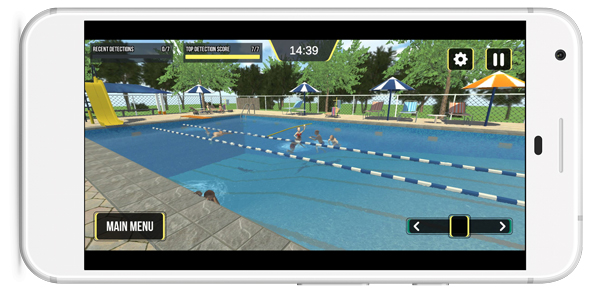
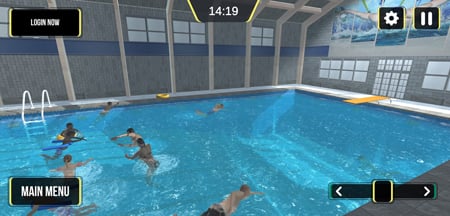
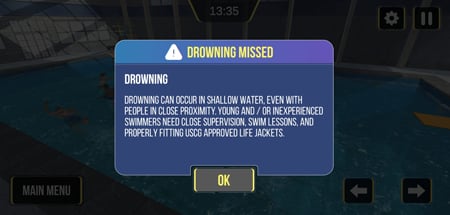
ASRG developed a phone app designed to practice drowning detection, using lifelike avatars to mimic actual drowning behaviors captured on security camera videos, according to Griffiths. “It gives lifeguards, supervisors, parents and caregivers the opportunity to practice scanning and surveillance. Aquatic facilities can also access the analytics for their employees using the app,” which is free to the public. This can help users understand how drownings happen and how to better recognize warning signs.
The American Red Cross has also released the Red Cross Lifeguard VR app, since “many critical components of lifeguard training aren’t replicable in a classroom setting,” said Rowland.
Maintaining optimal water and air quality is also critical for keeping pool visitors and staff safe, and new technologies are also aiding these efforts. “Many facilities are indeed embracing enhanced controllers, remote monitoring and chloramine capture systems,” said Hefter. “These advancements aim to maintain a healthier environment and are becoming more common in new facility designs.”
Richard Lindhorn is vice president of a Pasadena, Calif.-based company providing technology and services to help manage pools and spas. And while conservation and efficiency are key outcomes of their software solution, he said “water safety is really at the heart of what we do. Our system continuously monitors water chemistry, mechanical performance and environmental factors across every body of water. It’s designed to detect irregularities early, alert operators in real time, and ultimately prevent unsafe conditions before they occur.”
Lindhorn said the system can track “pH, ORP (oxidation-reduction potential), free chlorine, total chlorine, temperature, flow rate, turbidity, conductivity or total dissolved solids (TDS) and tank levels,” as well as water usage and leak detection. The system sends automatic alerts whenever conditions fall outside of preset ranges. “That could be low chlorine or sanitizer levels, high or low pH, pump or flow interruptions, sensor malfunctions, or even temperature fluctuations that might suggest heater or chiller problems,” said Lindhorn.
The cloud-based platform integrates with many chemical automation systems, so facilities don’t necessarily have to replace equipment. “The IoT layer provides continuous readings that automatically sync with the platform,” so the system can make real-time dosing adjustments or alert staff “if balance is drifting.”
Lindhorn explained that their water safety score feature produces a data-driven rating based on sanitizer levels, pH, turnover rates “and other key parameters of the CDC MAHC.” This gives operators a quick visual snapshot of how healthy each body of water is. The solution now has an AI engine as well, according to Lindhorn, which analyzes the readings to identify trends and predict potential issues before they happen. “It also automates compliance and operational reporting, turning what used to be hours of manual work into a few clicks. Every reading, alert and adjustment is stored in a secure historical database.”
These days, “water safety couldn’t be a more important topic,” said Nawracaj, and “things like swimming lessons at a young age couldn’t be more important, especially as some schools are cutting out having pools to save money.” He said they’ve participated in the World’s Largest Swim Lesson campaign annually since its inception, which offers an hour-long, free swim lesson to registrants, “in order to help further the message of water safety importance.”
In February 2026, AOAP will co-host the annual International Aquatics and Water Safety Conference and Exposition alongside the National Drowning Prevention Alliance (NDPA), which Hefter said includes a range of safety-related programming. This includes “drowning prevention, facility safety, risk management, staff training, programming and special events, diversity/equity/inclusion, and water treatment, alongside opportunities to connect with service providers and product dealers and manufacturers.
“There are so many organizations with the same goal,” added Hefter. “By working together, we can and will make a difference. We can all go about it differently and still work toward the same outcome. It comes down to educating the public and everyone within our communities.” RM