

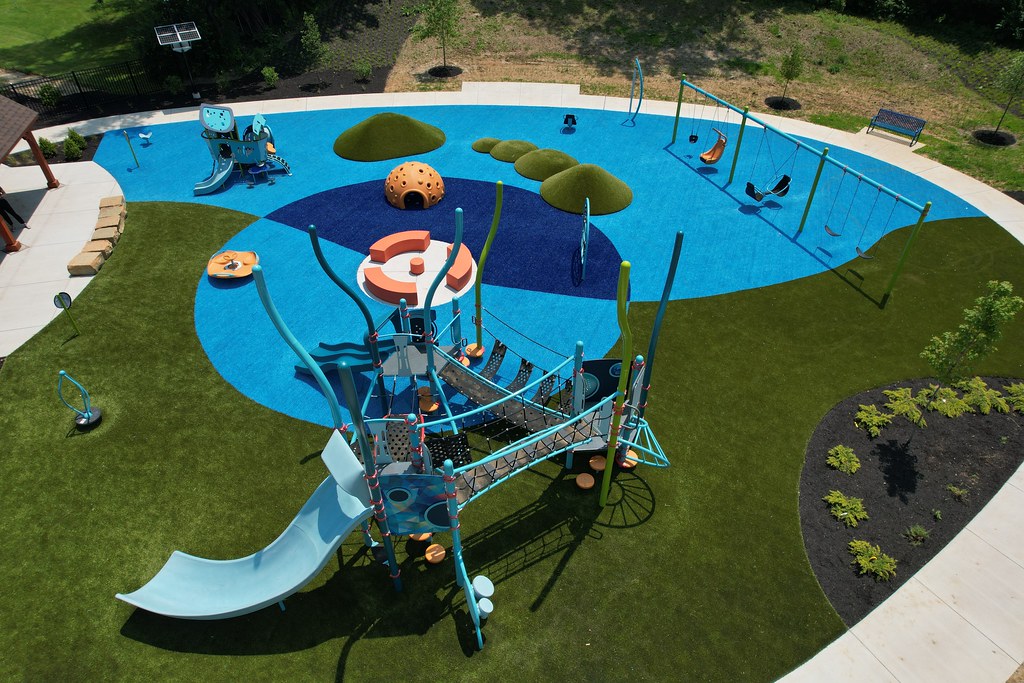
For parks and recreation professionals, playground success is defined by how well it meets the needs of the community—it’s defined by use. Are children showing up? Are they moving freely and easily? Are they playing together? And are families choosing to come back?
New research from the University of Texas at Austin’s Department of Kinesiology and Health Education highlights an often underappreciated factor that strongly shapes those outcomes: playground surfacing.
The Playground Surface and Playability Study examined how three common surface types—synthetic grass, poured-in-place rubber, and engineered wood fiber—impact playground use, physical activity, social play, and caregiver perceptions across neighborhoods of differing socioeconomic status. The findings offer practical guidance for communities focused on participation, equity, and long-term value.
Shifting the Focus to “Playability”
Rather than evaluating playgrounds only by equipment or compliance, the research centered on playability, defined as:
The socio-spatial and physical characteristics of a playground that make it more or less conducive for active, social, engaging, and inclusive play for all.
Researchers conducted systematic observations, paired with intercept surveys of caregivers. In total, 60 structured observations and 89 caregiver surveys were collected across six public playgrounds in the Austin metropolitan area.
Playgrounds were carefully matched for neighborhood context, density, and amenities, allowing surfacing type to emerge as a meaningful driver of differences in how playgrounds were actually used.
What the Research Found
1. Playground Use Varies Dramatically by Surface Type
Across all playgrounds studied, synthetic grass consistently attracted the most children—averaging about 12 users at a time, compared to 9 on poured-in-place rubber and about 1 on engineered wood fiber.
The difference was most striking in lower-income neighborhoods, where playgrounds with synthetic grass averaged five times more users than playgrounds with other surface types.
For park systems or municipalities looking for ways to better serve their communities, encourage use, and justify capital investments, this suggests that surfacing choice can strongly influence whether a playground becomes a community hub or an underutilized space.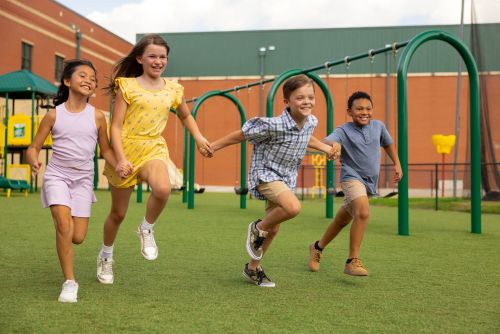
2. Physical Activity Is Higher on Synthetic Grass
Physical activity is a core goal for many park systems, and the study showed meaningful differences in how surfaces support movement.
Across all sites:
- 52% of children on synthetic grass were engaged in active play
- Compared to 34% on poured-in-place rubber
- And 16% on engineered wood fiber
In lower-income neighborhoods, activity levels on synthetic grass were more than double those observed on non-grass surfaces.
These findings highlight surfacing as more than a maintenance or aesthetic decision—it actively shapes how children move, explore, and engage within a play space.
A visit to the playground is often overlooked for its measurable health benefits. A well-designed, inclusive community playground encourages children to play for longer periods—averaging nearly 30 minutes per visit. This translates to roughly 26 minutes of active movement and approximately 1,800 steps. This type of sustained, active play isn’t passive; it generates moderate physical activity levels comparable to structured exercise. The benefits extend beyond the child to the broader community, contributing to healthier kids, reduced obesity rates, stronger social cohesion, and improved family wellness, to name just a few.
3. Social and Cooperative Play Thrives on Certain Surfaces
Playgrounds also function as social infrastructure. The study found that synthetic grass supported the highest levels of cooperative and group play.
On average, nearly three times as many social play groups were observed on synthetic grass compared to engineered wood fiber. In lower-income neighborhoods, children formed over five times as many social play groups on synthetic grass than on other surfaces.
For agencies prioritizing inclusive play, community connection, and child development, these social outcomes are as significant as physical activity levels.
What Caregivers Notice—and Value
Caregiver perceptions strongly influence whether families return to a playground. In intercept surveys, caregivers consistently rated playgrounds with synthetic grass higher for: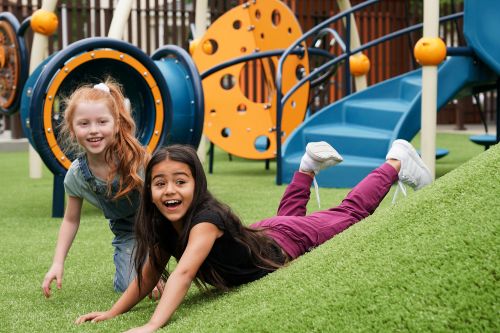
- Comfort and overall enjoyment
- Cleanliness
- Perceived safety and reduced injury risk
- Quality of maintenance
- Support for social play and a range of abilities
Qualitative comments reinforced these findings. Caregivers noted fewer issues with loose debris, a softer sensory experience for younger children, and children actively requesting to revisit these playgrounds.
Equity Considerations for Public Agencies
One of the most important takeaways for parks and recreation agencies is the equity dimension of the findings. Synthetic grass surfaces didn’t just perform well overall—they helped reduce gaps in use, activity, and social play between higher- and lower-income neighborhoods.
In communities where playgrounds often struggle with low utilization, surfacing emerged as a tangible design choice that can:
- Increase visitation
- Encourage longer stays
- Support more active and social play
- Improve caregiver confidence in public play spaces
For agencies balancing limited capital budgets with growing expectations for equitable outcomes, surfacing deserves consideration as a strategic investment—not just a line item.
Implications for Recreation Decision-Makers
This research reinforces a broader shift in parks planning playground success should be measured by behavioral and community outcomes, not simply installations.
When evaluating surfacing options, consider the following:
- Which surfaces actually attract children?
- Which surface option encourages movement and interaction?
- What surface type supports high-quality play across all neighborhoods?
While poured-in-place rubber generally outperformed engineered wood fiber, synthetic grass consistently ranked at or near the top across every measure and never underperformed relative to alternatives.
As communities continue to prioritize health, equity, and meaningful use of public spaces, evidence-based decisions—like playground surfacing—can play a pivotal role in ensuring playgrounds truly serve the families they’re built for.
Story Sponsored by ForeverLawn, Inc.
Photos courtesy of ForeverLawn, Inc.
