

From small rural areas to large urban neighborhoods, many communities are looking at ways to engage residents and attract visitors, to generate revenue and support local businesses. And sometimes these places have an ace in their pocket that they’re not fully taking advantage of: water.
“More cities and park districts are taking a fresh look at the lakes, ponds and quarry sites they already manage and asking, ‘How can this better serve our community?’” said Ron Romens, founder and president of a Verona, Wis.-based company that provides turnkey recreation solutions, including planning, design, equipment, installation and support services. “Many of these spaces were historically used only for fishing or passive recreation, and municipalities now see the opportunity to create family-friendly destinations that support quality of life and, in many cases, boost seasonal tourism.”
There are three strategies an entity can take to activate a waterfront, according to Romens, including “doing it themselves and getting into the operations game, which may not be such a stretch for larger communities where an aquatic center or public beach already exists.” Another option is working with a concessionaire on a public/private partnership to utilize an existing beach or body of water. Finally, you could choose to “work with/support a developer who’s willing or interested in opening a private attraction. All three (options) are viable and common.”
Romens mentioned Lake Nighthorse in Durango, Colo., as an example, where the city wanted to activate a “beautiful but underused reservoir. With thoughtful planning and the introduction of a dedicated swim area and floating recreation elements, the site quickly became a regional draw. Increased visitation benefited both residents and nearby businesses during the summer season.”
Of course, there are many considerations when developing these areas, including environmental and sustainability concerns. “Waterfronts come with a long list of variables,” said Romens, “including water quality, depth, fluctuating water levels, shoreline stability, wildlife considerations, infrastructure limitations, permitting constraints and community expectations. That’s why feasibility work is the critical first step.”
He said they look at how a site functions currently, and what it can realistically support. “In some cases, like the redevelopment of older quarry lakes, we’ve had to evaluate water circulation and habitat protection to ensure that recreation won’t create unintended impacts.” He described some environmental considerations and strategies, including “anchoring systems designed to protect the lakebed; non-invasive installation methods; materials engineered for longevity, UV stability and minimal environmental footprint; and circulation and access planning that supports long-term shoreline health.”
In Alabama’s capital city of Montgomery, the Alabama River played a central role in the city’s development. And near downtown, Riverfront Park is a “vibrant public space with recreational, cultural and historical features,” said Miguel Diaz-Lucier, director of communications for the city. He said the area was originally a hub for trade and transportation, and the park site once housed industrial and commercial infrastructure. Now there’s open space, a riverwalk, splash pad, boat ramp, riverboat rides, public art, and food and beverage offerings. The outdoor Riverwalk Amphitheatre offers grass seating for 6,000.
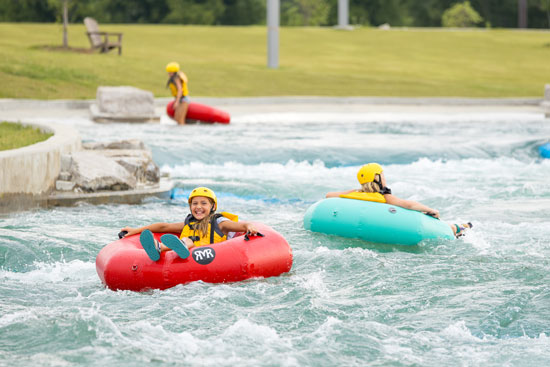
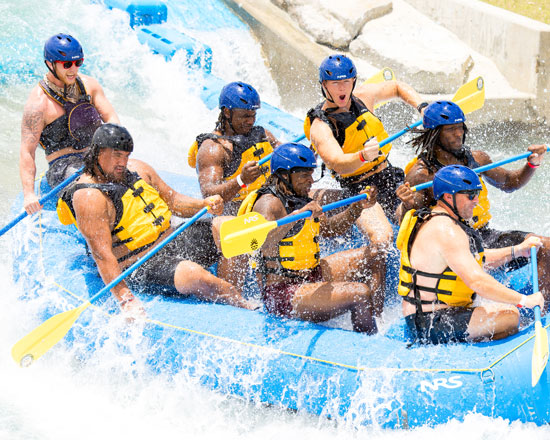
Nearby along the river, Montgomery Whitewater opened in the summer of 2023. The outdoor destination features plenty of green space for things like live music and yoga classes. There are game nights and family events, plus a full-service restaurant and bar. Winter programming includes an outdoor ice rink, campfire music series, 5Ks, broom ball and polar plunges. The centerpiece of Montgomery Whitewater is a recirculating whitewater channel, “utilizing the world’s most advanced whitewater technology.”
The project was made possible by a partnership between state, local and community leaders who formed the Montgomery County Community Cooperative District (MCCCD). They hold the property and all the physical assets on the site, and provide the overall governance structure, according to Jason Wilson, executive director of Montgomery Whitewater. “MCCCD also oversees the ancillary development planned around the park, while Montgomery Whitewater’s staff focuses exclusively on running and growing the recreation facility itself.”
Additionally, the Southern Whitewater Development Group (SWDG) was contracted to serve as the developer of Montgomery Whitewater, “leading the design and construction of the project,” said Wilson. “Once the facility was built and initial operations were established, management transitioned, as intended, to MCCCD.”
The recirculating whitewater channel system is self-contained, using water from the local water authority, with technology that allows for consistent, customizable water conditions. “This lets us fine-tune for a wide range of users, from Olympic-level athletes to complete beginners,” said Wilson. He explained that the Creek Channel offers a more beginner-friendly experience, while the Competition Channel provides “powerful, technical whitewater.” In fact, the facility hosted the 2024 Olympic Team Trials, with new international races being announced for 2026 and 2027, “all building toward the global spotlight of LA28.
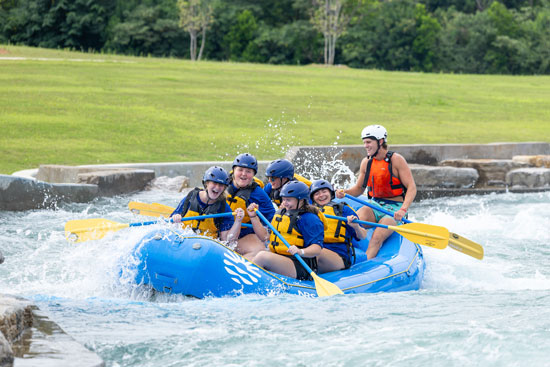
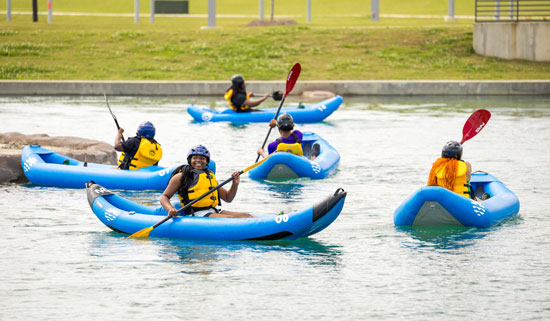
“We also use our bottom pond as a calm-water environment, where first-time kayakers can learn the basics without relying on river conditions or weather,” continued Wilson, who added that their mission is to lower the barrier to outdoor recreation. “Montgomery Whitewater gives (users) a safe, controlled place to build skills, try something new and develop confidence to eventually explore natural waterways.” Additionally, the first phase of an aerial ropes course opened, which will expand to include additional ropes elements and ziplines along the riverfront.
Montgomery Whitewater also recently launched a Swiftwater Rescue Training program, providing first responders with a “level of control and repeatability that simply isn’t possible on natural rivers,” explained Wilson. Adjustable channels allow agencies to recreate a wide range of real-world rescue scenarios. There’s also a Guide School, where students learn fundamentals of raft guiding in a controlled environment “before taking those skills to natural rivers around the world.” And an Outdoor Education program has launched, using the riverfront as a living classroom, “teaching students about ecosystems, water and environmental science.”
Wilson said the city-owned project site—previously home to a public housing community demolished 20 years earlier—consisted mostly of vacant land, a few private homes and the former Salvation Army building. “A major goal of the project has been to bring new life and meaningful public use to a riverfront area underutilized for many years.” The site is now a “major outdoor recreation destination… catalyzing new opportunities for investment, activity and positive development in West Montgomery.”
Future improvements along the river are anticipated, including a dock that will support flatwater kayaking, canoeing, stand-up paddleboarding, environmental education programs and guided river experiences. And Wilson said a long-term goal is to connect their trail system to downtown Montgomery along the river, linking to the River Region Trails network, which would “help integrate the riverfront more fully into the fabric of the community.”
In 2023, the nonprofit River Region Trails (RRT) unveiled a master plan for a 150-plus-mile trail network connecting neighborhoods, parks, schools and landmarks across Montgomery and the so-called River Region. In 2025, RRT signed the 30x30 partnership agreement with the city of Montgomery to expand and develop new trail segments and connections. “Per the partnership, RRT is responsible for leading community engagement, contributing conceptual and design input, developing strategic partnerships, leveraging philanthropic funding, and pursuing… relevant grant opportunities in support of project delivery,” said Ashley Thorne, executive director of RRT.
One 30x30 priority is Riverfront Park, with a focus on adding more shade and landscaping, public water access and a water-level trail connecting Montgomery Whitewater and Maxwell Air Force Base, according to Thorne. “In the future, the river trail could continue south toward EJI (Equal Justice Initiative) and the marina, and there is interest in opening the opposite riverbank floodplain for public use.” EJI’s Freedom Monument Sculpture Park sits on the river, featuring art, original slavery artifacts and the National Monument to Freedom.
Diaz-Lucier said the Riverfront Greenway Trail project is credited with attracting 250,000 to 300,000 annual visitors and generating $8 million to $9.6 million in economic impact. “It also supports 70 to 90 full-time equivalent jobs annually.”
Thorne said there’s also a focus to redesign Riverfront Park with flooding resilience, which is becoming a bigger consideration for many waterfront projects. Dena Prastos is president of Indigo River, a Nyack, N.Y.-based architecture and engineering studio focused on waterfront solutions, and she said climate adaptation and resiliency have moved from being specialized considerations to “becoming the primary lens through which waterfront projects and projects in critical flood hazard areas are conceived, planned, designed and executed.”
And while waterfront engineers have always dealt with these realities, Prastos said planners, architects and developers have had to adjust approaches to “address the fundamental reality that the shoreline is no longer fixed and the climate baseline is no longer stable.” And beyond resiliency work, we’re witnessing a “new philosophy and typology in waterfront design, integrating flood protection, public access, ecosystem restoration and long-term adaptability in a single, cohesive framework.”
Prastos mentioned some projects around New York, including South Battery Park Resiliency, the East Side Coastal Resiliency in New York City, Coler Hospital on Roosevelt Island and Harlem River greenway, where the parks are the resilient features and “solutions are no longer discrete ‘barriers,’ but integrated public realm infrastructures of which parks are the majority. As we look toward future climates, we must design waterfronts that can flex and evolve, acting as both defensive systems and civic landscapes.”
She pointed out that public policy and approvals have also shifted toward more robust submission and design requirements for permits from local, state and federal agencies, who “now require that resiliency and climate adaptation be addressed in the permitting and design process.”
Developed by the nonprofit Waterfront Alliance, WEDG (Waterfront Edge Design Guidelines) is a science-based, national rating system and set of guidelines to “create resilient, ecological and accessible waterfronts,” and Prastos said they’re seeing a significant rise in clients interested in WEDG verification. “Where LEED helped transform individual buildings and Envision did the same for civil infrastructure development and construction, WEDG is helping redefine urban systems and coastal environments.” She said WEDG elevates expectations for what a waterfront should offer, including “healthier shorelines, resilient infrastructure, inclusive public access and ecologically responsible development.”
The River Ring project in Brooklyn aims to develop a waterfront site on the East River, which was “effectively an unused oil storage terminal,” into a waterfront park. And while the project hasn’t yet been built, Prastos said it “already plays a role in shaping discourse about the future of urban waterfronts; the project has received all construction and regulatory approvals thereby setting some regulatory precedents.”
The River Ring design represents a shift from defensive waterfronts to “immersive, educational, climate-responsive ones,” according to Prastos. “The developer willingly sacrificed some developable land and moved that offshore to create breakwaters and flood/surge protection elements that invited access, not prevented it.” The design includes an outdoor classroom, beaches, nature play, trails, a boat launch, picnic area, amphitheater and boardwalk.
The Westchester Riverwalk Connection is a proposed shared-use trail along the Hudon River shoreline in Tarrytown, N.Y., that would complete a missing link in the Westchester Riverwalk. “Linear waterfront systems do something uniquely transformative in that they create continuity, stitching together neighborhoods, parks, ecosystems, transit modes and community assets into a unified experience,” said Prastos. “Their planning and design look to encourage active mobility, expand daily access to nature, support local businesses, strengthen climate resilience and provide platforms for future recreational and cultural programming.”
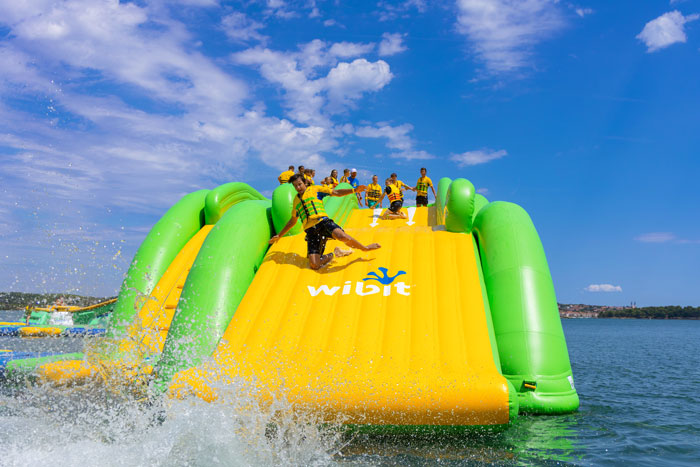
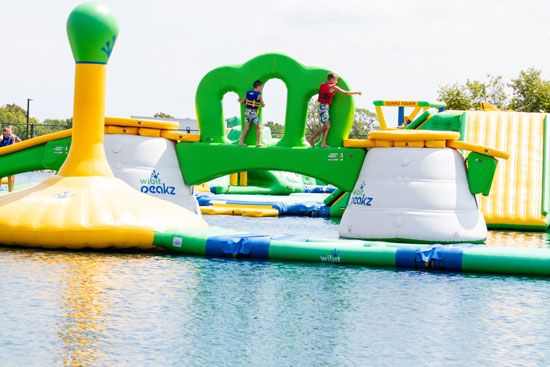
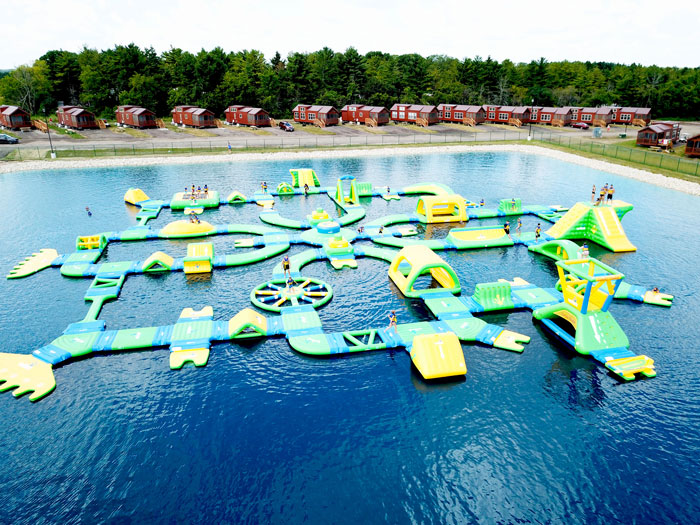
After nearly 60 years of serving the community of Blanchardville, Wis., the McKellar Park swimming pool closed due to structural issues. Construction costs were too high to replace the pool, so the town pivoted to a different solution: creating a natural swimming pond with an aqua park featuring inflatable amenities including slides, climbers and obstacle courses, which was a fraction of the cost of pool replacement.
The park has been a big success, acting as a community gathering place and providing an economic boost through day pass and season pass sales, as well as from visitors supporting local businesses and the campground. Future plans include an accessible bathhouse for events, storage and recreation, as well as continued integration of the aqua park into youth programming and school activities.
“Not every site has the right depth, water clarity or circulation needed for swimming or floating attractions,” explained Romens. “In those areas, engineered water features create an opportunity where none existed.” His company designed the McKellar Park aqua park, and he said environmental constraints shaped the entire design, “…including where the new water feature would sit and how it would interact with the rest of the property. Sustainable development isn’t a separate task; it’s woven into the planning from day one.”
He said it’s becoming more common to develop new water features, and McKellar Park is an example. “The municipal team needed a safe, predictable space for family recreation but couldn’t rely on existing natural water. A purpose-built water feature allowed them to design an experience with controlled depth, improved water quality management and defined lifeguard zones. It gave the community a waterfront experience that simply wasn’t possible within the natural landscape.”
Romens said the modular nature of most inflatable amenities means budgets are flexible. “We’ve seen communities start with a single inflatable circuit or a limited rental fleet then add new elements once they see demand. This phased approach is something many municipalities appreciate—they can build momentum without overcommitting upfront capital.”
Park operators often refresh their amenities each season, according to Romens. He mentioned Bear Paw Beach in Caledonia, Wis., as an example, where the team regularly updates their layout, as “even small changes keep the attraction fresh and give returning families a reason to come back. The modularity also helps with demand management; if a feature becomes especially popular, operators can expand it. If feedback suggests a need for more beginner-friendly obstacles, those can be added as well.”
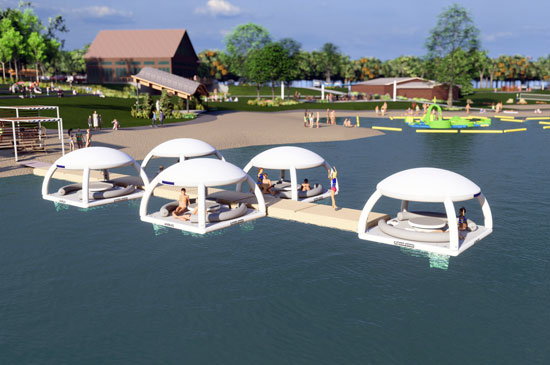
Additionally, “Floating cabanas, shaded platforms and social hangout areas give families a comfortable ‘home base’ and extend time spent at the waterfront.”
For some municipalities, rentals are a first step in revitalizing an underused lake or pond, according to Romens. And once they see strong participation and community interest, they build from there, “adding inflatables, shade structures and other amenities to create a more complete waterfront experience.” He said many communities find that offering kayaks, pedal boats, stand-up paddleboards or water trikes helps broaden the appeal of their waterfront. “They also fit well into community programming; things like introductory paddling classes, family activity days or special events.”
Romens said the most successful municipal waterfronts don’t rely on water alone. “Land-based amenities extend the season, broaden the audience and create multi-activity destinations where families can spend several hours.” He mentioned pump tracks gaining traction as they give older youth and teens an activity they can’t easily find elsewhere.
“Shade structures, social seating, yard games and cabana zones also help create a community hub that remains active before and after swimming hours, and even into the shoulder seasons.”
Prastos reminds us that various types of waterfront projects—resiliency systems, greenways, maritime facilities, living shorelines—are expressions of a broader cultural shift: “Waterfronts are becoming our most important civic laboratories. They ask us to confront climate volatility, expand mobility, restore ecosystems, sustain maritime commerce and support the human need for connection with water. If we design these spaces with clarity, humility and foresight, they will become the resilient, equitable and inspiring public realms that future generations deserve.” RM