


As indoor sports evolve, manufacturers of indoor sports surfaces are also advancing their offerings to keep pace. The result is a growing range of surface and subfloor systems designed to help operators get good results—no matter the sport, maintenance or budgetary need. This article looks at recent trends in indoor sports flooring, offering advice from the experts to help you make the right decision and maintain your surface in optimal playing shape for its lifespan.
Focus on the User
In some cases, the choices can seem overwhelming. And that’s why it’s always essential to consider the needs of your clientele first and foremost. “Who are the people using it, and what are they using it for?” said Cory Corullo, vice president of sales for a manufacturer of multiple sports flooring types based in Mercer, Wis. “If they say, well it’s high school kids, and we want a weight room, and here’s our budget, we can come up with something for that. If it’s a retirement home, and there’s some spin bikes and stair steppers, and they bring coffee in there every morning, maybe that’s something different.”
While Corullo’s company offers both maple hardwood and synthetic options, he is seeing more demand for synthetic options for numerous applications. In part, this is because the growing array of synthetic products gives facilities many different options to choose from at a variety of price points.
The Basketball Standard
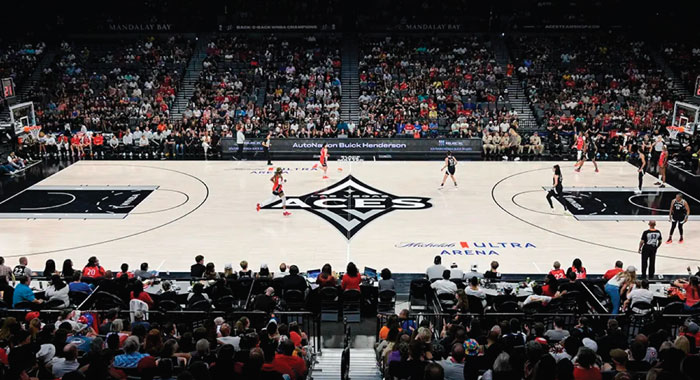
That said, maple flooring continues its reign as the surface of choice for higher-end competitive basketball courts. “Every NBA floor is our floor. Almost every Division I basketball court is ours,” said Steve Bernard, executive vice president of the Maple Floor Manufacturers Association (MFMA). “But they also have the money. As you get down further into places like grade schools where they might have mixed-use facilities, those might be better suited for a synthetic floor.”
While maple floors may come at a higher cost, they also offer unrivaled longevity if properly cared for. In fact, the MFMA now encourages architects and builders to limit the specification of thicker 33/32-inch maple flooring and to instead specify a 25/32-inch floor for most applications. “What we were finding was that a 33/32-inch floor would outlast the length of the building,” Bernard said. In some cases, this could be 100 or more years old.
According to the MFMA, a 25/32-inch floor can be sanded up to six times by a knowledgeable, skilled flooring contractor over its lifetime. Sanding the floor every eight to 12 years as recommended, according to the MFMA, results in a typical lifespan of 75 years or more.
Corullo noted that ongoing advancements in wood floor finishes are also contributing to longer maple floor life. “The liquid clear coats that they’re putting on are so much more durable now that you don’t need to sand the floors as often,” Corullo said.
According to Jay Henley, indoor sports surfaces division president of the American Sports Builders Association (ASBA) and vice president of athletics for a sports surfacing company with several Southeastern U.S. locations, facilities selecting a maple floor need to make sure they have the maintenance budget for annual recoating of the hardwood and for the larger investment in the re-sanding at least once every 12 years. “At that point, you’re making a large investment to refurbish that court that’s sometimes upwards a third of its original cost,” Henley said.
Maple floors are also more susceptible to water damage and humidity than synthetic surfaces. “A big no-no is floor scrubbers on our floor—you’re introducing water to it,” Bernard said. “Big swings in temperature and humidity can also affect the floor, again because it’s taking in moisture.”
To preserve the court’s function, the MFMA recommends that maple floors be installed in areas where the HVAC system is functioning properly and set to maintain indoor relative humidities between 35% and 50% year-round. Because wood is naturally porous, it can absorb and release moisture, expanding and contracting in the process. For this reason, it’s often important to include expansion voids around the court perimeter and around columns or floor inserts, while also including expansion joints in the floor surface. “You don’t want anything to restrict the movement of the floor,” Bernard said.
Maple floors can also come with a variety of subfloor system options with different performance characteristics and designs that are explained in depth on the MFMA website. “An NBA court is extremely different than a grade-school basketball court. It’s really what’s underneath the floor that makes up the court,” Bernard said. “The subfloors all do the job. It’s really, do you buy a Ford Focus or do you buy a Porsche? They’re both cars that get you where you’re going, but one has more bells and whistles.”
Higher-end courts such as those used in the NBA feature verified performance characteristics that define a “good sports floor.” These top-performing northern hard maple flooring and sports flooring systems meet MFMA PUR standards through a pass-fail evaluation of key performance measures that include shock absorption, vertical deflection, area of deflection, ball bounce, and surface friction.
While these qualities are not needed for all installations, Henley is seeing more emphasis on their inclusion. “In basketball floors, we’re seeing a shift to high-performance, vibration-dampening subfloors to help minimize Achilles, ACL and MCL injuries because it’s affecting return on investment on athletes with the introduction of the NIL,” Henley said.
When going with a maple floor, it’s also important to work with an experienced contractor in your area, versus just doing research on the internet. “You need to understand what’s available in your market and what works in your market,” Henley said. “Not every floor or subfloor makes sense in your climate. What works in a dry climate out west doesn’t necessarily work the same in the southeastern U.S.”
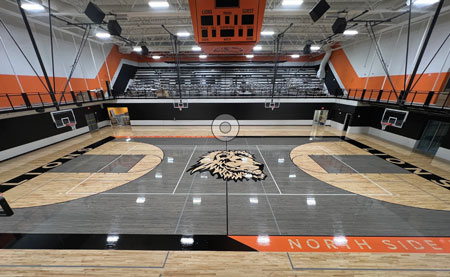
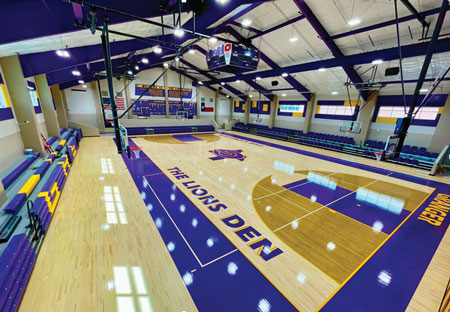
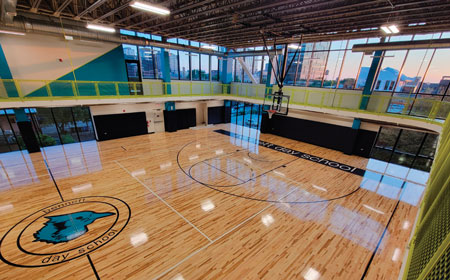
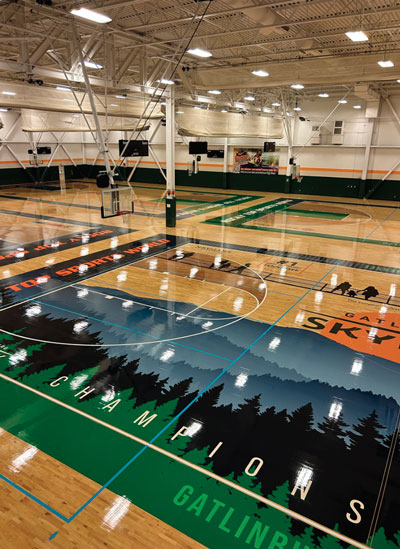
Customized graphics are also becoming more common in maple basketball courts, with the trend migrating down from the NBA through the collegiate ranks and to private high schools. The graphics can also be changed over time, a process that requires a re-sand and that is often done when the regular re-sanding of the court surface is due.
“A lot of these big universities are using their maple hardwood gyms as a recruiting tool,” Corullo said. “They’re really putting money into the look and design of their gym so that it looks impressive to kids they want to go to school there.”
Different Materials for Different Uses
Because some facilities want to use some courts as multi-use spaces, some larger facilities are choosing to offer a mix of maple and synthetic courts, even for basketball. “A lot of rec centers I’ve done over the years will have some wood courts, and they’ll have some synthetic courts, or synthetic areas,” said Courtney Spicer, vice president of sales for a manufacturer of multiple court surfaces based in Gurnee, Ill. “The key is the owner just understanding what their programming is, because that’s really what it boils down to.”
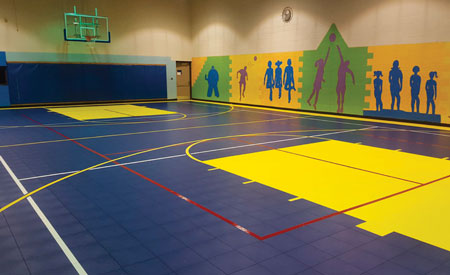
In rec centers, Spicer will often see maple basketball courts also being used for volleyball. But increasingly, in high-end dedicated volleyball facilities from Division I down to the K-12 level, he’s seeing cushion-backed sheet vinyl flooring installed as a surface of choice because it’s a softer, more forgiving surface for landing knees and elbows.
According to Corullo, similar shock absorption can be achieved with pad and pour solutions featuring a recycled rubber roll glued to the concrete with a poured urethane surface on top. But these solutions last longer—20 years or more—and can be reused after that by re-topping the urethane surface and keeping the existing rubber subsurface. “My guess is that sometimes the bigger colleges, universities and high schools want to be able to change the look of that place after 10 years or so,” Corullo said. “The vinyl-backed materials are inexpensive compared to some of the other options, and they can change them.”
For multiuse spaces, Spicer often sees vulcanized rubber selected as a material of choice. “To me, it’s the best multipurpose flooring you can buy,” Spicer said. “It checks so many boxes with coefficient of friction, products that you can engineer for different shock absorption, you can put different textures on it. I don’t want to say it’s bulletproof, but its ability to wear over time is fantastic for relatively low maintenance and low cost of ownership.” While more expensive than some other synthetic floors, it can also be longer lasting.
Pickleball Spreads Indoors
As the popularity of pickleball continues unabated, more and more dedicated indoor facilities are being built for the sport. And pickleball players often want better performance characteristics than what part-time use of a basketball or volleyball court can offer.
Jake Angrisano, sales and marketing specialist for a maker of modular flooring based in Utica, N.Y., notes that this can create conflict when people try to use one space for pickleball, basketball and volleyball. “Typically, where we see the conflict, ultimately, is between volleyball and pickleball,” Angrisano said. “Volleyball wants that soft base. Pickleball wants that hard base for a solid ball bounce.”
Ideally, many pickleball players can benefit from the best of both worlds: a surface with bite along with some cushioning underneath that’s forgiving for older joints. “Pickleball is becoming more sophisticated in that there are specifically designed indoor pickleball systems now offered by most manufacturers where they are creating a surface that resembles outdoor pickleball with the friction of an acrylic outdoor but with a cushioned court subfloor,” Henley said.
Spicer has been seeing demand for pickleball on a variety of surfaces. “We’ve been lining floors and striping floors with a lot of pickleball, and we’ve put it on rubber, we’ve put it on vinyl, we’ve put it on tennis surfaces,” Spicer said. “It’s run the gamut, but there’s certainly a trend of having pickleball in a lot of facilities, even in K-12 schools. When we’re doing new facilities, it just seems like it’s going in everywhere.”
Portable and Modular Have Their Place
Modular and portable installations also have their place, especially in convention centers, arenas and other applications where the ability to remove the floor and store it is an important consideration. “It’s all about the activities that are going to take place in a building,” Henley said. “You can’t have a monster truck show on top of a wood floor. You can’t have a rodeo on top of a wood floor, or a modular floor.”
Modular and portable offerings can also be a good option for those renting a space. Henley noted the example of a volleyball coach who needs two volleyball courts but is not permitted to adhere a surface more permanently within a space. “You want that floor to be able to be picked up and taken to another space when you leave that facility,” Henley said. “We see a lot more portable and modular purchases with all the advancement and growth in club sports and private training and private fitness.”
Angrisano sees his company’s modular tile-based products being used in permanent installations as well as in part-time applications where the flexibility they offer is critical. “We have some customers who put the tiles down for their melted ice rinks for the offseason,” Angrisano said. “And then they can put down basketball lines on it, we’ve had them do roller derby, inline hockey and box lacrosse. It’s more comfortable than a bare concrete space and it can be more customized to their colors.”
Those tile-based products offer a 15-year warranty, but Angrisano has seen some installations last much longer. “The good news with our tile is that if you do crack one, you can pop it out and replace it with another piece,” Angrisano said. “That’s easy to do, even if it’s in the center of the room.”
Weight Room Trends
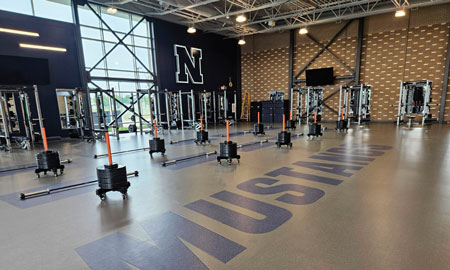
An ongoing trend for weight rooms is thicker floors for more shock absorption and comfort, as well as more inlaid weightlifting platforms with custom graphics for higher-end installs. “You don’t have those raised platforms that you have to worry about potentially cleaning around or having trip or fall hazards,” Spicer said.
There is also more demand for multi-surface spaces with rubber and turf areas. “If they’re going to have turf and rubber in the same space, it’s important that they get these surfaces to marry up properly,” Henley said.
Maintenance Needs
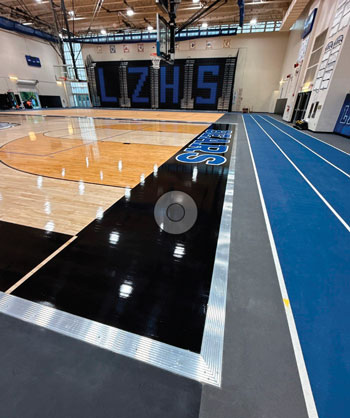
All floor types may have different requirements, but it’s generally helpful to dry mop both hardwood and synthetic floors daily to prevent dust buildup that can change the coefficient of friction of the surface and cause injury.
It’s also important to follow the detailed maintenance instructions for your particular floor surface. “It’s very important that they understand the product and the warranty so they understand what they are able to do and what they’re not able to do,” Henley said. One example is that you cannot use an auto scrubber on a wood floor under warranty. The moisture can damage the wood, while the pressure of a scrubber can also damage the finish.
“On synthetic, it’s important to understand the proper type of machines to use so that you don’t strip the coating off any of the synthetic materials,” Henley said.
Often, improper maintenance can be the biggest risk to a floor over its lifetime. While a manufacturer may provide the right literature to the contractor, the architect or owner, at some point the facility may hire a janitorial service that may not be as knowledgeable. Henley noted that using a mop with a bleach product in it, for example, could fade the colors on a surface. A high pH cleaner could eat into the synthetic coating. Using a buffer could remove the coating and lines on a synthetic coating. Or a carpet brush machine on a synthetic coating could scratch the coating. “There’s a lot of things that can happen,” Henley said. For this reason, making sure that the right information always gets to the people cleaning the surfaces is critical.
Lean on the Experts
As flooring options proliferate, so can confusion. It can be helpful to ask the experts. “I don’t think that there’s one particular floor that everybody’s gravitating to, because the reality of it is that not everybody’s needs are the same,” Spicer said.
“My main advice is to not just try to Google something,” Corullo said. “Call the people that actually deal with it every day, and we’re more than happy to talk to them. And just with a couple of quick questions, we can probably steer them in the right direction.”
Henley noted that while the ASBA will not direct anyone to a specific brand or type of flooring, they can connect people to ASBA professionals and builders for assistance on a construction project. Henley noted that issues range from tariffs to supply chain issues to shifts to low-VOC coatings; ASBA professionals are able to choose appropriate products that can also be delivered and installed in a timely manner.
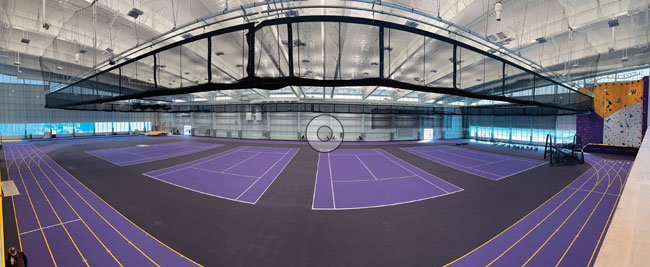
Most importantly, the right indoor sports flooring will have the right surface and shock-absorptive qualities for the sports it will be used for. “Proper shock absorption is critical for reducing chronic injuries such as lower back, knee pain and shin splints,” Corullo said. “And the leading cause of surface-related injuries is improper friction characteristics. Improper friction can contribute to career-ending injuries to knees, ankles and Achilles.”
“I would encourage them to connect with an ASBA professional and builder and visit like facilities to understand functionality and establish expectations—what you’re looking for and what can the floor do,” Henley said. “I personally do that a lot. I’ve got multiple meetings coming up where we’re taking people to look at other facilities.”
Seeing and using a surface firsthand can provide insights into its playability. And talking to others who have the surface in their facilities can provide good insights into the day-to-day maintenance of the surface too. A combination of expert advice, firsthand investigation and strong consideration of how the product fits with your budget and maintenance capabilities can lead you to the right decision—and to a surface that will keep your patrons playing safer and happier over the long haul. RM