

Baby, it’s hot outside! According to the World Meteorological Organization, 2024 was the hottest year on record for the U.S. and globally, with 31% of U.S. cities recording their highest temperatures ever. 2023 and 2025 were ranked second and third, respectively. In fact, the 10 hottest years on record have all occurred in the past decade, and climate experts agree that extreme heat events will likely become more frequent and intense.
These trends are projected to be even more severe for those living in so-called urban heat islands, which experience higher temperatures than surrounding natural areas. The Environmental Protection Agency reports that air temperatures in a large city can be 2 to 22 degrees Fahrenheit higher than in rural surroundings.
Heat islands form when cities replace natural land cover—trees, grass, wetlands—with pavement and buildings, as this eliminates the natural cooling effects of shade and evaporation of water from soil and leaves. Pavement, rooftops and other non-reflective surfaces absorb heat during the day and release it at night, increasing overnight temperatures. Additionally, tall buildings and narrow streets reduce wind flow and heat the air that’s trapped between them. Further increasing the effect is heat from vehicles, factories and air conditioners.
Extreme heat is the deadliest form of extreme weather, in most years killing more Americans than floods, tornadoes and hurricanes combined. And studies consistently show that low-income and underserved neighborhoods—including majority Black or Latino communities—are significantly more likely to suffer from urban heat island effects. These neighborhoods often experience temperatures up to seven degrees hotter then wealthier, predominantly white areas, according to a study conducted by researchers from the University of California, San Diego.
These disparities are driven by a lack of green space and less tree canopy, while there are more impervious surfaces like concrete. There are often higher concentrations of industrial, commercial and traffic-dense infrastructure, and less access to air conditioning. And historical inequities, such as redlining, have resulted in lower-income areas having less investment in heat-mitigating infrastructure.
Knowing that these extreme heat events will likely be the new normal, city and park officials, community leaders, outdoor venue operators, landscape architects and others have much to consider when it comes to cooling and hydration strategies for their residents and visitors. And while major infrastructure changes will be on the table going forward, there are also simpler actions to be taken that can help people beat the heat and stay safe.
Staying Hydrated
The European climate adaptation platform Climate-ADAPT suggests that “Repairing historic drinking fountains and installing new ones creates more opportunities for people experiencing the negative effects of heat in the city.”
“We do still see a lot of drinking fountains, including a potential increase in ones with pet bowls, and many are selecting the bottle filler option instead of or in addition to the traditional bowls,” said Eric Hornig, senior principal with Hitchcock Design Group.
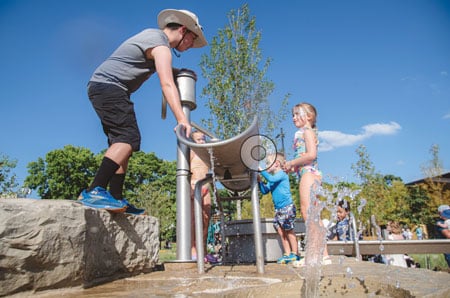
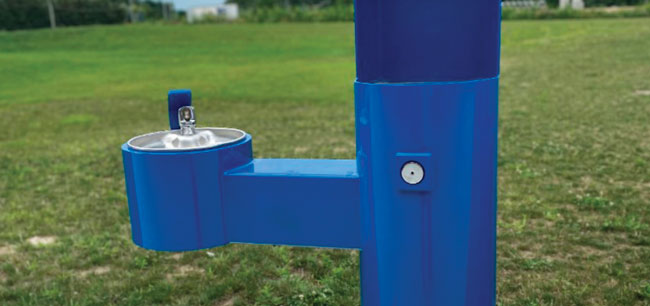
“Drinking fountains are still very relevant, but they’ve evolved,” said Meagan Deacon, marketing manager for a Lexington, Va.-based online distributor of commercial outdoor furniture. “Parks and recreation departments, municipalities, schools, campuses and outdoor venues continue to specify them, often choosing modern, ADA-compliant designs with bottle-filling stations to support accessibility, hydration and sustainability while reducing single-use plastic.”
With a variety of materials offered, Deacon said stainless-steel models tend to be “the most popular overall because they balance durability, low maintenance and clean aesthetics. Metal and concrete aggregate options are chosen for heavy use or design-driven projects.”
Many units also include vandal-resistant features “like tamper-proof hardware, recessed bowls and rugged construction to stand up to high traffic and public environments,” she added.
Deacon said wheelchair-accessible drinking fountains are popular for public and institutional projects, and bottle fillers are in high demand, “often paired with traditional fountains.” Pet fountains also are increasingly popular as “owners expect hydration options for their animals wherever people gather. They’re being specified at parks, trails, campgrounds, mixed-use developments, and we absolutely see dog parks and municipalities including them as standard features to support both people and their pets.”
Fountains with integrated refrigeration systems are also available, which Deacon said are “popular in hot weather and high-use environments because they deliver noticeably cooler water, which users appreciate at athletic fields, parks, campuses and recreation centers. They’re a premium option that many customers choose when comfort and hydration performance are priorities.”
In addition to their drinking-water function, some water fountain models feature hose bibbs, and some parks hosting summer day camps use hoses for cool-off time, allowing for sprinklers, water balloons or just simply getting wet.
Deacon’s company also offers outdoor body and foot showers, and while she said these are designed for rinsing sand, salt or chlorine, “many people do use them for a quick cool-down on hot days. They’re especially popular at pools, splash pads, beaches and aquatic facilities where comfort and user experience matter just as much as function.”
There are shower options including triple and quad units, and Deacon said combo units are popular “because they deliver multiple functions in one amenity, which maximizes value and meets diverse user needs. Customers often choose combinations like drinking fountains plus bottle filler plus pet bowl, and adding foot shower or wheelchair-accessible heights is common in parks, trails, campuses and recreation sites to ensure inclusivity and convenience in a single station.”
Showers with adjustable timers are available, “allowing owners to set how long the shower runs with each activation, helping manage water use while still providing a comfortable rinse or cool-down for users.” And she said solar light add-ons for drinking fountains or showers are popular options “when there’s no nearby power source or when customers want low-maintenance, self-powered lighting for safety and visibility. They’re especially useful at trails, parks and remote sites where traditional electrical hookups are impractical.”
Sun Protection
While we know that shade is a critical amenity for providing comfort, the numbers are impressive: Studies have shown that shade can lower ambient air temperatures by as much as 15 to 20 degrees. Additionally, shaded surfaces like pavement can be 20 to 45 degrees cooler than those in direct sun.
Sean Schmeiser is a sales manager at a Holland, Mich.-based company that designs and manufactures outdoor shelters, and he said that “Over the last several years, conversations around heat mitigation, urban heat islands and user comfort have become much more common among municipalities, park departments and school districts. What used to be a ‘nice-to-have’ is increasingly viewed as a necessity. Customers are thinking not just about shade, but about surface temperatures, user safety and how long people can comfortably occupy a space. In urban parks, playgrounds and sports venues, shade is now often part of the initial planning instead of an afterthought.”
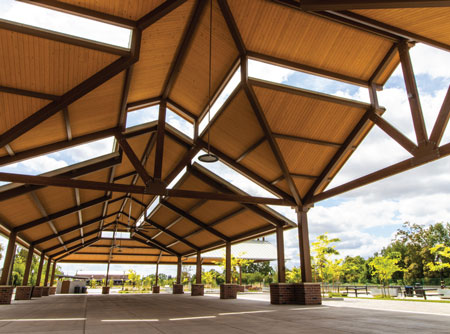
And while Schmeiser said they still do plenty of larger shelter and pavilion projects, the need for individualized-use shelters or unique shelter options with multiple configurations has increased, leading them to design a smaller, modular shelter line. “This line has multiple configurations that can help create a unique shade space. We’re seeing more projects covering playground equipment, benches and picnic tables, outdoor classrooms, kiosks, bike racks, sport courts, dugouts and even spectator seating. Some small shelters can be integrated with bench swings that allow a place to relax. These projects often come from cities, schools, parks and sometimes private developments that want flexible shade options without committing to a large pavilion footprint.”
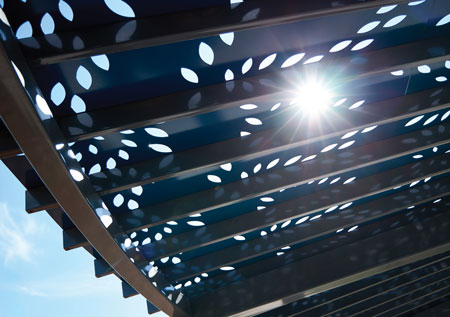
Filtered light arbors utilizing laser-cut panels are also popular shelter options, said Schmeiser. “Through precision-cut patterns, heat buildup is reduced and creates a cooler and more comfortable space beneath the structure.” Panels can be customized with unique designs or simple perforations to provide shade while letting light in, offering “strong visual appeal and contributing to the overall aesthetic for the park design.”
Material choice matters quite a bit, according to Schmeiser, who said steel performs very well structurally and long-term, especially outdoors, but how it’s finished and paired with other materials makes a difference. “Some metal roofing is designed with a high solar reflectance that will keep the surface temperature lower on the roof, which in turn creates a cooler space below. Other materials, like vegetated roofs, can be an option to create a green space in a fun way, contributing to a lower temperature underneath.”
A green roof is a vegetative layer grown on a rooftop. They’ve been proven to help reduce heat islands by providing shade, removing heat from the air, and reducing temperatures of the roof surface and surrounding air. During the day, the surface temperatures of green roofs can be 50 degrees lower than those of conventional roofs.
Hornig said that while it depends on the region and type of project, they’re including some type of shade on most projects. “We’re seeing heavy demand for shade aside pickleball courts and increased shade requests in and around play environments. Careful planning of orientation of key features—like slides—is one strategy for success. Some are requesting overhead shade, but often it’s a combination that includes vegetation to balance budget, visual appearance, and true protection.”
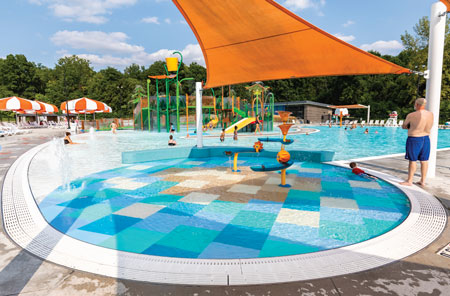
Permanent shelters and shade sail products are go-to standards to provide protection and increase the visitor’s length of stay, added Hornig. “Shade sails and roofs over dugouts have increased, and shade sails over spectator areas are on the rise. And shade—often large umbrellas—is a must for any project with water,” including pools and splash pads.
“Umbrella options—including those with built-in stands and ice bucket features—are gaining traction beyond the usual patio setup,” said Deacon, and they’re seeing them used by various venues with pool decks, lounges and outdoor dining, as well as at “campgrounds and RV parks, where guests appreciate multi-use shade and cooling stations.”
She added that steel and fabric shade structures are being used more often to “enhance outdoor amenity spaces. They’re popular over drinking fountains, showers, gathering areas, playgrounds, picnic spots and pathway rest points to provide sun protection, encourage longer stays and improve user comfort.”
Spray Down
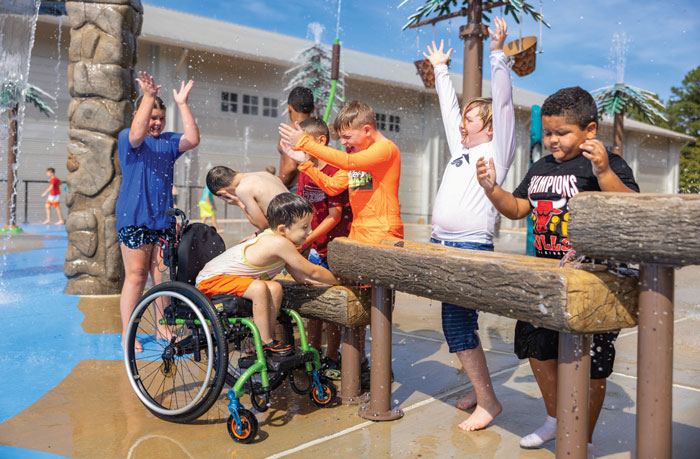
Water is another major player in the war on excessive heat, while also bringing the fun. Mist works as natural air conditioning; when tiny droplets evaporate, they absorb heat energy from the surrounding air, creating a cooling effect, which can lower air temps by several degrees. Cities like Las Vegas use mist-producing water features in public squares to combat heat.

Aaron Skogen is general manager of a Delano, Minn.-headquartered water feature and spray park design, fabrication and construction firm. He said a vast majority of client discovery calls “include discussions around creating spaces that allow for a reprieve from the rising temperatures in their communities. Regardless of socioeconomic status, age or ability, splash pads and interactive fountains are a great solution to bring some relief from the heat.”
While large, full-blown splash parks remain popular, Skogen’s company also offers packages for smaller footprints, which he said are ideal for small communities, urban pocket parks, HOAs, schools, churches and childcare centers. “We have ground-spray-only, ground-spray-and-misting, and misting-only packages that provide for fun and interactive cooling stations, in addition to more traditional packages with dumping buckets and structures.”
The smaller packages are self-contained, using the company’s patented non-electric water delivery system, which “only requires a two-inch water supply and four-inch drain line,” explained Skogen. “Simply press the button on the activation bollard and the water runs for about 90 seconds. Because the installation, operation and maintenance are so simple, and the water use is minimal compared to traditional splash pads, these systems are a great solution anywhere a client wants to bring splash play.”
He said they’ll often see this system showing up adjacent to sports parks, along with their three-dimensional aqua mister, “to provide a misting/cooling station for the athletes.”
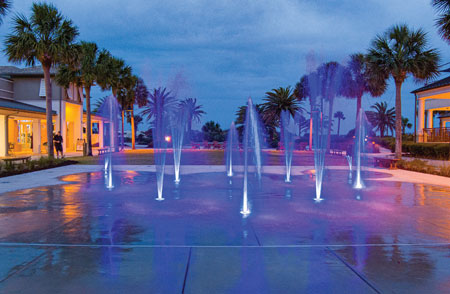
And there are interactive fountains with numerous water and nozzle effects, featuring dancing water formations and LED light shows, enjoyed throughout the day and into the night. “The demographic of patrons shifts from children and caregivers splashing around in the daytime to teenagers and older adults enjoying the ambience created through water and light in the evening,” said Skogen, who added that these systems are truly multi-use, including cooling.
Bryan Had is a regional sales manager and engineer for a San Marcos, Texas-based designer, manufacturer and supplier of commercial aquatic equipment including architectural fountains. He explained that while fountains act like traditional “swamp coolers” in hot, dry climates, in more humid locations “interactive fountains are best for cooling off as you can simply get wet. For the fountains where a cooling effect is desired, we typically use cascade or geyser jets that create tall, massive conical mounds of highly aerated water. The large amount of surface area with those fountain jets helps the evaporative cooling effect.”
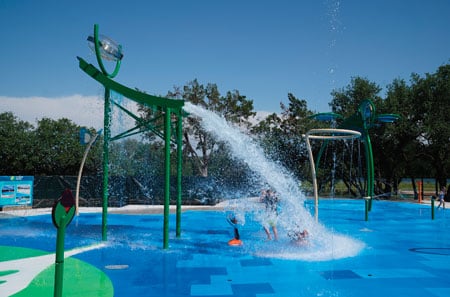
“Water in general is magic, and even a small splash pad can provide a huge service to the community,” said Hornig. “We’ve seen several instances where these either replace or provide a complement to an aging pool. While the community has difficulty letting go of the nostalgia of a pool, the results are well-received.”
Skogen said a large percentage of their projects involve replacing aging pools, as “the cost of operating a splash pad is significantly less than the costs associated with operating and staffing a pool.” And he pointed out that splash pads are also more inclusive.
Myles Phelps is vice president of strategic partnerships for a swimming pool developer and service provider, and he said they’ve also seen this trend, “especially in warmer regions and rural communities. Many municipalities are shifting away from traditional rectangle pools and instead investing in smaller, more efficient solutions like splash pads or compact recreational pools. Budget constraints are a major driver. Splash features and simplified aquatic amenities offer a lower-cost way to provide heat relief and keep public spaces active without the operational burden of a traditional pool.”
More Cooling Options
Looking at other cooling strategies, Hornig said “We’re landscape architects, so bring on the trees!”
Vegetation helps cool the environment, and trees reduce urban heat island effect through shading surfaces like pavement and buildings, blocking solar radiation, and releasing moisture into the air via evapotranspiration.
“The science is clear about the importance of trees in improving the nation’s public health, economy and community resilience to hotter summers,” said Vivek Shandas, a professor of climate adaptation at Portland State University.
Other options for reducing heat island effects include “cool roofs,” which are designed to reflect more sunlight than conventional roofs. The energy.gov website says that conventional roofs can reach temperatures of 150 degrees or more on sunny summer afternoons, while reflective roofs could stay more than 50 degrees cooler under the same conditions. There are cool options for nearly all types of roof coverings. Additionally, white roofing products stay coolest, reflecting 60% to 90% of sunlight.
Reflective coatings can be applied to roads as well, and the nonprofit Climate Resilience Project’s website described how “black asphalt roads in Los Angeles were shown to be a whopping 23 degrees cooler after they were coated with a white, highly reflective sealant.” The site also suggested removing pavement altogether, with preliminary studies suggesting that removing just 10% of a neighborhood’s pavement could lower temperatures by seven degrees.
More cities now have heat response teams and even dedicated heat officers who initiate emergency planning and lead strategies for tree planting, installing cool roofs and reflective pavement, and updating building codes. They organize outreach for at-risk populations and open public cooling centers at park facilities, libraries, senior centers and other locations.
Deacon said that as summers get hotter, “Cities, parks, sports venues, campuses and recreation facilities are prioritizing hydration, cooling and comfort amenities more then ever, which is driving more purchases of drinking fountains, refrigerated units, outdoor showers/foot showers, shade structures and other heat mitigation products to help keep users safe and comfortable outdoors.” RM