

While people of all ages are spending more time attached to their devices, it’s nice to know that there’s still a large segment of those who desire some adrenaline-pumping action, including pursuits like climbing, aerial adventures, and challenge and ninja courses.
“There’s a growing appetite for ‘digital detox’ recreation,” said Abby Burt, owner and chief marketing officer for Applied Adventure Consulting, which provides full-service operational management for adventure parks. “People are actively seeking authentic, curated experiences that help them disconnect from screens and reconnect with each other.”
Burt said the adventure/aerial adventure industry has continued to grow in exciting ways, though it’s leveled out some after a post-COVID bump in 2021 and 2022. “Demand is still strong, and parks that continue investing—whether that’s infrastructure upgrades, better guest flow, expanded programming or special events—are absolutely finding success.”
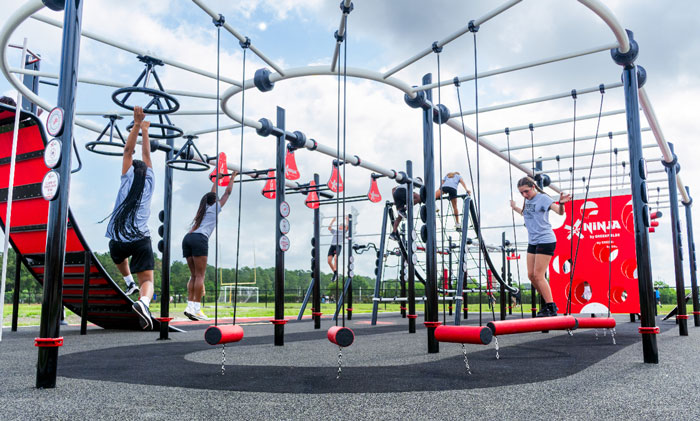
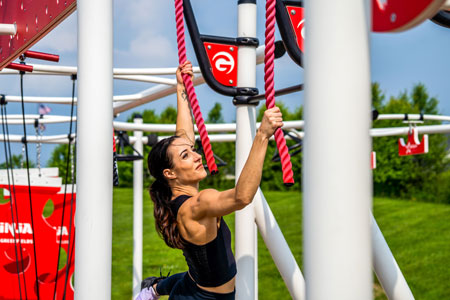
Ninja-style courses continue to maintain popularity, “capturing all the fun of playgrounds while taking the sense of adventure to the next level by incorporating obstacles that push teens and young adults to their limits,” said Allison Abel, director of marketing for an Anaheim, Calif.-based manufacturer of outdoor fitness equipment. She said the courses are also inviting for those “who may not be interested in traditional sports, by providing a thrilling challenge that may be completed alone or with friends.”
Each course provided by her company is designed with obstacles that nearly anyone can complete, while certain elements “may need more practice to pass through with ease,” said Abel. “The sport is unique in the sense that instead of requiring strict techniques, it has an infinite variety of ways athletes may approach different elements, allowing for creativity.”
Abel’s company offers six standard ninja-style courses, but these can be customized. “Customers can add or replace elements, modify layouts to fit space requirements, customize colors and even modify the elements themselves.” For example, she mentioned a school district that raised the finish wall two feet higher than the standard and added step-up clamps “to make it easier to reach tall elements.”
Schools sometimes integrate the courses into their P.E. curriculums. “There are great programming opportunities that come with (the courses), especially as users compete against the clock to beat their friends’ and their own personal best times,” continued Abel. “We’ve seen innovative programming such as schools bringing in experienced ninja athletes to compete against beloved teachers, and cities collaborating with local teen center day camps to organize a themed week” around their course.
The nonprofit Climbing Wall Association (CWA) has a mission to “support the health and independence of the climbing wall industry,” and Executive Director Garnet Moore said the sport continues to expand. “As you see with increased adoption of climbing in the Olympics, the sport of climbing is growing with increased awareness all over the country. In 2025 we saw dozens of new climbing gyms open.”
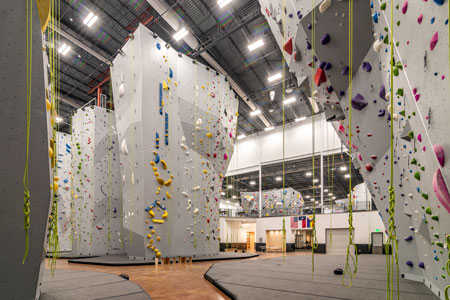
And climbing walls are popping up in other places too, according to Moore, including “park and recreation facilities, fitness gyms, community centers, private homes, apartment buildings, schools and universities. Many of those facilities are members of CWA and use our resources to make operating their walls easier and more successful.”
CWA offers a certification program, including Climbing Wall Instructor, Work at Height, and Professional Route Setting. They also publish engineering and operational standards for the industry, helping gyms to “build and inspect climbing walls, navigate running a gym, manage workplace safety, maintain route setting operations, and teach people how to climb.” Their inspection standard is “often facilitated by climbing wall manufacturers and third-party inspectors.”
Allison Justice is marketing director for an international company offering climbing infrastructures, products and services, including inspections and maintenance. She said their services team has assessed and decommissioned walls where underlying structural issues developed due to inadequate maintenance, “highlighting the importance of regular inspections to maintain long-term safety and performance.”
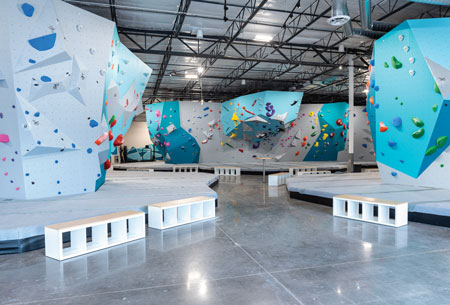
As far as product trends, Justice said macros have been popular, which are designed to add dramatic, complex features to a climbing wall. Larger than standard holds, they’re typically made of lightweight fiberglass or recycled plastic. “Holds are fashion; they’re perpetually evolving, and everyone wants the latest thing. Macros are the latest trend.”
As for climbing walls, many indoor facilities are requesting natural wood grain finishes and dark paint tones to create moody, architectural spaces, according to Justice. “We’ve also seen a lot of interest in outdoor walls, specifically those that utilize the same large, flat panels found in modern indoor gyms.”
Most of the walls they build are custom-designed, said Justice, specific to the building, users and goals, and they like to collaborate with clients early in the design process. “Planning for the required structure, clear areas for fall zones and sufficient wall articulation is often overlooked.”
The company’s pre-designed products are often used outdoors, where spaces are less restrictive. “Our pre-designed walls for indoor use tend to maintain basic modularity and work well for recreation spaces, K-12 environments and other budget-minded customers with large spaces and less specific goals.”
Adding accessible routes with rope assist for adaptive climbers is becoming more common, according to Justice. “The inclusion of climbing in the 2028 Paralympics demonstrates this growth. Including apparatuses for para climbing is straightforward and doesn’t place significant demands on a facility, while making climbing accessible to an entirely new audience.”
Kevin Riley works for a Louisville, Colo.-based company offering climbing walls, products and services to the industry. He also said custom designs are the norm, and they ask clients about potential user-groups, programming, budgets and building limitations. “Then we design a wall that meets the client’s needs.”
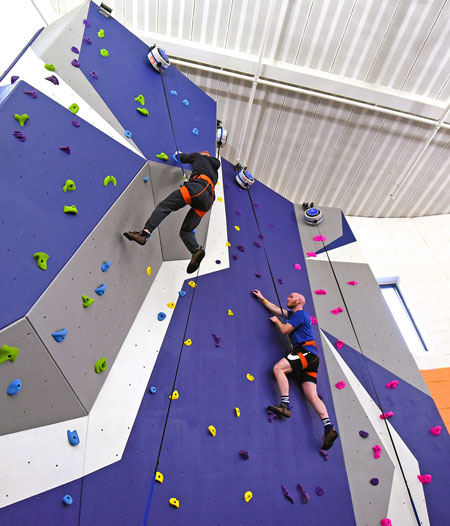
Panel walls have become the standard for commercial climbing walls, according to Riley. “They’re fast to install, incredibly durable, easy to maintain, and they look clean and modern.” The large, flat panels have a dense pattern of T-nuts that let climbers attach various handholds and features anywhere on the wall, giving route setters freedom to easily update climbing routes. And replacing panels if they become damaged is easy.
It’s important to inspect and maintain flooring systems regularly, said Riley, and replace a system once it’s reached its lifespan. “Common issues we see are ripped or torn flooring that can be a tripping hazard or soft spots that may not provide adequate fall protection.”
Riley added that their modular, multi-lane climbing towers are really catching on. “Fun climbing has been popular in Europe for years, and the U.S. is finally jumping in.”
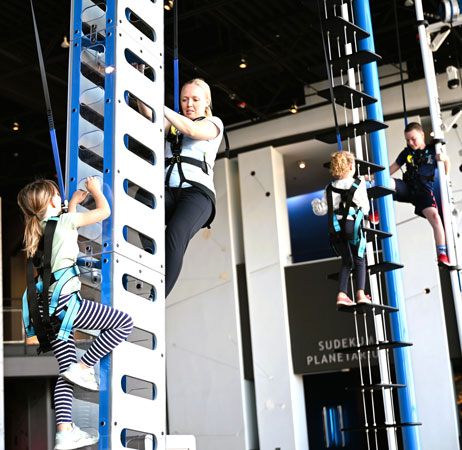
The towers feature myriad challenges and components, which are interactive elements. “Think part climbing wall, part ninja course, part adventure course. The best part is everything can be swapped out; facilities can change the elements to keep things fresh without rebuilding the whole structure. We see these going into family entertainment centers, rec centers, trampoline parks and anywhere that wants to attract kids, teens and adults who just want to move, laugh and try something new.”
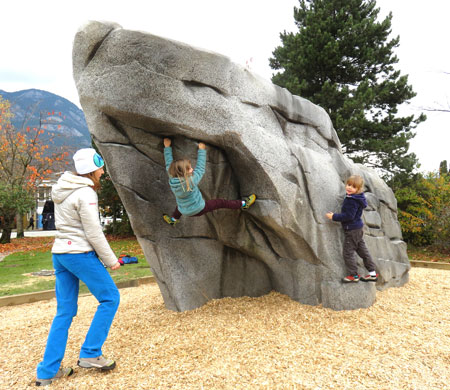
Outdoor boulders are also popular, said Riley, “especially with park departments that want playground experiences that feel natural to the space and are aesthetically pleasing.” He said their boulders are painted and sculpted by artisans to match any rock type—sandstone, granite, limestone, etc. And while many clients choose pre-engineered boulders for cost savings, they’ve also made custom boulders to replicate an area’s natural features. “Parks will typically purchase three to four boulders and place them near each other to make the space feel like a boulder garden.”
For most climbing walls—especially those indoors—proper staffing is crucial, and Justice said their staff training services are popular. “Wall maintenance—including weekly and monthly inspection routines—and route setting are the most common topics we’re asked to cover.”
Ensuring quality routes is essential to a facility’s success, and route setting requires “specific training, knowledge and experience to achieve certification,” Justice said. Professionals consider who they’re setting for, “including age and skill level, as well as more complex factors such as making routes visually appealing, enjoyable to climb, engaging and fair for different strengths and weaknesses.”
Riley agreed that route setting is vital for keeping climbing walls engaging and said commercial climbing gyms usually have their own route setters who will “reset on a weekly to monthly basis. Universities typically lean on their community to set routes. Corporations, multi-family residences and some K-12 will have us route set.”
In addition to new designs, Justice’s company also consults on remodels for climbing facilities. She said a common upgrade is “converting from a rock-realistic wall surface to a modern flat panel wall. Painted plywood walls allow greater versatility for route setters by creating opportunities for large holds and volumes to be screwed onto the walls.” She said the new appearance and diversity “helps tremendously with keeping customers engaged.”
Non-climbing areas are also important considerations, depending on a facility’s goals, according to Justice, with commercial gyms typically devoting only about half their space to climbing. “Climbing facilities require significant storage, hold-washing accommodations, and tend to be most successful when surrounded by other fitness amenities.”
“Most climbing gyms will have excellent general fitness and yoga options,” said Moore. “You can also expect some great climbing instruction, whether you’re in the gym for the first time or looking to get stronger and climb more difficult grades. Most gyms can also facilitate birthday parties, corporate events and larger groups.”
Added Riley, “Birthday parties and team building events generate significant revenue for many commercial climbing gyms and family entertainment centers.”
When Burt’s company started providing operational support to adventure parks in 2019, one motivation was to “create a model that brings more stability to both the owners/investors that we serve and our team members.” She said their multi-state structure helps build repeatable systems and leadership pathways, instead of every location “having to reinvent everything each spring. It also creates clearer career growth for our staff compared to working at a single, standalone, seasonal park.”
She said this brings cost efficiencies and stability to clients, including private owners, municipalities, tribal enterprises and nonprofits.
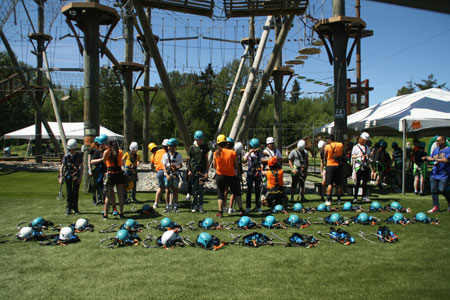
For potential clients, a site visit and feasibility assessment is often a starting point, “because every property has its own opportunities and constraints: access, parking, guest circulation, terrain, tree stock, environmental or cultural sensitivity, neighboring uses, staffing realities, and the community’s goals for the project,” said Burt. They can then advise on what attractions make sense, and complementary activities “that can extend length-of-stay and broaden the audience.”
Staffing and training are overseen, and Burt said since they operate a nationwide network of parks, they have a pipeline of talent—from frontline guides to experienced managers—who can step in quickly. Internal leaders are available to train teams, and training is intentionally repeatable and consistent across locations. “We focus on the practical operational realities that matter most in aerial adventure: risk management, guest flow, harness fitting and checks, course monitoring, rescue readiness, and the kind of customer service that delivers unforgettable experiences.”
Burt said regular daily and weekly maintenance should be handled in-house, as it’s “the only way to stay proactive and catch small issues before they become big ones.” Additionally, most parks also utilize third-party inspections and base procedures and safety systems on recognized standards. Many follow Association for Challenge Course Technology (ACCT) standards, “as a framework for their operating procedures, documentation, training practices and inspection protocols.”
Youth programs and camps can be reliable pieces of an adventure park’s revenue mix when designed intentionally, said Burt—building repeat visitation and community goodwill while improving weekday utilization. And group outings “can be especially valuable because they help fill weekdays and shoulder seasons, and they often lend themselves naturally to packaged experiences.”
Adding extra activities—such as laser tag, bags games, mountain biking, archery, etc.—can extend length of stay and broaden audiences, explained Burt, to include those who, for instance, aren’t interested in “adventuring at height. And they provide more flexibility when weather or capacity constraints affect the primary attraction.”
Burt said they’re seeing more public agencies explore adventure facilities as “both a community amenity and a potential revenue-positive recreation asset. A big part of that shift is that municipalities and parks departments are increasingly focused on experience-based recreation—things that are active, social and memorable.” And she said there’s been more appetite for management agreements allowing public land to host attractions with “professional operational oversight running the day-to-day.”
An example is the popular Quarry Park Adventures, owned by the city of Rocklin, Calif., and built around a former working granite quarry. It features a three-level aerial adventure, free fall and rappelling attractions, rock climbing, zip lines and paddle boats. The location hosts special events, camps, parties and group offerings.
Burt’s company took over operations of the park in 2019. “The park’s early years came with a learning curve under a prior operator, and public perception can form quickly when a new, high-profile facility opens on public land. It’s a helpful reminder that the concept and capital investment are only part of the equation; the day-to-day operations, consistency and community communication are what ultimately determine whether a park earns trust and builds long-term momentum.”
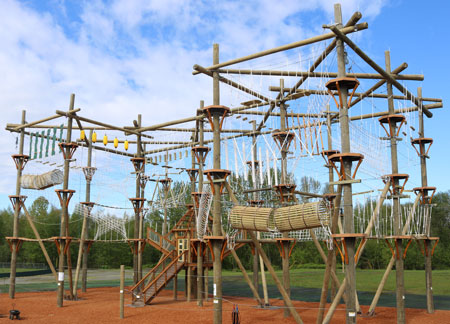
In Everett, Wash., High Trek Adventures features a three-level aerial ropes course with 60 elements and six zip lines, and a 24-foot fun tower/climbing wall. The course has a dedicated level for ages 4 to 8, and ages 9 and up can “go through all the courses and zip lines, which are the most popular,” said General Manager Shannon Olson. “The top level is the most difficult and very challenging. The course was well-designed to… put smiles on all skill levels’ faces.”
Each participant entering the course to climb and zipline needs to watch a safety video and go through “ground school,” which takes about 30 minutes. “For customers who may need or want assistance to go through our course, we have staff available to climb with them,” said Olson. This is popular for caregivers who don’t wish to climb, and adults who may be apprehensive.
“We operate by ACCT standards as Washington state has adopted these,” said Olson. They perform daily and monthly in-house inspections and have a third-party inspection annually. She and an assistant manager have level two industry certifications and train all staff. “All ropes course rescue-trained staff go through a five-day training at the season’s start, then an in-house refresher every month.” She feels this helps staff identify potential issues before they become serious. “We communicate with several ACCT members annually and find it beneficial in operating our course successfully.”
Olson said they offer a summer camp, company picnics and various youth group outings—important as they’re “big ticket items and help round off the month. We’ve fine-tuned our ropes course to host groups of 250 or more in a four-hour period.”
Extra activities—which she said help attract larger groups—include mini golf, laser tag and axe throwing. Their popular Adventure Pass includes all activities, and individual attraction tickets are also available. There are also food and beverage offerings and a gift shop. “The goal was to create a place that customers could spend four to five hours at and feel they had fun, were challenged, and got a good price.”
Burt believes that adventure offerings help people disconnect from screens and reconnect with each other because they’re “inherently present-moment and shared: you’re challenged, you’re laughing, you’re doing something you’ll talk about later. Parks that lean into that idea—connection, confidence, shared achievement and real memories—tend to stand out in a crowded leisure market because they’re not just selling an activity, they’re selling a meaningful experience.” RM