

Over the next six pages, we’ll take the pulse of the health club side of the market, considering responses from health clubs, sports clubs, fitness clubs, and medical fitness facilities. These respondents made up 4.3% of the survey population in 2025.
Health club respondents were most likely to be from the Midwest, with 46.2% of these respondents indicating they called the Midwestern states home. The next largest group of health club respondents was from the Western region of the U.S., with 20.5%. Smaller numbers of health club respondents were located in the Northeast (12.8%), South Atlantic (10.3%), or South Central (10.3%) regions of the U.S.
 Nearly half (46.2%) of health club respondents said they were located in suburban communities. Another third (33.3%) were from rural areas, and just over a fifth (20.5%) were located in urban communities.
The average population size reached by health club respondents in 2025 was 60,280 people, with a median of 12,500. Nearly half (47.9%), reach a population of less than 10,000 people.
Health club respondents were most likely to work for private, for-profit organizations. Some 57.4% of health club respondents said they were with for-profit facilities, compared with 10.3% of non-health-club respondents. Conversely, just 11.5% of health club respondents said they worked for public or governmental organizations, compared with 60.6% of non-health-club respondents. The remaining health-club respondents worked with nonprofit or “other” types of organizations.
On average, health club respondents in 2025 said they manage 3.8 individual facilities, up just slightly from 3.1 in 2024. Nearly two-thirds (66.1%) of health club respondents said they manage just a single facility, compared with 36% of non-health-club respondents. Just 5.1% of health club respondents manage 10 or more facilities, versus 19.1% of non-health-club respondents.
 Health club respondents in 2025 were among the least likely to report that they had formed partnerships with other organizations. Some 64.4% of health club respondents said they had done so, compared with 88.2% of non-health-club respondents.
The most common partners for health club respondents in 2025 were: corporations and local businesses (31.1% of health club respondents had partnered with businesses), local schools (26.7%), healthcare or medical facilities (26.7%), nonprofit organizations (22.2%), and colleges and universities (20%).
Health club respondents were much more likely to report that their facilities’ primary audience was made up of adults. Half (50%) of health club respondents primarily reach adults, compared with 13.5% of non-health-club respondents. Another third (33.3%) said they primarily reach all ages. Much smaller numbers of health club respondents primarily work with seniors (8.3%), college students (4.2%), teens (2.1%), or children (2.1%).
Health Club Budgets & Costs
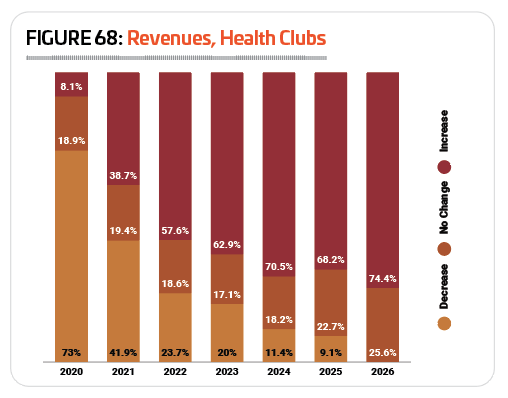
Respondents from health clubs in 2024 were more likely than in any year since the COVID pandemic to see higher year-over-year revenues. More than seven in 10 (70.5%) health club respondents said their revenues were higher in 2024 than in 2023. Another 18.2% reported no change, while 11.4% reported a decrease in revenues. (See Figure 68.)
Health club respondents painted a similar picture for 2025, with 68.2% expecting revenues to increase, 22.7% expecting no change, and 9.1% expecting a decrease. And in 2026, no health club respondents are expecting to see their revenues decline. Nearly three-quarters (74.4%) expect to see higher revenues in 2026, with 25.6% anticipating no change.
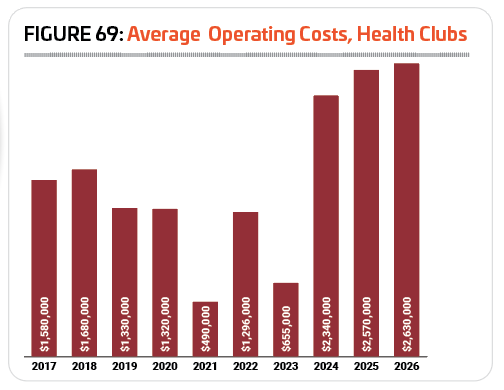
Health club respondents’ average operating budget for 2024 was more than 250% higher than the average reported in 2023. Health club respondents spent an average of $2,340,000 on their operating budgets in 2024, up from $655,000 in 2023. The median expenditure for health club respondents in 2024 was $530,000.
Looking forward, health club respondents are expecting their average operating cost to increase a further 9.8%, to an average of $2,570,000. They projected a further increase of 2.3% in 2026, to an average operating cost of $2,630,000. (See Figure 69.)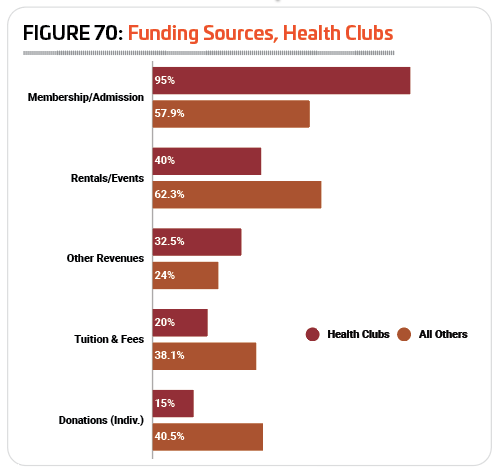
On average, health club respondents earn back 71.5% of their costs via revenues. Just 9.8% of health club respondents said they earn back 30% or less of their costs via revenues, compared with 28.7% of non-health-club respondents. On the other end of the spectrum, 41.5% of health club respondents said they earn back more than 80% of their costs via revenues, compared with 25.4% of non-health club respondents. More than one-third (34.1%) of health club respondents earn back more than 90% of their costs.
Health club respondents are by far the most likely to support their operations with dollars earned via membership and admission fees. In fact, 95% of health club respondents said their facilities were at least partly funded through membership and admission, compared with 57.9% of non-health-club respondents. The next most common sources of funding for health club facilities were: rentals and private events (40% of health club respondents funded their facilities via rentals and events), other revenues (32.5%), tuition and fees (20%), and donations from private individuals (15%). (See Figure 70.)
Respondents from health clubs were slightly more likely than others in 2025 to report that they had taken action over the past few years to reduce their facilities’ operating costs. Some 82.9% of health club respondents said they had taken such action, compared with 78.9% of non-health-club respondents. This is up significantly from 2024, when 69.7% of health club respondents had acted to reduce their costs.
The most common measure health club respondents relied on to improve their bottom line was increasing fees. Some 61% of health club respondents said they had increased fees, compared with 51.2% of non-health-club respondents. The next most common methods health club respondents used to reduce their costs were: improving energy efficiency (39% of health clubs had improved energy efficiency at their facilities), reducing staff (36.6%), putting construction or renovation plans on hold (19.5%), or cutting programs and services (12.2%).
Health Club Facility Use & Construction Plans
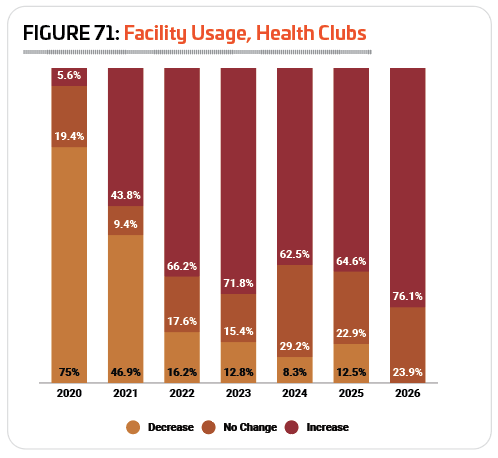
Health club respondents were more likely to report that the number of people using their facilities either increased or remained the same in 2024 than in 2023. While fewer saw an increase in that number in 2024 than in 2023 (62.5% vs. 71.8%), more reported no change at all (29.2% vs. 15.4%). The remainder, who reported a decrease in the number of people using their facilities, fell from 12.8% in 2023 to 8.3% in 2024. (See Figure 71.)
In 2025, slightly more health club respondents (64.6%) said they expect the number of people using their facilities to increase, while 22.9% expect no change, and 12.5% are anticipating a decrease. And looking forward to 2026, more than three-quarters (76.1%) of health club respondents expect the number of people using their facilities to increase, with 23.9% anticipating no change, and none at all expecting a decrease.
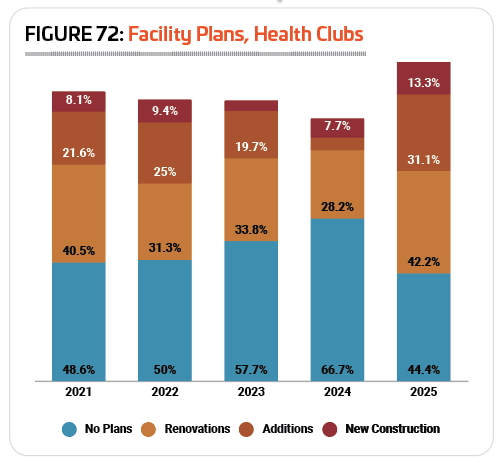
Health club respondents were again the least likely to be planning construction of any kind over the next few years, though significant more had such plans in 2025 than in 2024. In 2025, 55.6% of health club respondents said they were planning construction of some kind, up from 33.3% in 2024. This compares with 72.3% of non-health-club respondents in 2025 with plans for construction.
Health club respondents were more likely in 2025 to be planning every kind of construction than in any year since 2020. They were most likely to be planning renovations to their existing facilities, with 42.2% indicating they had renovation plans, up from 28.2% in 2024 and 33.8% in 2023. Another 31.1% of health club respondents were planning additions to their facilities, up from 5.1% in 2024 and 19.7% in 2023. And 13.3% of health club respondents were planning new construction, up from 7.7% in 2024 and 4.2% in 2023. (See Figure 72.)
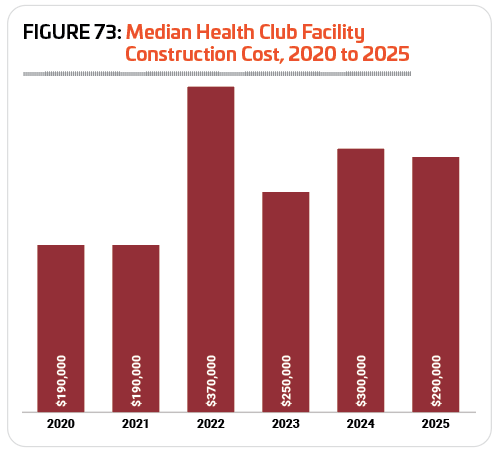 The average budget for health club construction in 2025 was $960,000. The median construction cost for health club respondents was $290,000, 3.3% less than in 2024, when the median cost was $300,000. This represents a 52.6% increase over the past five years, from a median cost of $190,000 in 2020. (See Figure 73.)
The amenities and features most commonly included in health club respondents’ facilities in 2025 include: fitness centers, exercise studio rooms, locker rooms, Wi-Fi services, concession areas, indoor aquatic facilities, indoor courts for sports like basketball and volleyball, classrooms and meeting rooms, childcare centers, and bleachers and seating.
As usual, health club respondents were less likely than those from other types of facilities to report that they had plans to add features or amenities to their facilities over the next few years. In fact, non-health-club respondents were more than twice as likely to have such plans, with 33.4% indicating they would add features, compared with just 14.8% of health club respondents. This is virtually unchanged from 2024, when 14.9% of health club respondents had plans to add features at their facilities.
The most commonly planned features for health club respondents in 2025 include:
1. Playgrounds (33.3% of health club respondents with plans to add features said they would add playgrounds)
2. Splash play areas (22.2%)
3. Synthetic turf sports fields (22.2%)
4. Classrooms and meeting rooms (22.2%)
5. Exercise studio rooms (22.2%)
6. Open spaces such as gardens or natural areas (22.2%)
7. Climbing walls (22.2%)
Health Club Programming
The programming provided at health clubs helps attract more members to get fit and socialize, and creative program ideas are continually being introduced to entice folks to sign up and show up, and keep coming back for more. In 2025, 100% of health club respondents said they provide programming at their facilities, up from 92.5%
The 10 types of programs most commonly offered in health club respondents’ facilities in 2025 include: fitness programs (provided by 91.1% of health club respondents), functional fitness programs (82.2%), group exercise programs (80%), mind-body balance programs such as yoga or tai chi (75.6%), personal training (75.6%), nutrition and diet counseling (55.6%), programs for active older adults (53.3%), holiday events and other special events (44.4%), swimming programs (35.6%), and day camps and summer camps (35.6%).
Some 27.9% of health club respondents said they were planning to add programming to their facilities’ lineup over the next few years. This is up from 25% in 2024, but still below the 31.3% who had plans to add programming in 2023.
The most commonly planned program additions for health clubs in 2025 include:
1. Nutrition and diet counseling (up from No. 3)
2. Adult sports teams (up from No. 8)
3. Teen programming (up from No. 6)
4. Therapeutic programs (did not appear among the top planned programs for health clubs in 2024)
5. Youth sports teams (did not appear in 2024)
6. Special needs programs (did not appear in 2024)
7. Adaptive sports programs (did not appear in 2024)
8. Daycare or preschool programs (did not appear in 2024)
9. Sport training such as tennis lessons or golf instruction (down from No. 2)
10. Aquatic exercise programs (did not appear in 2024)
As usual, there was a lot of change in the top programs planned by health care respondents compared with last year, with more than half of the programs on the list not included in last year’s top planned programs. They replace: mind-body balance programs, sports tournaments and races, environmental education programs, holiday events and other special events, programs for active older adults, and group exercise programs.
Industry Challenges
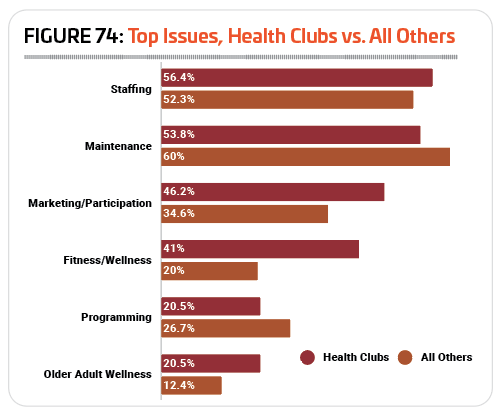
Asked about what they consider to be the top challenges and issues for their facilities, health club respondents were most likely to cite staffing problems. Some 56.4% of health club respondents said staffing was the top challenge their facilities were facing, compared with 52.3% of non-health-club respondents. (See Figure 74.)
On the other hand, health club respondents were less likely to name equipment and facility maintenance as their top challenge. While it was the second most common challenge for these respondents, with 53.8% of those from health clubs naming it a problem for their facilities, more non-health-club respondents—60%—named it their top challenge.
Health club respondents were also more likely than non-health-club respondents to call out marketing and participation issues as a top challenge (46.2% vs. 34.6%), as well as fitness and wellness challenges (41% vs. 20%), and older adult fitness and wellness (20.5% vs. 12.4%). RM