

This month, we talk with Ariel Mansholt, OTD, OTR/L, CPISI, and inclusive play specialist with Landscape Structures, about embracing inclusion in water/splash play. Mansholt is a pediatric and adolescent occupational therapist with experience in outpatient and school settings, who was inspired to pursue her career after participating in her autistic brother’s therapy as a child. As an inclusive play specialist, she leverages her expertise to help inform inclusive design and educate and advocate for inclusivity in play spaces.
RM: What are some of the ways to make splash play more inclusive?
Mansholt: Thinking about access starts from getting to the splash pad. That means having public transportation accessible nearby, accessible parking with ADA parking spots, accessible trails, clearly defined signage, and crosswalks.
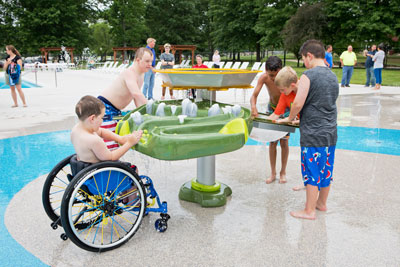
From there, you need to think about physical access when you get to the splash pad. Seamless transitions make it easy for those with mobility devices to get on the splash pad and engage.
But it’s also about facilitating a sensory experience by having elements that promote self-regulation, or control of our emotions, pretend play opportunities, and all those developmentally appropriate modes of play on the splash pad.
We need to make sure we have accessible restrooms nearby. We want to make sure we have drinking water nearby. And we want to have areas of shade and sitting areas. A lot of kids with autism or ADHD are on medication that makes it hard to regulate body temperature, so those places for cooling off are important. That’s great for multigenerational use as well, because elderly and younger visitors are likewise less able to regulate temperature.
RM: What are some of the ways children of varying abilities can engage with splash play areas?
Mansholt: Going back again to physical access, children with mobility devices can wheel up and engage with water tables and the dumping bucket elements. They can engage with the animal elements that are popular, and the different pressures and temperatures of water can be engaging.
Moving into that multisensory experience, different types of sprays and water events feel different, so we want to think about the pressure of sheets versus mists versus sprays versus dumping buckets. All provide a different proprioceptive input that’s super-regulating for kids needing that pressure.
From the different water elements there’s a lot of auditory input and visual input as well. And sometimes kids need a place to get away from so much input. When we get kids under a water shroud, they can take a break and regulate, and get less input visually. They can sit and engage with the water there before they go back and get into more interactive elements.
Interactive elements are also engaging for kids of varying abilities. Water tables and interactive elements that can be manipulated, for example, to see who can launch the water the farthest.
Our designers are already great at designing zone-specific events for different age groups—gentle water for those just entering the splash play experience, and mixed and more dynamic water zones. These kinds of zones are also inviting for kids with disabilities, so they don’t just find themselves in the most dynamic part of the splash pad immediately, but can get there gradually.
RM: What are some ways of building support in the community for an inclusive aquatic space?

Mansholt: First off, it’s important to find out who’s coming to that space—who you’re going to have locally and regionally. Parents are going to be your biggest advocates and champions. From there, it’s about reaching out to local schools, specialty clinics, ADA clinics, or occupational therapists, and seeing what those providers say about the kids they’re seeing. As an occupational therapist myself, I love to be invited into this kind of thing.
From there, you need to ensure that you have the proper maintenance and upkeep plan. Knowing that the plan is in place running forward helps ease everybody’s minds regarding that upkeep and maintenance. And then also, make sure to provide the training for those who will be managing it.
RM: What are some examples of inclusive aquatic spaces, and what makes them innovative or unique?
Mansholt: Here are three examples:
- Aces for Autism Facility in Winterville, N.C: Founded by a couple with a son with autism, this facility provides services for kids with autism up to 18 years old. It features a 1,200-square-foot splash pad. There’s animal features, a dumper element, an interactive tactile water-play station, and tactile play through the ground elements. It’s such a great facility, and has a great mission at its core and heart.
- Parkersburg City Park in Parkersburg, W.Va.: The community wanted to revamp its pool back to its glory days. This splash pad is a little under 8,000 square feet, which is pretty big. It has a main structure that includes slides, water manipulation activities, and water dumpers. It has a lot of mists, sheets, and drops that provide a lot of different tactile sensory experiences, and the main structure lends to kids having that social connection and social play.
- Burrus Old Mill Park in Blue Springs, Mo.: This combination playground and splash pad is super innovative. It has jungle safari themes with water animals and jungle animals. It tells a story, and is super cohesive throughout. RM